
I was really amazed at home many expats popped up last week to comment on their fears and facts about trips to the Metzger here in Germany. It seems like every time I turn around, there are more and more American expats here in Germany. 😉
Now for those of you that don’t live over here, and don’t ever plan to, you might want to just snooze through this post. But for those of us living over here who want a good steak or a nice roast, this next post is crucial. I will preface this by reminding you that I am from Texas and we take our beef VERY seriously. I cringe at thought of people out during the summer with their disposable chemical grills who are cooking pork steaks on them. “Pork” and “steak” do not belong in the same sentence. I know it’s cheaper but I have never had a pork steak that came anywhere close to a beef steak in flavor. And I just can’t handle the fattiness of it.
So, let’s take a little lesson in American beef cuts first…these are the basic cuts, basically dividing the cow in half down the spine and then into a fore-quarter and hind-quarter:
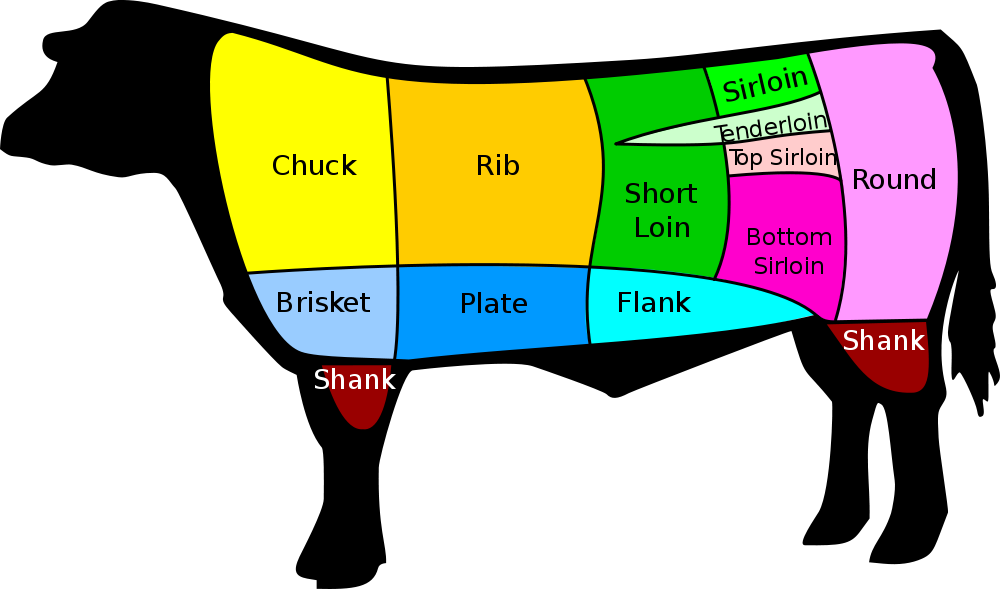
And here are the German cuts, which may follow the anatomy of the cow more and make more sense in that respect, but are seriously confusing for the non-natives:
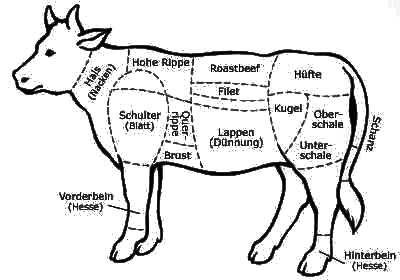
Now you’ve probably noticed some immediate differences…mainly that everything is just jumbled around and things like the tail and legs are on the menu. What they don’t mention in the diagram is that really all the innards are served here so if you’re a fan of anything from tongue to heart to lungs, you won’t have to search too hard to find it on the menu. I will say that although legs are supposed to be a Hessen specialty (which is where we live) I wouldn’t be able to recommend a place for you to get a good plate of leg. Sorry.
Now unfortunately, there are a few key cuts missing in my mind:
- Brisket is a big miss since we have a smoker and we will throw just about anything on there in the summer. But I will definitely be talking to our butcher across the street about getting some lower shoulder cuts in the future. Talking them into making pastrami (which also comes from brisket) will be a whole other story.
- T-bones and Porterhouse steaks used to be really hard to get here in Germany. They’re somewhat difficult to cut (coming from the short loin and tenderloin) and from what we were told, there was a great risk of mad cow and things like that due to the bone in the steaks (please don’t quote me on that). But a few years ago, the risk level dropped and now you can usually get T-bones at just about any butcher if you ask. They are not cheap, usually weigh about 700 grams or more EACH and they take a while to get because of the aging…but they are great. Our butcher used to have American neighbors who taught him the wonders of American beef cuts, so he was actually making his own stash when we rolled into town. He is extremely protective of his T-Bones and looks at us like we’re taking away his children. I’m pretty sure that if I wasn’t American, he would jack up the price even higher or just refuse to sell them to us…he loves his steaks that much.
- Flank steak is where you traditionally get London broils and skirt steak for fajitas. Again, they’ve got nothing but the huge Lappen over here but in general that just means you’ll end up with a softer, less chewy meat part of the time. Darn. But it also means it’s likely more expensive than the flanks which are known to be pretty tough in general, making them great for fajitas.
If you know what cut of meat you are looking for and can take the butcher a diagram of the exact cut, he is probably going to be willing to cut it for you. You’ll probably have to wait for it because he’ll need to slaughter a new cow and unless you’re planning to buy the whole thing (which would require multiple trunk freezers and a few thousand Euros), it’s just going to be a few months.
What’s the cut of beef you’re missing the most? What’s the German cut you just can’t figure out?
If you’re looking to learn more about American cuts of beef, try wikipedia…they’ve got articles on nearly ever cut of beef and I wouldn’t want to bore you.
And if you’d like to know what the German cuts are for pork, hop over here!


Oh, thanks so much for this! Any suggestions for what German cut to buy for pot roast?
I usually just ask for a Schweinebraten to make pot roast, and depending on what they have available and they point to, I take.
It is often Schweineschulter or from the Oberschale. Most Germans, I’d assume, just ask for Schweinebraten when ordering.
It is more important what we do with it at home, such as preparing, simmering, etc. With the right seasoning, almost any cut will come out smelling and tasting delicious.
Forget what I said.
This post is about beef, and my mind was on pork:-)
Maria is right as far as the location, but I’m guessing you’d want beef instead of pork. Pot roast is usually made with meat form the chuck cut so shoulder or neck should work…Rinderschulter or Rindernacken. DO NOT use “Suppenfleisch” — tried it before and it was completely tough even after hours of cooking. I don’t really care to cook my pot roast for a day or more to get it tender…but “Suppenfleisch” in the right dish is of course fabulous.
What is the right dish? What about in beef and broccoli? Or in soups?
Thanks for this! I’m from Missouri, so I feel you on the beef-missing. I’ve more or less given up on it in Germany. I never put in the time to compare the U.S. & German cut charts, but I had a feeling it was just a totally different way of butchering the animal. No wonder that “brisket” I attempted was such a disappointment. Couldn’t possibly have been operator error 😉
I’ve read some of your recipes so I’m sure it was the meat’s fault. I actually learned a lot here since I really didn’t know much of anything about the various cuts besides steak…it was always just sort of hit or miss. But I am dreaming of a mighty fine brisket for the summer in the smoker! Mmmmh…
You asked about German cuts that we can’t figure out? How about the pork cut that Schwenkbraten is made from? I believe it is from the neck area, but can’t figure it out. We do our own pork and tried, but it isn’t right. Any ideas, charts, or knowledge? Thanks!
Sandy
Hi Sandy,
The Schwenkbraten is steak from the neck area, above the shoulder. This image shows you where in general that cut comes from:
http://upload.wikimedia.org/wikipedia/de/1/1d/Schwein-Nacken.png
Leaving some of the Fetter Speck (fatty tissue and skin) on the neck is where you get the Schweinebraten cut from 🙂
Does that help? I can do a bit more digging if you need!
This is great!! I am building a part of my site about things that are good to know in Germany. Would you mind if I linked your post up on my blog?? I think it would be really helpful to those curious about the Metzger!
Link away! Of course I’m happy for you to share my post 🙂 Hope others find it useful as well!!
Hi there,
A super silly question. I’ve been missing chuck steak and can’t seem to find it in Germany. Would you know what it’s called? I’ve tried every sort of google translate and the staff at the supermarkets have no idea what I’m taking about 🙈.
Same question here, any suggestions how to find chuck steak in Germany / what cut to ask the butcher for to get something similar?
BRILLIANT! I miss T-bones and Porterhouse steaks like you can’t believe. But I have learned to love pork in a way I never thought I would. Great post!
Aw shucks! Make me blush why don’t you. 😉 T-bones are a monthly thing in our house…well we try anyway!
That is great information! Now if I can just figure out how to cook the different types of wurst (and what they are)!
*Gasp*
This is just BRILLIANT, thank you! I am going to ask my husband to print it out so I can keep it in my purse. Fab 🙂
The one that always makes me laugh is the cut they call “roast beef”, which, in summer when I asked for something like a steak to bring to a barbequeue (all the sirloin was gone), is what I was offered. It looks nothing like the roast beef we used to be served up for a Sunday roast!
And the fact that to buy just chopped up bits of beef (the cheap stuff, for putting in a stew or similar for a long, slow cooking), you ask for gulasch (which to me is a kind of spicy stew).
Not sure how it works for a traditional brisket, but we recently made brisket tacos using Tafelspitz.
It was perfect (and had the top layer of fat as American brisket does). After slow cooking (in the oven) it yielded perfect, falling apart beef!
We also tried them with Rinderbrust – it will also work, but had a bit too much fat scattered throughout.
For roast beef we usually use Rinderbraten.
what is tafelspitz ?
Tafelspitz is Tri-Tip.
Is there a non-German-carnivore’s guide to pork cuts in the works as well?
I’d like to replicate some country-style ribs inspired by my MIL but am not sure where to start.
I’m wondering what’s the best cut to make Goulash? I’ve tried the cut up Goulash bits that they sell, and I cooked it for a while and it still was tough. I then tried the shank and cut it myself. That shredded nicely, but still wasn’t the result I’d hoped for. I just bought a crock pot, so I’m going to try yet again, but something tells me it is just the way they use older animals for meat here.
I have a few more questions as well. I’ve seen at the counter US roast beef sold here. What cut is that?
Is there anyway to get short ribs here?
Thanks!
Shoulder is usually the desired cut, or the thick Bugstück (part of the shoulder). I have never had very good luck getting nice gulasch meat from a grocery store, but my local butcher cuts it fresh right when I order it which I think makes a bit of a difference. It shouldn’t be too fatty either.
Roastbeef here is usually cut from the roastbeef area on the German cow — and would generally be from the rib area. It’s sometimes also referred to as prime rib. In the US, you might also get roast beef which is the round roast, from the rump. Usually when a butcher shop is referring to something as US, it’s generally because the meat has come over from the US but could also be that they have aged it (generally at least 6 weeks) which is not something they do quite so long here in Germany (which also makes a difference in the quality of the meat when you cook it).
I’m assuming you mean beef short ribs (since that’s what we’ve been talking about so far) and you may be able to get them by asking for Rinderrippenstück –although that can also be the prime rib cut. Or they could be called Rinderrippen, Bauchrippen, Spareribs (but make sure you clarify von Rind since that’s the same term for pork), Leiterstück, Querrippe or Spannrippe — it’s really a matter of the location and the butcher. They should definitely be able to cut them for you though. They are not the back ribs, but the ribs underneath near the belly, on the Plate section of the US cow .. or around the Querrippen area. If the butcher looks at you dumb — take in this diagram and point him to G1 on the diagram in the upper right corner: http://www.amazingribs.com/images/beef/angus_beef_chart.pdf
what is the best piece for gulash depends on two things: (a) how relevant is teh price and (b) do you like the meat almost fall apart or do you prefer the chunks. YOU need something that is willing to cook forever (since I have moved to the USA I had a need to render my own schmalz so I bought lots of tummy meat as I still have no source for ACTUAL fat (the next butcher doing more than lamb and chicken is more than 30 minutes away by car when you manage to get a time without traffic) SO I found myself cutting the fat of pork tummies and froze the piece which are superb *cooking* meat (as opposed to roasting) ( I am putting them in my Kale (tiffany have you ever tried to make Braunkohl in winter? I highly recommend trying it is the norther german way of referring to a Kale dish which is haveing such a different flavor compared to other leavy greens (I might be able to can some, because it tastes best if cooked in big batches, and looks just as ugly as Erbsensuppe ;)) So I know that is a great cut from pork for cooking. Based on that I have tried to use brisket here with varying sucess (and I find it quite a waste of the meat) So what would you use in teh USA? mostly I get teh sense (as I cannot buy at a butcher regularly) most stores simply take all smallish pieces of meat and call it ‘stew meat’ A polish expat might be the person to ask, actually.
I have made delicious gulash from ‘falsches Filet’ it has a tendency to fall apart but who cares if it tastest as good as it does.
For goulash, the best part is the “Hesse” or “Vorderbein,” which you need to separate from the bone and dice yourself. Ox cheeks work really well too. Naturally, you need to buy an appropriate quantity, and again dice it yourself. Shoulder (Schulter) ought to work too.
This is such a great post – thank you for lining up both diagrams!! I’ve had a craving for pot roast for an embarrassingly long time and was always too…timid or something to go to the butcher and try to hash out which piece of meat I should buy. No longer! 🙂
Wow thank you so much!
I emailed a butcher that I found on the Internet, and he mentioned the Dicken Bug. I’m going to go down there this week and pick it up.
That diagram is so helpful! My US cut knowledge is not so good either. I rarely used to eat beef when I was growing up in the US, then I moved to Australia, and I started eating beef. So I learned all about the cuts there, but here it’s completely different.
Just a quick question on short ribs. I do mean beef. You said to point out G1 on the diagram to the right, but what about A3 or A4? I think it is A3 or A4 from what I see in the bigger picture to the left. I saw a recipe for braised short ribs, and it looks like that. I’ve never cooked short ribs before in my life- sorry!
Thanks so much for your post. I finally have enough courage to go to a butcher instead of supermarkets or Galleria.
Oh I forgot to add- if you know any good butchers in the Frankfurt area, send suggestions please.
Sorry, didn’t see your message while I was writing mine…
Here’s the address:
Metzgerei Zeiss – Leipziger Strasse 73 -60487 Frankfurt am Main
The name of the owner is Raimondo Gallo, if you go there, ask of him directly and tell him I sent you -if you say “Giuliana from Rome” he will know who I am 🙂
He’s a nice guy and I must say I always got great meat from him.Even my German boyfriend had to admit it was better than the average REWE stuff 😉
We are definitely going to keep this in mind, even though our butcher is pretty great locally. But as it turns out, my husband used to go to that Metzgerei all the time because he worked right around the corner. 😉
Hi everybody, I came across this page by chance, I was trying to find a chart with the German names of beef cuts and I landed here.Now,I am Italian and fortunately only jump between Rome and Frankfurt (I do not live there, my boyfriend does)but when I read your comments I was like “I am not the only one who had problems with meat shopping in Germany!!!!” I struggled for almost one year wandering through the butcher’s corner at REWE and getting depressed at the limited choices of cuts they had ( in Italy the cuts available are nearly double compared to the ones this chart,not to mention that at Supermarkets you mostly find pork meat,which I don’t like at all…).Also, the people working there are not even able to let you choose your cut and get some ground meat from it, as they are not “certified butchers” or whatever it takes in Germany to be allowed to do something sooo special as to use a met grinder,so you gotta take what is been prepared before (when the “real butcher” was there)!!!! Anyway, by chance I got to know that a friend from Rome has her uncle who lives in Frankfurt and who has a butcher shop!!! You can’t imagine how happy I was…finally I would have MY butcher in FRA and he would also understand my requests (both for language and for type of meat)!!!!So, I am now much happier when I go to Fra, but I have also come to realize that some differences cannot be erased..they don’t have all the cuts we have here (they simply do no exist..)and talking about T bone steaks, last time I visited this place 2 weeks ago he said “We usually don’t take them in this season because barbeque season is over and Germans will not buy them now”..Since this butcher is Italian, he would call the T bone steaks as “Fiorentina”, which is the Italian name for it 🙂 Aside from this, I must admit the veal meat they have is generally more tender than the one we eat in Italy (really VERY tender),their fillet is generally sold totally fat free and cuts that I would NEVER imagine as suitable for roast beefs (as they look nothing like it) are indeed very good (even though it looks weird with that almost squared shape and I always wonder which side it should be sliced from, LOL)
But yes, having a butcher you can trust and who can UNDERSTAND what you want is totally a must!!!!! 90% of my meat shopping frustration has disappeared now that I have found this place 🙂
If any of you is interested, I can let you have the address of this Metzgerei in Frankfurt.It’s in the area of Bockenheim, so pretty central.
PLease: If you EVER find out which american cut corresponds with Falsches Filet, DO post it!! I am all compassionate about teh comapartively poor beef in Germany (though the pork is cosrespondingly better, methinx) BUt I would LOVE to find out what to buy to have that part of the animal for pot roast and stews again
Does anyone know the German name for hanger steak (onglet in french)? My favorite inexpensive cut, but I don’t know how to ask for it…
According to leo.org, the translation in the French/German dictionary calls the “onglet” cut either Nierenzapfen (with a side note that it’s Steak from the Zwerchfellpfeiler), also sometimes called Herzzapfen in Sudtirol & Austria.
Hopefully that helps! 🙂
During the five years that I lived in Germany I never really tried getting American style cuts of either beef or pork, I always went with the German cuts, but then I was using a typical German stove/oven which was much smaller than its American counterpart. The small size is one of the reasons that most German cuts are boneless cuts.
Also I worked out a deal with the local butcher in the village where I lived and about once a month I would order a Front Quarter of Beef, a full side of pork (included head and tail), or a whole lamb. I’d place the order on Tue or Thurs when he would be in the shop and then meet him back at the shop around Noon the following Saturday and we would drive the village about 3 kilometers up the road where he had his main shop and cold storage facilities and I’d pick out my meat and we take it in the cutting area and we would butcher it together. Mostly he did the work and I acted as his assistant while he taught me hand butchering along with the various cuts of meats.
This was a totally different experience from watching the customer side of counter as an American butcher ripped through a front quarter of beef with a bandsaw or other mechanical equipment.
Hey Kenneth
Im very interested in your Story. I am here in Germany doing bbq. I’ve been trying to find a way to work with butchers here to get American cuts as well as learn the German cuts. Could you put me in contact with this German butcher? I would like to work with him or at least have a chat. Thanks!
Which part would Suppenfleisch be from? I’m trying to make shabu type sliced meat by buying a block of beef and slicing it half frozen on my own. I wonder if Suppenfleisch would be suitable?
Hi Daphne,
Suppenfleisch is generally a few different cuts but I think one you’re talking about is probably from the Querrippe or Breast region. It’s generally fairly fatty and I would think a nicely marbleized or tenderized piece might be pretty good. Most recipes I looked at for Shabu Shabu called for rib eye, which would generally be more in the Hohe Rippe section.
Hope this helps and I bet it’ll be delicious with either! 🙂
Tiffany,
there is still one unanswered question:
The US equivalent to falsches Filet; it is cut from the Round section.
aef91 used Tafelspitz to prepare brisket. Wrong end of the cow, your diagram does not show the Tafelspitz Section; that would be Kugel/Oberschale.
Excellent meat to boil, but not for Brisket.
Brisket is made of Brust (your diagram does not show the proper location: it should be more extended to the front). In Germany it is difficult to buy a complete Brisket, most of the time you get a flat, a point is hard to find and a complete brisket, well, make it a custom order.
Tafelspitz is used in Argentina for Picanha and that works very well with German Tafelspitz.
Just for completion, while I am at it:
Short beef ribs: Querrippe, but you need to ask for a big piece, usually the butcher has small chunks which are used as Suppenfleisch
Rumpsteak is cut from Roastbeef (one word, and it is called the same in German, mostly pronounced as Rostbeff)
Rib Eye Steak is cut from Entrecôte (yes, the French word)
Onglet, you already revealed as Nierenzapfen, but hard to come by.
My favourite meat from the smoker: short beef ribs and Hochrippe (in the diagram named Hohe Rippe).
Cheers from Wuppertal,
Michael
Fyi picanha is Brazilian cut n not Argentinian! 😃
“Brisket is a big miss since we have a smoker and we will throw just about anything on there in the summer. But I will definitely be talking to our butcher across the street about getting some lower shoulder cuts in the future.” For a brisket,ask for brust/breast part, not from shoulder ☺
Hi, great post – thanks so much! I wonder if you know if there is an equivalent in Germany to cubed steak in the US. If so, what is it called? I’m guessing that I will probably need to buy the right cut & then tenderize it myself.
What cut is “Falsches Fillet”?
Hi Natalia,
Falshces Filet is a shoulder cut, sometimes also called Schulterfilet or Buglende
Any tips on how to order rib eye roasts (not steak, I want it with the bone) from the butcher? Thanks for the guidance!
Hi Debbie,
Something like a Hochrippe mit Knochen vom Rind? Or a Tomahawk steak?
Hi, I’ve just bought ‘Rinderbraten aus der keule’ and came across this thread while researching what cut it is! any ideas? Translated as beef from the club… confused!
This is so helpful — thank you! I have a Rinderbraten aus dem Vorderviertel… Could you tell me what that is in English? Thank you!
My mother in the u.s used to buy a *chuck roast* or sometimes brisket for making pot roast. It was oval and only a couple of Inches thick. She put it in a bag with broth or wine and in the oven for 3 hours! It fell apart in all sorts of pieces and strings and melted in your mouth. What Piece of Beef in Germany is that called? So far, I haven’t found it.
The cuts are quite different but I usually used a shoulder piece for a roast. It’s usually rather inexpensive as well.
what is the german equivalent to the american chuck roast (for pot roast). I want to cook it for 3 hours or so and it to fall apart. mmmm
A shoulder (Schulter) usually works well as a pot roast and is inexpensive.
What about a pork cheat sheet? I would like to find a ham, like the traditional Easter hams in the U.S. Is that even possible here to find a wet or dry cured ham for baking?
Hi Heather,
here is the version for pork cuts: http://www.noordinaryhomestead.com/auf-deutsch-pork-cuts/
That’s a tough one to find I fear…
Hi, I once bought Beef Short Rip (meat without the bones) in Singapore and tried cooking it as steak, as it has a lot of nice fat marbling. The flavour is amazing and the meat tender! I would like to buy it in Germany, since I’ve not really find a nice piece of steak from Supermarket, even though the labels said Angus beef or Ripeye.
Question: Does anyone knows if the Short Rip meat that I’m referring to is called “Querrippe” or “Hochrippe”? Or should I just point at G1 on the beef chart and I should get what I want? German (esp. at the butcher) is so confusing… Thank you all in advance!
Thank you so much for this for I was amazed how different German beef really is from US beef. A cow’s a cow, right but cutting it like you have mentioned is different. Question, does Germany have Eye of the Round cuts, if yes, please let me know. I’ve been dying for a good eye of the round roast ever since I’ve been here. Expat from Stuttgart area.
Hi Richard,
That is one I had to look up! I’m not sure there’s an exact matchup for that since they slice up the hind-quarters quite differently in Germany. But some German butchers study American cuts like t-bones and roasts. So you may be able to ask around in a local shop for the specialty cuts you would like. I usually used Hufte for roasts but don’t know much about the Eye cut.
Try taking your diagram of the required cut, on the animal, to the butcher. Show him what you want.
I live in Switzerland and find my butcher very helpful, no language required!
It helps if you speak the language of course.
A little advice from a North Carolinian turned Hamburg newbie on tough cuts for stew or pot roast..
Coarse salt it, squeeze a lemon over top, and put it in a pyrex bowl in the fridge (or open air) for an hour. Cover it in the cheapest beer you can find and put in back in the fridge over night. I learned the trick from an Argentine and adapted it for buck meat due to the alkaline and tough nature of mature male whitetail deer. If you need to vent some agression you can salt it and then beat it with a mallet (forces coarse salt into the grain).
Drain it and crisp the outside of the meat in a cast iron pan or broiler before putting it in the crockpot. If you want to expedite buy a pressure cooker.
Great post, thanks.
Does anyone know if in Germany they have any classification similar to the USDA ones for beef? (Select, choice, prime). Thanks!
What is Rindfleisch vom Bug
This is really cool. I’m an American in Berlin trying to get American cuts like brisket. I‘m a bbq guy looking for a supplier. I would love to talk more about this.
what is german term for oyster blade steak