
Updated for 2026
Pantry moths (also known as Indian meal moths) are one of the most frustrating and disgusting kitchen pests I have ever encountered. If you’ve discovered webbing in your flour, worms on your ceiling, or tiny moths flying around your kitchen, don’t be ashamed. And know that you are not alone!
The following post covers:
- How pantry moths enter your home
- How to eliminate pantry moths completely
- What actually works (and what doesn’t)
- How to prevent pantry moths from ever coming back
If you’ve been a reader of No Ordinary Homestead over the ages, you know we dealt with these evil, stupid pantry moths for a while! It was a multi-month battle and over a year in total. And even once you nip them in the bud, you still continue to look over your shoulder for their fluttering wings.
I’ve been quite surprised and almost alarmed that this has become one of the most popular posts on NOH. I don’t know if that’s because these moths are becoming more prevalent (I can’t remember ever having them or hearing about them growing up) or if I’m just more aware of them now. But to put it in the words of The Waterboy‘s mama, “These bugs are the Devil!”
If you’ve had pantry moths in your home, what did you do to get rid of them? Or are you still battling them months/years later??
I’ve been putting off writing this post…because to be honest I’m totally repulsed by these things. In fact I am utterly disgusted by what I’m about to share with you. But they are an incredibly common problem in the kitchens and pantries of the world. And since we almost all buy staple products that have been sitting on a warehouse shelf for at least some stage in their lives, we’re all at risk.
Let me forewarn you the following pictures are icky, gross and not appetizing in the least. They may even cause you to get the creepie crawlies or the heebie jeebies. I apologize in advance.
Discovering Pantry Moths in My Home
A few months ago, I noticed a fine, silky webbing in what I thought was an airtight container of oats. Then I saw it in some cereal, a container or rice and so on.
“What the heck is that??” I thought. And then I pulled out a package a wheat germ, ready to bake some muffins and found this guy on the bottom of the package:
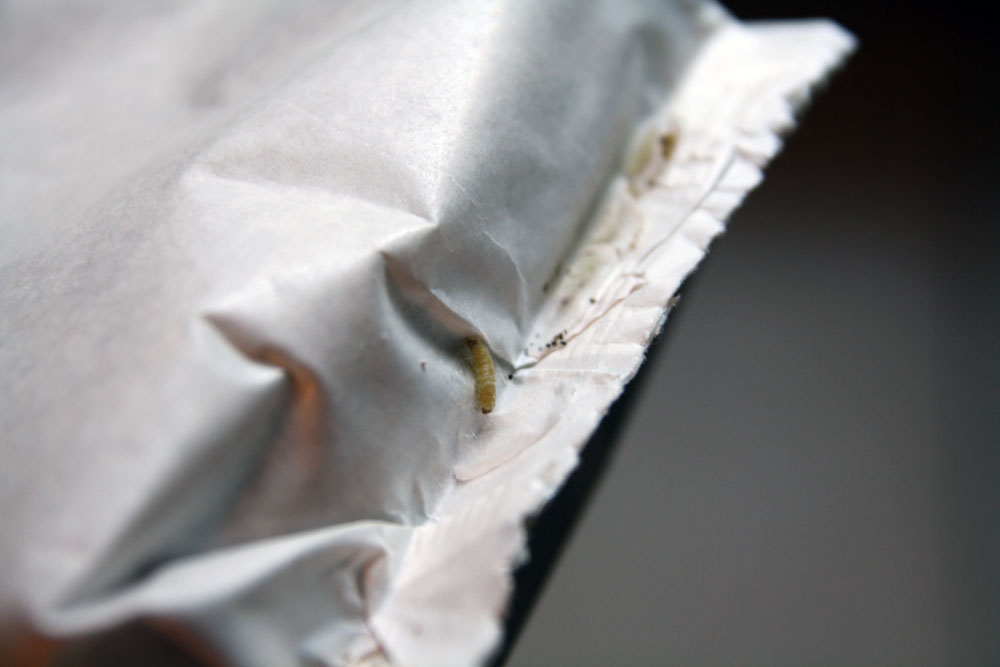
GROSS! These little larvae actually make me want to hurl. But at the same time they also make me really mad that they think they can invade my pantry and eat our food. I mean seriously.
What are Pantry Moths?
Meet the pantry moth, properly know as the Indian Meal moth (Plodia interpunctella). They are usually most active in summer months, and that’s when they got really bad for us…but they will hang with you for a long while and having you praying every day that you don’t see any more traces of them.
They are also resilient and will will hunt down those little kernels of wheat germ that drop to the bottom of the box or spilled flour on a shelf and begin a thriving colony in your home.
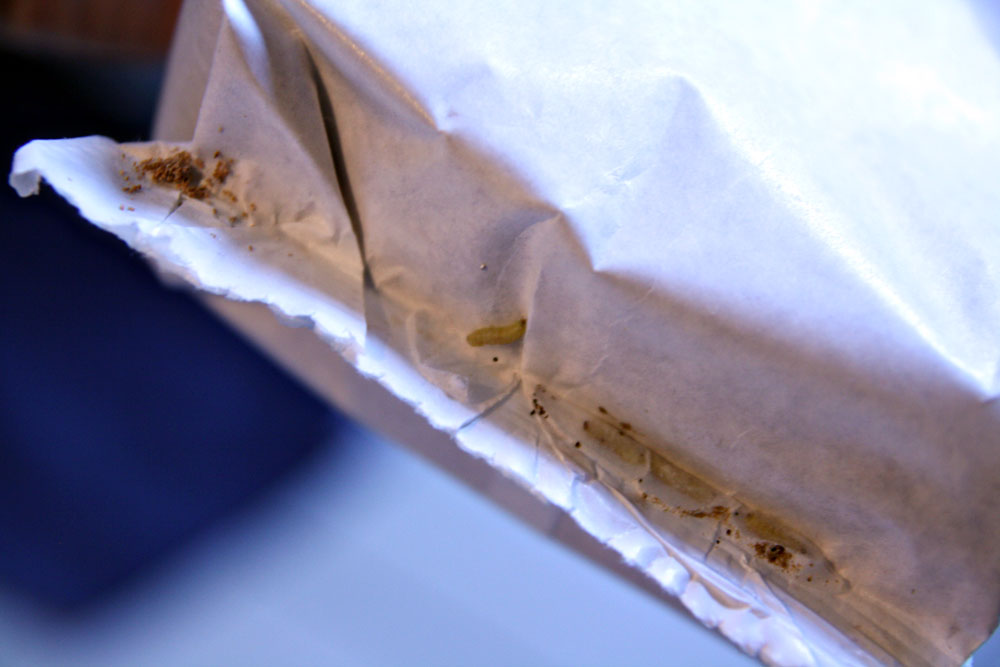
I now have a vendetta against these creatures in all stages of life. Let me give you a quick rundown of the lifecycle of a pantry moth:
- You may first notice the little brownish moths that flit around your kitchen. They will lay somewhere between 200 and 400 eggs which will hatch 2-14 days later. The mommy moth, wanting to take good care of her kids, will usually lay these close to a food source. Then, once they hatch, they don’t have very far to travel before they start to feast.
- The larvae/worms look a bit like small caterpillars are a whitish-yellowish color with little black heads and about 2/3-inch (1 cm) long. They will burrow into anything and everything they can find, continuing to eat for 2 – 41 weeks, depending on the temperatures. They take longer to complete their life cycle in cooler weather.
- Once they are finally full and have left behind their tell-tale webs, they will enter pupa stage and crawl off somewhere looking for a cozy place to nest and spin a cocoon. This will often be crevices in your kitchen you don’t normally see or maybe even where the ceiling meets the wall (they seemed to find that a particularly nice nesting place in our house.) They will stay in this stage for 1-3 weeks.
- When their metamorphosis is complete, the pantry moths will emerge as flying adult moths, ready to start the cycle again in the 15-25.
How Do Pantry Moths Get Into Your House?
Indian meal moths will eat a lot of things, from dried fruit to nuts, grains, rice, cereal, OATS, powdered milk, chocolate, candy, seeds, pet food, crackers, pasta…they will seriously devour just about any sort of staple in your pantry, leaving silky webs in everything.
Pantry moths come into your home when you buy food at retail locations that supply all variety of foods. They may including any sorts of boxed and packaged store-bought foods, bird seed & pet food, foods in bulk bins, or cardboard packaging.
On a side note, in August 2022, we had a friend visiting us in Germany and she used to work for a major national drug store chain in the US. I asked her if they had ever had any run-ins with pantry moths. She immediately called them by their proper name of Indian meal moths and said that there had been occasions when large amounts of food had been tossed out because moths had been found.
These businesses importing and selling goods are actually required to throw out the food which is infested — but I have to wonder how many chains just fail to notice that they are infested, how many things get shipped out in winter months when the bugs are mostly dormant and as Chris comments below, how many non-food products are infested with these things as well?
They will definitely build nests in small cracks and crevices of even books as they eat the glue. They also seem to love stuff like bunched up bags, as well. So just because it’s not food doesn’t mean there are no moths in it.
Signs of a Pantry Moth Infestation
A few of the tell tale signs of pantry moths include webbing throughout your food containers, finding the crawling larvae, or being accosted by the flying micro-beats.
I often seemed to find moths in cycles, after a couple of them hatched at the same time. They’re not fast fliers and very easy to catch in your hand. Then I just smoosh them in a paper towel or on my dirty work jeans. And I have to say I’m really not a fan of bugs, but somehow killing those moths is a pleasure.
One of our big problem areas has been my spice cabinet so I finally had had enough last week and I tore the whole thing what I found was really gross.
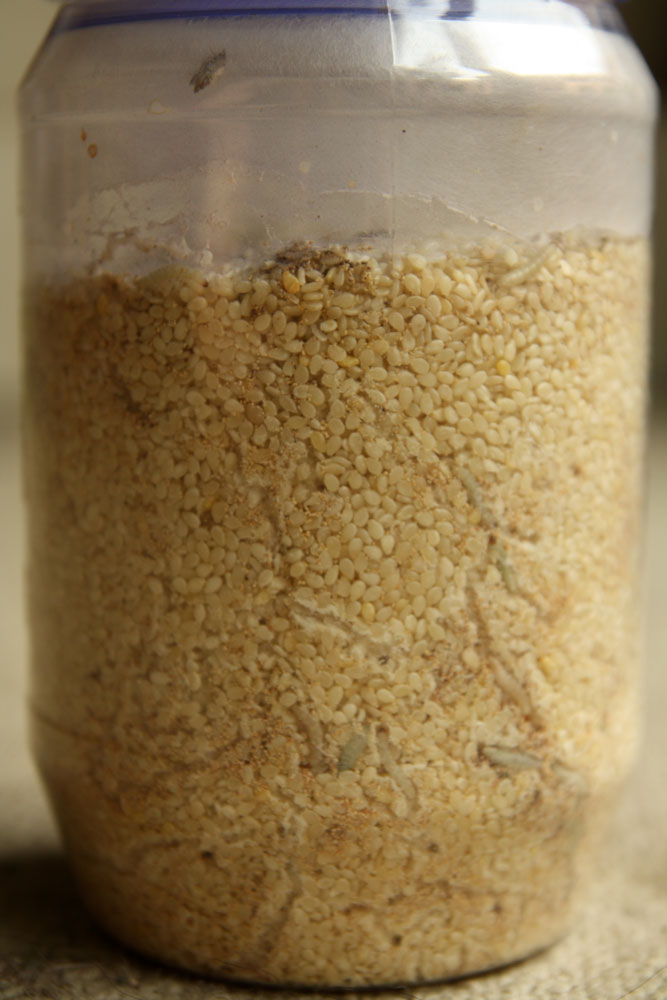
I have a tendency to buy sesame seeds for one recipe and then swear to myself that if I buy the bigger, cheaper bag, I will find a great recipe to use the rest of them in. Or sprinkle them in my salad. But then I never figure out what to do with the rest of them. Now I know that I can just leave them out for pantry moths and turn it into a science experiment. I was pretty amazed at the way these things just tunneled around in the jar, eating their way through the seeds.
It was really an entire pantry moth ecosystem inside this jar, from worms to moths to eggs galore. Oh joy.
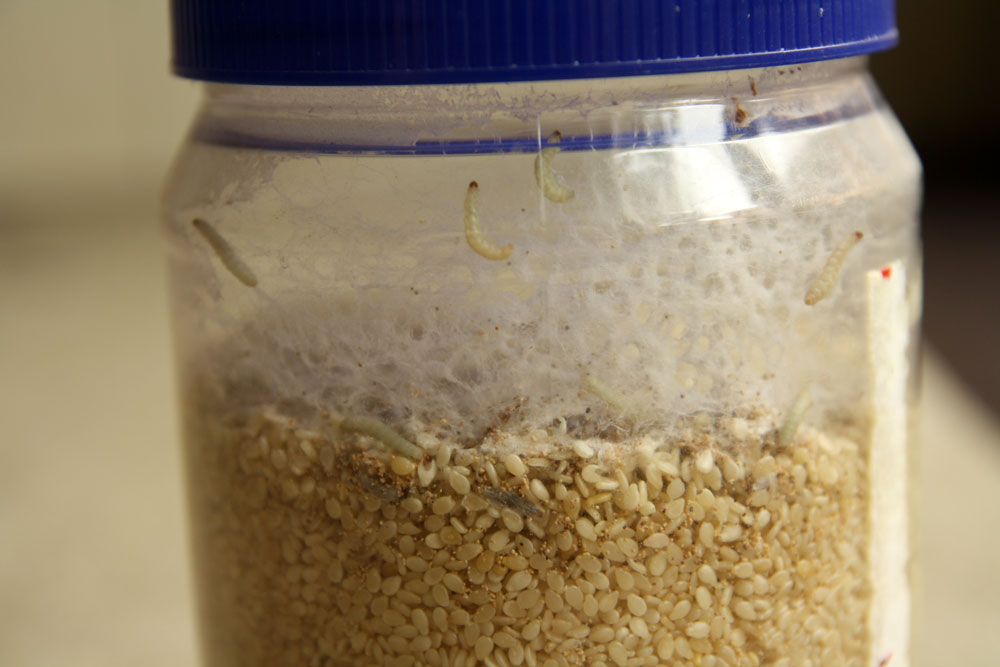
I also discovered them inside a box of brownie mix that I was finally going to make, just to have it out of my kitchen. I did find it a bit strange that there was some chocolate powder on the top of the box, but didn’t give it too much thought — then opened the lid and saw all the webbing inside and the moths. Into the trash it went (outside, not inside!)
We went into the kitchen one morning and I swear there were no less than 5 of these things crawling around up there. We promptly killed them and hoped not to find anymore. But there were more…there always are.
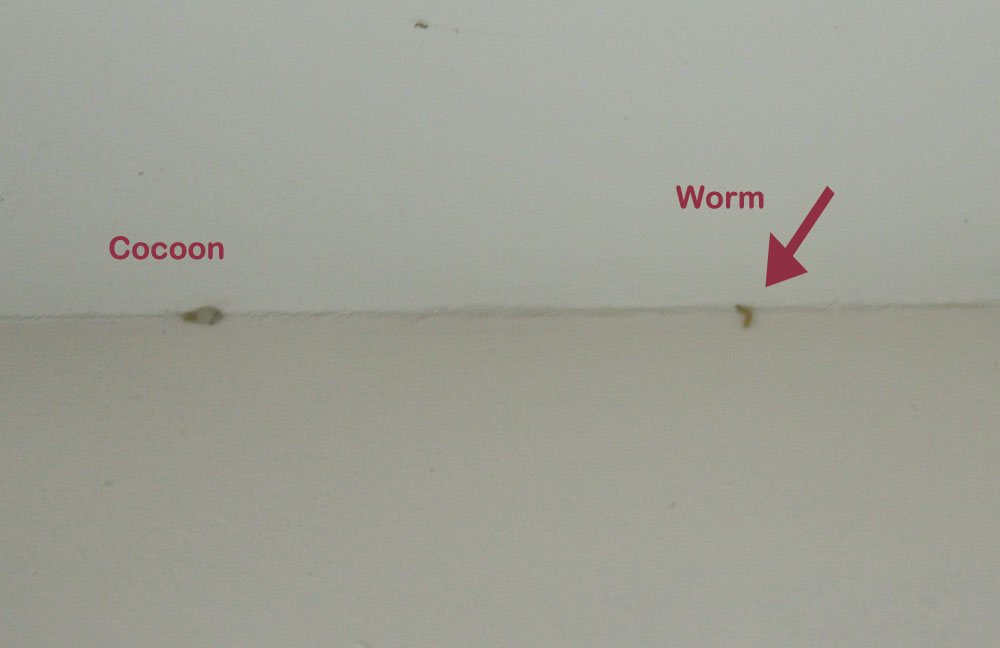
And apparently, they love to nest under things you don’t use very often…
I have a collection of baskets on top of our very high kitchen cabinets that I don’t too regularly. The took a liking to one basket in particular which had some sort of fruit in it at one point (it’s been a few years so I can’t remember anymore). So I was moving some of the baskets around, searching for something, I go to lift this one down and notice that there is a pantry moth jamboree taking place.
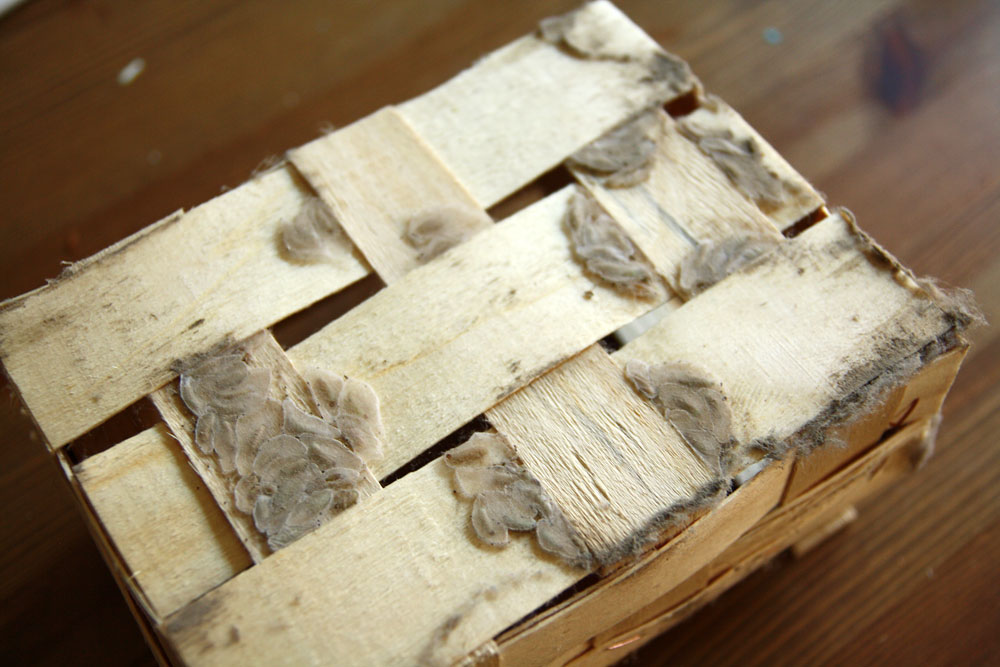
Disgusting! So this basket promptly went into the trash and I did as good a job dusting up on top of there as I could. I didn’t find any more of the bugs on the other baskets but I can assure you I inspect each one of them closely now before I use them.
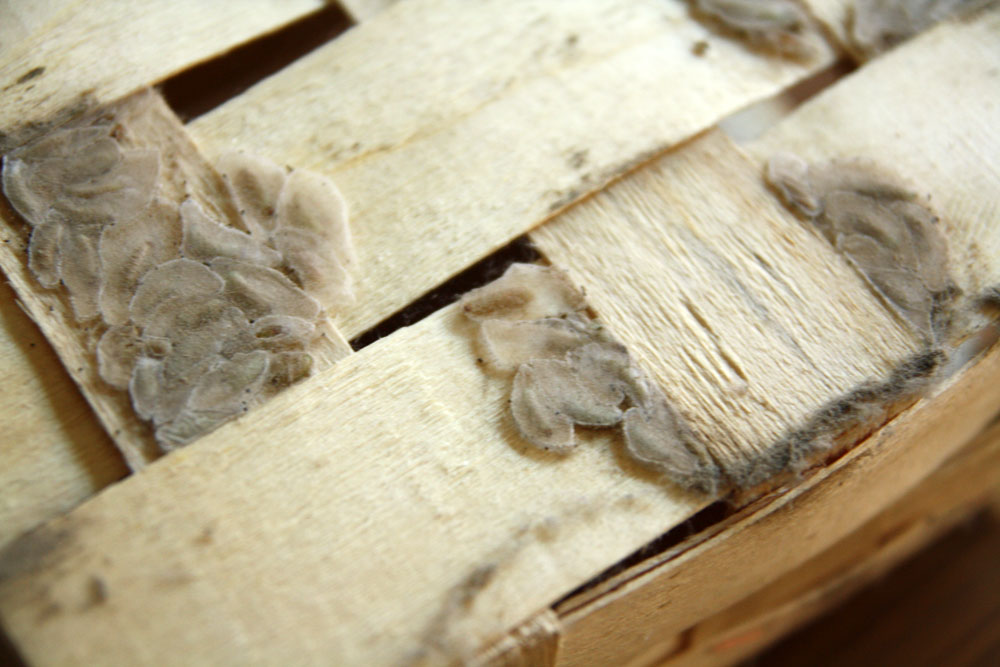
Apparently these things tends to overwinter and we might get a rash of pantry moths hatching in April. I just can’t wait. Until then, I have quarantined all packages of oats and wheat germ to the freezer (they seem to be especially tasty and I have to wonder if I brought them in with the oat packaging from Lidl). I also keep a very close watch on all of my “airtight” containers that don’t really seem to be as airtight as originally thought.
Are Pantry Moths Dangerous?
By now, you may be wondering if these pesky little creatures are dangerous. And aside from being really icky and annoying, they are not harmful. But none of us want to bake with contaminated flour or eat a handful of nuts with moth larvae in it, right? So the issue of contamination is a real one and you do need to handle the situation seriously if you discover Indian meal moths in your pantry or beyond.
Why Pantry Moths Keep Coming Back
I battled our pantry moths for over a year and missed eggs and cocoons generally were my downfall – and mostly because I was not harsh enough with purging. I would clean everything in the pantry and think I had them all — only to find a nest of them a month later. A few dollars of food is not worth chasing these things for months.
About 1.5 years after I discovered the first pantry moth, we moved out of the farm house and it sat empty for about 1.5 years. I hope that no other moths were ever found but when we moved out, I did find a few dead ones in several places that had nothing to do with food at all (like between two flaps of cardboard in some boxed up espresso cups I rarely used). So I made sure to trash anything that looked questionable before we moved out and we had no signs of moths in future homes.
The 7-Step Method on How to Get Rid of Pantry Moths
- Identify the primary source
- Remove and discard infested food
- Freeze or heat-treat questionable items
- Deep clean shelves, cracks, appliances
- Install pheromone traps
- Transfer food to airtight containers
- Monitor for 30-60 days
The way you react and at what speed after you find the first sign of pantry moths makes a difference. You’re working on eliminating everything that the moths have already fed on and are currently feeding on, and quarantining anything they may want to feed on later.
The only really good way to get rid of these evil creatures is to be thorough and go on a massive cleaning mission. You need to take everything out of your pantry, cabinets, etc. and inspect for larva, webbing, pupae, or other signs of pantry moths. You may also notice tiny holes in plastic bags or boxes.
If you think something could be infected or see evidence of infection, do one of the following:
- Place it in your freezer 0°F for four to seven days. A 10 cu ft or larger deep freezer chest is perfect for this.
- Microwave it for five minutes.
- Bake it in a shallow pan or tray in the oven at 140°F for one hour or 120°F for two hours. Stir food periodically to prevent possible scorching.
- Sift the food to remove insect silks and any larvae that may be pigging out at the buffet. Silks and bugs will not harm you if eaten, just make you gag if you realize you’ve eaten one.
- If you are certain insects have been killed, contaminated food like seeds or nuts can be used outdoors during winter months for bird feed.
Immediately destroy or bag any cocoons or worms you might find and heavily infested bags of food. Get them as far from your house as quickly as you can. Don’t just leave them sitting in your garbage can in the kitchen for a week or two. Bury them, squish them, drown them, take them out to the curb…just get these pests away from your home and their food sources.
Once you have everything out of the cabinet or drawer, you need to sanitize them. Take everything out of your cabinets and vacuum up every trace of food, no matter how small. They don’t need much to feed and they will find even the smallest collection of crumbs to live off of until you still some flour or a bag of rice and forget to clean it up.
If you have your cabinets lined with paper, remove it and put down new stuff. I’m pretty sure these moths would LOVE to nest under the paper.
Pull out appliances from your wall and clean behind and under them with soap and water.
Keeping Pantry Moths Out
Going forward, when you’re shopping, carefully inspect every package you buy for signs of tiny little holes. For foods that you rarely use but are especially susceptible to pantry moths (like seeds or spices), try to buy smaller quantities that you can use up quickly. I know it’s not always economical but it can save you a lot of headaches. Or make sure that the items are stored in the fridge or freezer, or an airtight container to prevent infestation.
I also eventually purchased pantry moth pheromone traps which made a huge impact on catching moths. While it didn’t catch them all, it does catch many of them – which can be better than getting the wing dust all over the walls and ceiling. Try not crowding too many into a small space, though, or you might confuse the moths and make them less effetive.
If you continue to find moths, you need to make a another pass through your food storage and clean everything again. There are likely some holed up in a collection of plastic bags or in a box of brownie mix or an airtight container you think they’d never get into (or escape) — but they do
I hope that if you are on a quest to destroy these pests, that your journey is swift and successful. There is a ton of good advice within the comments, so be sure to read them all!


You’re braver than I am – no way would I smoosh them with my hands. I’d have to smoosh them with a shoe or something.
I just encountered a seemingly major infestation of these littel critters. I found what worked well was the taking everything out of the pantry and disposing of what might be infested. I used clorox roundup to spray the shelves. The spray and vapors seemed to be very effective–they dropped and ran from everywhere. I ventilated the kitchen as much as possible before doing so.
We have battled the little buggers off and on for a while. I think I may have found the way to break the cycle. Remember fly-paper? Well, since the wormies seem to want to crawl up to the pantry ceiling to spin their cocoon, I placesd a strip of carpet tape a few inches below the ceiling. Carpet tape being sticky on both sides catches them if they try to crawl over or under. If you try this don’t press the tape completely against the wall or you will have a hard time getting it off. I just run my finger along the middle of the tape. So far it is catching those little wormies as they try to cross the threshold and they get stuck for life! Eventually, hopefully less that a year, we will be rid of them.
This reply to your post will probably disgust you Tiffany but, years ago, while still in military service, I got up early to go to work one morning. I didn’t want to disturb the other members of my family so I didn’t turn on any lights and had a pop tart and glass of milk while standing over the kitchen sink in very dim light.
I came home after my 12 hour shift and my wife said, “we need to take these pop tarts back to the commissary because they’re full of worms.” I looked at the pastry that had been nestled together in the package with the one I ate and it was swarming with activity.
I feel sure that the one I ate must have been similarly infested but I can vouch for the fact that it tasted okay. I marvel at the fact that I didn’t feel them wriggling as I chewed them up. Oh well. 🙂
I use a lot of dried Mexican peppers and they also are prone to insect infestations unless they are kept sealed very tightly.
Oh, Charlie…you definitely made me gag a little 🙂 On the other hand, I’m sure it was some much needed protein in an otherwise virtually protein-free breakfast. lol Still gross!
You’re absolutely right Tiffany. In primitive societies, the insects that infest grains are the primary source of protein and B vitamins!.
I once enjoyed some organic broccoli that was the sweetest I’d ever tasted. Then my wife noticed the florets were full of aphids. A little research turned up a recipe for using aphids as an organic sweetener!
I don’t welcome pantry moths, but I found a lazy way to eliminate an infestation: moth traps. These are non-toxic sticky sheets that you “bait” with pheromones–female pantry moth sex hormones that attract males. The pheromones are contained in small patches that are sealed in plastic film to keep them from losing potency.
When I got my traps, I cut open the packets of pheromones & was immediately surrounded by about a dozen fluttering moths. Some of them did a little fertility dance on the plastic that had contained the pheromone bait.
I placed the traps in cabinets containing the foodstuffs most likely to be infested. One of them attracted about a dozen moths over the next few days, but the other remained pristine. I thought it might be a dud, but then I switched it with the active trap and it too began to fill with (male) moths stuck to the surface.
For several weeks, I still encountered worms and (female) moths on a daily basis. I wondered if I’d ever get rid of all the moths, and if so, what the end game would be. Then a day went by without a moth sighting, then another and another and another. Finished! I have not seen a moth in a week and I feel confident that I’ve broken the cycle of life for these vermin.
I wish all the best to everyone who reads this.
The traps are really fantastic, I have to agree. Since I started using them, I have noticed a SIGNIFICANT decrease in the number of moths flying around. Now it’s just a matter of getting the larvae gone as well! Thanks for your very knowledgeable comment 🙂
Thanks Tiffany,
Still no moths. I’m very pleased. I thought there might be a few stragglers who were taking their time going through their life cycle, but they just stopped.
I had some at my beach house as well and bought some traps but didn’t deploy them. Now they have disappeared just by bagging all the foodstuffs in ziploc bags. I also noticed they were getting stuck in a pool of oil that sits atop a large flat-topped canola oil can. They seem to be attracted to the oil, presumably both male and female, but that trap has stopped collecting them too.
Tonight I opened a large ziploc bag containing a 5 pound bag of all-purpose flour and an unopened bag of whole wheat flour. I noticed a live adult moth was trapped in the bag, and I crushed it before opening. There was a small web inside the opened bag of white flour which I removed with a fork, and evidence of larvae in the unopened bag which I also removed.
Then I made bread…I think I’ll go ahead and deploy the pheromone trap just to be sure.
jc if you think you got ride of them that easy you are probable wrong i did the same thing and didn’t see any for a month then all of a suddenly bang they were back with a vengeance. they were all over the place again so i got more moth traps and started over again good luck
Tiffany,
Barbara and I are fighting these moths in Texas. They are on the ceiling and even flying around the house. Barb hates these “monsters”. I put out moth balls and got quite afew of them, but barb hates the smell……Great job on the story on the moths….
I hate to tell you this, but my husband (the sanitation inspector for restaurants and bug officianado) has told me that they’re not getting into your snap lock containers…they’re already in the food that you’re putting into your containers. Apparently there’s an “acceptable” limit on the number of bugs that can go through a factory in our food products. Keeping your items in your fridge and freezer is the best thing that you can do to keep them from hatching out. And ziploc bags for everything. That way if they DO hatch they’re contained inside the bag. This is only useful for things that you don’t use frequently in my opinion.
An excellent point, Kathie! I actually meant to mention that the bugs were already in the bags but it’s definitely true that the oats were likely heavily infested to begin with. Or the cereal (also had oats in it). Or both. Those are the two snap containers that had the majority of the bugs a few months back. I actually had another bag of oats (which I don’t use that often) in a ziploc and they were just all over it. Now I store that in the freezer…and if I continue having trouble I’m either going to start freezing everything in the subzero trunk for a while before I put it into my containers for use. Maybe I should just be going to to the local mill and getting the flour and such there…never seen bugs in the grains I have stored from them!
I think that part of the issue with these bugs is that they are pretty hard to get rid of, you often don’t notice them until you’re about to use the product and perhaps that is part of the reason why it’s “ok” for food to be sold with these creatures in them. That doesn’t make it right but that’s just my guess. With everything being centralized out of a few main warehouses and “just in time” stocking, this sort of problem is bound to get worse.
I’d also like to point out that anyone who has a real problem with these things should look into the pheromone traps that are available. They attract the males, trap them on something like fly paper and cut off the reproduction cycle. It’ll likely still be a battle since there will still be eggs hatching and so on, but it should at least help slow down the process…assuming you get most of the males. Big assumption I know.
Hi.
just made flapjacks to discover little black things crawling around in empty packet, hope it won’t harm us. Not the first time i have had them, washed all cupboards out with anti-bacterial stuff,flour ect in plastic bags then plastic containers,little beggers must already be in when bought plenty of date still left on packet.
I have little to contribute except for two things.
1. Thank you for posting how to solve this problem. And,
2. EEEEEWWWWWWWWWWW!
Hi Tiffany
Christian züchtet die als Futtertiere, darum kann ich dir sagen da hilft kein einfrieren oder so. Du musst ALLE Lebensmittelvorräte vernichten, Vorratsboxen in der Spülmaschine waschen.Ansonsten kommen die nur aus Glas nicht raus.
This comment is from my husband’s cousin and for those who haven’t been practicing their German, she is telling me that freezing the stuff will do nothing to actually kill the larvae. Great.
She’s an expert because her son has tarantulas (among other things) and apparently uses these bugs as feed for them. *shudder*
Instead you’ve got to toss out anything and everything that you know is infected and wash any food storage containers completely, making sure all traces of them are gone. And usually they cannot escape from glass.
So if you’ve got good food storage bins that are airtight, you can trap the bugs in there but you’ll have to trash the food to actually kill them. Freezing will keep them dormant I guess and works well if you’re bringing stuff home and just using it from the freezer as needed.
Oh yeah. My new husband and I combined households and still blame each other for the infestation — we’ll laugh about it for a long time. Nice to know we’re not alone… thanks for the post.
Well just when you think they’re gone, you find something else with them lurking in there. Found a package of sunflower seeds yesterday that didn’t necessarily have anything alive in it, but had definitely been decimated by bugs. The seeds had holes all in them and such. Into the trash it went.
They do like sunflower seeds, that’s where I first noticed them. I was surprised to find them in the dried fruit and in a bag of brown sugar, too. Sneaky larvae; I thought the sugar would have desiccated them.
We moved into a renovated house with brand new cabinets so at least those were clean; any more bugs will be the result of our lack of vigilance in the move. I threw away a lot of food — if it happens again, we’ll follow your advice and save a few bucks. Seeing those little whisper-y, web-y tendrils in a bag or bin… that will alter the course of your day.
Nuts and seeds of any kind they seem to adore. They went crazy on a bag of almonds and just drilled right through all of them. It’s the worst sinking feeling when you see those webs. But far worse for me was seeing the stupid larvae all over my kitchen. Crawling across the ceiling when I walked in the room, the dang moths flitting around the kitchen. Ugh I so hate these things. Still hoping and praying I’ve finally gotten them all.
Don’t blame each other. We went to a major hardware chain and the birdseed has caused a major outbreak there. Also, we were in a drugstore chain store and they had them too! They are everywhere!
I had a major infestation a few years back. I only noticed one container (of dried dates) which I immediately threw out and replaced. But then a couple months later they were in the new container. And then I started noticing them in other things. So I promptly freaked out and deep cleaned my entire kitchen. I went through every single thing in the pantry, washed down the whole thing, threw out anything that had creepy crawlies and put everything else into glass mason jars (plus a couple larger things in “airtight” plastic bins). Every new thing I’ve bought since has gone straight into a mason jar. Bulk quantities are stored in bug-proof plastic bins (and dusted with diatomaceous earth for good measure) or sealed into mylar bags (before going into plastic totes or buckets). I occasionally see the moths flying in the house, but I haven’t had a problem since. I <3 mason jars!
Hi Tiffany,
Thanks for your article. I have been battling these pests myself for some time now in my home in Australia. One thing I thought I’d mention is that I have had some success using pheromone traps (as you pointed out in comment 4.1) in combination with regular cleaning, use of airtight containers for susceptible foods, along with their periodic freezing to eliminate any grubs that happen to get in anyway. They seem to even get into watertight twist-cap glass and plastic jars and Tupperware, which I find incredible!
We have a pheromone trap sitting just outside the pantry, which seems to work in catching some moths, however since the pheromone traps are only typically effective at catching a proportion of the male moth population, we have found that simply placing the sticky-lined portion of the traps (without the pheromone lure) in the pantry alongside our containers of oats and cereals has also been effective at catching some other moths – possibly the female ones. I hear that it is important not to place more than one pheromone trap in close proximity to one another (such as in the same room), because the multiple sources may confuse the male moths which may not end up landing (and getting trapped) in any of them.
I would also like to mention that cotton-wool soaked in Eucalyptus oil (which has a very strong scent) or Bay leaves (which are less pungent) are good natural deterrents for moths along with other insects, so placing a few of these in your pantry is a good idea to deter moths from laying eggs in and around the pantry – not infallible, but since the moths are so pervasive, I’m keen to try all angles of attack!
We have not had these moths for long, only around six months. The numbers dwindled after our first massive clean-out, but occasionally we still see the odd moth flying around (which are promptly killed), or caught in one of the traps. Our food doesn’t appear to be contaminated, so perhaps the moths are just hatching several months from grubs that were present in the infestation we cleaned out that one time six months ago. I would love to know how long the period between the larval stage and the transformation-to-moth stage can be – if it is short, then perhaps we still have an infestation that I haven’t yet found… 🙁
Hi Aaron,
Thanks for your insight on the traps. I haven’t tried eucalyptus oil but definitely will. And the bay leave I have often heard about repelling all sorts of bugs, plus it generally doesn’t leave any taste if you put it inside containers with things like rice or flour.
I found an infestation in a plastic container with cereal again last week. I am fairly certain the moth larvae must have been in the food when it was purchased because all the worms seemed to be dead and so I guess they couldn’t escape the heavy lid. Normally if you find them inside some sort of airtight container, they were in there when you bought the food.
The life cycle is about 2-14 days for eggs to hatch, but the larvae can keep feeding for 2-41 weeks until they actually become moths. This depends on how warm it is and how well they’ve hidden themselves in the kitchen. We haven’t seen too many moths lately but I am keeping a vigilant eye out for them as they do tend to appear from time to time still. I can only hope that I’ve found all their nests by the time it starts to warm up here.
I did eradicate a bad infestation in my food cupboard. Here is how I did it: 1. Throw out all food that is in a container that has been opened. Throw out anything that comes in a cardboard box or paper bag, including sealed boxes of pasta, etc. 2. Thoroughly inspect cans or unopened jars of food and discard if the least bit suspicious. 3. Discard everything to an outside location and clean your pantry thoroughly. 4. Inspect your pantry DAILY, morning and night. Kill any moths or larvae that you see. The moths are looking to mate, so killing them will interrupt the life cycle. 5. Keep this up for 6 months to a year. this sounds tedious but once you get into the habit, it is not so bad. good Luck to all!
Thanks for the great rundown on your process of getting rid of these evil pantry moths!
We’ve been seeing moths again around the kitchen, I guess they are hatching since it’s gotten a bit more springlike here. I’ve been vigilantly killing them but I do think I’m going to need to completely go through a few other cabinets in the kitchen to make sure there are no larvae lurking anywhere.
While tedious, the final outcome of never having to see one of these disgusting creatures again will be worth it!!
After a 5 month absence I returned home to find a massive peanut jar with the most amazing webbed nest that I have ever seen. I wish that I had taken a picture to post on this site. I am infested with the little pantry pest. So now we are pretty much on a gluten free diet to try to minimize the food they are drawn to. Now they attack me in the morning because I have killed so many of their family and friends. I eagerly look at my glue traps to see how many were captured the night before. I am obsessed with getting rid of them.
I’ve had these pantry moths for about 4 months! When I first discovered them, I threw out all my boxed and bagged foods…several huge bags. For awhile I didn’t see any, but lately I’ve been deluged once again. I bought the pheromone traps, but haven’t seen any improvement yet. Had company and a moth landed right on top of a cake as we were serving it! Ugh! I kill about 20 moths a day. Fortunately they are easy to kill. I really don’t want to go the exterminator route, being the kitchen, but I’m about wild. I opened up a cookbook and discovered the webbing inside the cover!
Help!
I HATE THESE THINGS!!!!!
Someone told me to wipe my pantry down with vinegar- did that. Fail.
I’ve bagged all my grains, inspected everything thoroughly.. no grubs now.. but we kill 2-6 months an night. it’s become a household sport. This house is old and has a lot of cracks, too many places they can hide.. pheromone traps sound good.. chemical warfare sounds BETTER! I also am sick of all the little shiny grey smears on my walls where a kid or hubby went SMACK!
Never heard of the vinegar trick — but I guess it would be to neutralize any smells and sanitize the pantry?
I’ve got two pheremone traps up now and they’ve caught quite a few moths each – one is in my pantry and one near the ceiling where they like to hang out. But honestly we’re still killing 5 or so a day by hand. The traps only attract the males — which in turn should cause the moths to die out, if your females are not yet pregnant and if no more hatch.
Seriously some of the worst bugs ever!
Thanks for your comment & best of luck with the fight! I’ve found that if I swat them to the ground and then step on them, I have a nearly 100% kill rate. lol
Thanks for this article! I have waged war with these pests, and I just hate having them in my house! They are in my childs bedroom, hallway, and kitchen. I have been dealing with them for over a year, and nothing has worked so far. I have tried cleaning, getting rid of everything, freezing things for a few days….nothing works. I wonder if the pheramone traps work well? I am going to buy some and hopefully, they will help.
At any rate, I hope you all get rid of those nasty pesky moths and I hope you do fast! I hope to get rid of them soon too!
Thanks for leaving a comment about the horrid pantry moths. I am happy to say that I have tried the pheromone traps and although they are expensive and only last about 6 weeks — they are totally worth it! I do feel ever so slightly bad for the moths that get stuck and struggle on them for a few days until they die — but only slightly bad since I really despise them infiltrating all the food and the house. Once we put the traps up in our kitchen, the number of moths flying around dropped dramatically. Now we just have to buy news ones and keep it up until all traces of them are gone…which apparently could be a long while!
Best of luck with your fight! 😉
I’ve been using the pheremone traps for quite awhile and they catch a lot of moths, but unfortunately, the house is still infested. Luckily, I’ve never found webbing or larvae in my pantry items, but these moths are all over the house. I’ve found cacoons in the wall/ceiling crevices of just about every room, between papers, on stacked clothing, etc. I don’t know how they got all over the house when I’m not finding them in food. I first found them upstairs and just thought it was strange I kept seeing little moths in the house during the daytime. Then when I mentioned it to my grandma, she said she has them and gets them in her food and are all over her house, so I think I might have gotten them from a bag of clothes I brought from her house. So be careful what you take to others houses! I wish I would have known to start combating them before they took over the house! Anyone out there seeing little moths flying around even if not in their kitchen, don’t delay fighting them!!!!
Anyway, I wanted to share another method of combating these moths that I’ve found handy – battery operated handheld bug zappers. They look like tennis rackets and make it very easy to kill moths that you see flying or sitting around. Just come up under the moth and zap! Then I throw them in the toilet to make sure they’re dead (some have survived a zap so in the water they go).
Good luck everyone!
I thought I won. Found them in everything specified cleaned and threw out everything and they went away, sort of. So now its really hot a year later and now they are everywhere again. Sure enough the food I bought like black beans, rice, flour, cornmeal, pancake mix even powdered sugar all infested. I figured out they more than likely came from the beans or the rice. I like to buy extras of these items because I like to have more than I need just in case. I find it ridiculous that one cannot store certain foods because they basically self destruct even before the expiration date of the item. Almost wonder if its intentional. So I’m wondering if maybe vacuum packing the material might kill them by way of no oxygen to breath. Otherwise I have to freeze more than likely bake the items I would like to store for long periods which come on might work for dried beans and rice but flower and sugar I don’t see that happening. I’m guessing not even industry can figure out how to get rid of these things they are such a pain. Wanna be rich? Figure out how to get rid of these little menaces and please tell me! Another thing I would like to bring up I have been storing foods for YEARS and never seen these pests accept within the past few years or so. Anyone here shop at Publix?
I have been using an exterminator for about 4 or 5 months and they are not totally eliminated. He leaves traps every month or two and has sprayed the entire kitchen cabinet area inside and even some areas outside. I have not had any food in my cabinets for about three months. All cabinets are totaly empty. I want them to use something toxic as this other stuff does not work. Some years ago when I lived in another house, I had an infestation in three rooms. I took the kitchen first and emptied it out as if I were moving. I cleaned all cabinets completely and then I used an insect bomb or fogger as they are called. After setting it off, I closed the doord and used masking tape on four sides. I left the house for four hours as directed. When I returned, the fogger was through fogging and I then opened all windows and again thoroughly cleaned all surfaces and the floor and cabinets inside. My next step was to do the living room and dining roomn which were opened to each other. Again, I masked the door to the kitchen on all four sides as well as the door to the hall. The second fogger was left four hours again and again and I left the house for four hours. Again I returned and opened all windows and vacumed the floord and drapes. All this took a whole vacation week and I made sure the rest of the family was away when I did this. I want to say that it got rid of all molths, eggs and I nevere again saw another moth in that house for the remainder of the time we lived there which was about 10 more years. I am now in a condo and aftere 20 years, I got another problem. I think I am going to resort to something more final again either with an exterminator or my self.
What bomb did you use?
Thank you for posting this! If nothing else it made me feel better just to know I am not alone! We have been cleaning and recleaning our kitchen and spraying it and all kinds of stuff for the past week sinsce we noticed the terrible moths. They are so nasty! We have thrown out a ridiculous amount of food storage, and are seeing less and less of them, but they are still there. We will be moving across the country in 11 months and at this point I have decided to start packing up as if I am moving and keep only essentials out (like one set of dishes adn a few pans). We could live like that for a year right?! 🙂
Hopefully it will keep getting better and these suckers will be gone at some point. It is also the hotteset most humid summer we have had here in Nebraska in a long time, so maybe that is why they are so bad. Maybe the ice cold Nebraska winter will freeze out if we still have survivors in winter…
Until then I will just keep being vigilant in killing them and in cleaning up! (ANd try not to break out in clod sweats and panic attacke each time I see a stupid moth…)
Thanx 4 all your knowledge people. I have Had this pantry moth problem every year now(for two years) in my new apartment. Last year I had a problem with moths in the pantry but was fixated only in the pantry. All I did to get rid of them the first time was: 1.Bought “Mothballs” and 2. Just cleaned pantry(throwing away infected food and cleaning)…. and wahla problem solved. But now they are back and more than before. They are now all over the ceiling in the most of the apartment. I am so MAD it irritates me so much. So anyways now I am removing EVERYTHING from the pantry and throwing away all the infected items such as FLOUR, who I think was the cause of it this time cause of all the larva eggs inside it, and then spraying pesticide inside the pantry. Hope that does it and now I am going to be extra careful of what I put in there. Hope that kills their food supply and they start dying off… still I am going to hunt them down, with a vacuum cause the flyswatter doesn’t reach parts of the ceiling or corners. Hopes this helps you readers with the same problem.
You just have to really keep after it, Tommy. I have found the pheromone traps help a lot, keeping them in areas they frequent. I have at least 2 out at a time. You will see a serious reduction in the number of moths when you start using them ….and then you just have to worry about finding the stupid worms. I am looking for the worms every time I walk in my kitchen. Seriously have to repaint soon because of all the moth dust and worm guts.
I hate these things with a vengeance! Best of luck with your battles! 😉
where can I find the pheromone traps
You should be able to find them in home improvement stores and sometimes grocery stores…and also online in places like Amazon. Hope you get rid of them quickly!
I don’t believe they just come in with food. I never had moths before but soon after buying a few boxes of sandwich and freezer bags from the biggest retailer we all know I had them. When I went searching I found their shells/cocoons inside these boxes. With product stored in warehouses for months if not years it wouldn’t surprise me if these critters are spreading like wildfire. Inspect everything that you buy.
What works really well is leaving a little wine in a glass. Next morning you’ll find several DOA in there. (found that out by accident) LOL.
I have also found these critters in boxes with waxed paper or parchment. I have some cookbooks on a shelf and have found tons of larvae between pages especially the magazine type with the staple. I keep a small vacuum in the kitchen and daily vacuum the ceiling. I’m sure I get about 25 a day. I get great pleasure when I find 2 moths “doing it”. I think there must be eggs in the fan housing because I can’t figure how the worms get on the ceiling. I had boxes of Jello and that has to be a favorite. When opened they were full of webbing and shells of bodies. Recently we were gone on vacation and when I came home, that vacuum was going before we unpacked. They have been with me for years. I think I brought them in when I bought a huge box of dog bones from the feed store. That’s when the problem started. They are mostly in the kitchen but occasionally I will see them flying elsewhere. The traps help. I change them weekly. If I leave water standing overnight I will find dead bodies floating. I’ll have to try the wine…wonder if they still bottle Boone’s Farm.
AND I’ve found them in folded white plastic garbage bags. What next?
Also, when I went looking I found their cocoons in closet corners and along the wall where it meets the ceiling. I think they eat natural fibers so inspect your clothing carefully as well. And, keep bags of birdseed in the shed or garage and put in an airtight container if possible.
Thanks for your tips and input, Chris. The crack where the wall meets the ceiling is certainly a favorite place for them in our house. I actually think they manage to get into the holes where the light fixtures are attached as well as tiny cracks in the walls and breed in there. These things are nearly as bad as bed bugs it seems.
I think what you are finding in your clothing are Webbing Clothes Moth (Tineola bisselliella) which look quite similar to pantry moths but are not quite the same. They also produce a similar webbing and may feed on produce from time to time — but really prefer wool. The Indian meal moth, on the other hand, will generally not feed on anything but foods.
Hi – great post about moths. I’ve been battling these in my kitchen for (I hate to tell you) years. They first came in the house in a bag of bird seed, and over the summer when we were away they infested the kitchen like nobody’s business. I think (knock on wood) we have finally beaten them (basically with constant vigilance and killing and cleaning stuff all the time) but I think it has been almost three years. They have become very infrequent over the last year and I now have seen no evidence of them for 3 months.
One place I found lots of cacoons cleverly hidden: in the little holes where you can adjust shelving inside cupboards. They love it in there – the only way to reach them is to squish them with a toothpick. EWW. Good luck!
Well we’ve had ours about a year now, and I keep hoping and praying they are gone, but they always seem to pop up again. BUT, yesterday after I edited this and reposted, I started digging around in part of my kitchen pantry (I have a divided pull out kitchen cabinet pantry plus the separate room away from the kitchen for backup) and I found two bags of almonds (they really seem to love almonds around here) and some kid’s cookies (which needed to be tossed anyway because Mack never liked them) that were absolutely infested with the worms. So I quickly tossed those out and I have not yet seen a worm today — whereas I was killing at least 5 or 6 a day recently. Fingers, toes and everything else crossed while I keep praying that might have been the last of my fully infested stuff.
But the advice about checking in the adjuster holes is really great. I found some wedged behind the backing of my cabinet and a shelf, so they really do seem to get everywhere.
Congrats on the lack of moths for 3 months! Hopefully you’ve gotten the last of those nasty suckers!!
I love this Blog site. I searched to learn more about dealing with my second outbreak of pantry moths. I read every word from all the reports and learned this can’t be taken lightly. I am using the commercial traps which appeared to work well the first time, 8 mths ago. I threw away most of the items in my pantry without searching out the larvae, just assumed much was effected. No I’m learning they definitely do infiltrate sealed containers. Today I threw everything out of my pantry! Canned goods in case the larvae was hiding under the labels, unopened jelly jars, pickels, everything is out in the trash bin…far from the house. My first infestation was sourced to an opened bag of paper towels bought at Costco. Utterly amazing. All stored paper napkins and grain goods was tossed. This time, when I saw not only flying moths upon my return from a summer in Lake Tahoe, but larva and webs up in the corner of my pantry ceiling. That convinced me to throw absolutely everything out. When I was washing small appliances, baskets, and plastic containers, I discovered the impossible. I had a coffee thermos that was so tightly screwed that I struggled to get the cap off to wash in hot sudsy water. Inside the threads of the screw top was a worm/larvae still alive. I showed it to my husband just to document my crazy sighting. That thermos hasn’t been used for years! I found the same in glass mason jars, empty plastic screwed containers and other sealed tops. This compells me to take this opportunity of not having anything in my pantry and calling our exterminator to gas the walk-in pantry with his strongest chemical. Obviously this isn’t the best choice. But when I saw my plastic, sealed container of Cheerios looking like granola, totally infested with the entire life cycle of the pantry moth, I am ready to arm up and get them out of my house. Thanks for sharing the gross but needed information to compell me to do more than a clean up and traps. I thought about using the refrigerator to store my dry goods until I read that it just puts them in dormant. Good luck to all my compatriots. I am 62 and this is the first experience with pantry moths that look relatively harmless when flying in the kitchen, 2 or 3 at a time.
Shortly after you commented, another round of worms was found making their way across our kitchen ceiling. Naturally they didn’t make it much further. Then I found one in the cabinet where I keep my cookbooks. Honestly don’t know what that worm thought he’d find in there but you’re definitely right that they will apparently nest anywhere.
Apparently I still have a whole lot of cleaning to do. It’s starting to cool off a bit here so they’re becoming more dormant. Hopefully I can find most of their cocoons and get these suckers out of my house finally. Ugh.
P.S. Tiffany, We also have a 9 yr. old Newfoundland. I don’t keep her dog food in the pantry or any of her treats. She is innocent.
Newfies are the best 🙂
I haven’t yet found any of these beasts in her food which we keep in a plastic container elsewhere…but the mice that like to visit us in the winter sure did have a field day with her food a few years ago. Always gotta be on your toes…
I just got online to try to figure out what these moths were. I am infested with these things. They are gross and driving me crazy. Thanks for all the post, they seem to give me some real insight on these little demons.
Best of luck with your quest, Amanda. These things are devilish and just keep popping up. Just be vigilant and try to get your hands on some of those pheromone traps — they are really useful to at least stop the breeding cycle. Then the hard part becomes figuring out everywhere that they’ve nested. Since the larvae can live for such a long time, it really is a mission.
I am so glad I am not alone! I have been infested with these things for months. I am using the pheromone traps which have helped but I am still finding the worms in the craziest places. I threw out a lot of food yesterday that I hadn’t realized was infested until I looked closely and I am actually driving to the landfill today because of Labor Day weekend we won’t have trash pickup until Thursday and I don’t want them hanging out in the trash cans! What makes this situation worse at this point is that my power was out after Hurricane Irene for 4 days and I lost just about everything from my fridge and freezer too so I am very limited on what food I have in the house right now. Just praying they don’t get into the new cereal, I think I eat it fast enough that it hopefully is safe…
Thank you for the information! My husband and I just went through this adn were looking for what these things were. We just threw out Lord knows how many bage of rice, pasta, etc…as they had even eaten little holes in sealed bags. UGH! We also were vaccuuming them from the ceiling. I was sooooo mad to throw all of this stuff away! We were already pullingeverything out of the cabinets and wiping them down when I found your article. Thanks for the extra info!
The moths in our house (well larvae really) absolutely adore whole nuts. I can’t even have them here a day without finding worms in them. I usually keep them in the fridge for this reason on the rare occasions that I buy them…or airtight containers. Then they usually only manage to get into the rim of the container.
I have become infested with these things the past 2 months. I just found out the other day what they were. I am also disguested and grossed out. I do not have them in my pantry or cabinets but mainly in my basement. I stored a bag of dry dog food in my basement and they must of come from there. The larvae do like the crease of the ceiling and the wall. I am killing everyone I see and trust me I do look for them. I only had one larvae in my living room which I killed but the rest of them are on the basement ceiling coming up the stairs as I stored the food at hte bottom of the stairs. The moths do get in the house as the basement door is opened but I kill them the second I see them too and I am home all day unless I have an appt so they don’t get to hang around much. Sadly no matter how much I kill the moths and the larvae they are there later that day or the next day. Has anyone thought about bug bombs. I am going to try that this weekend but don’t know if it will kill the larvae. I really don’t have money to throw away all my food and I haven’t seen anything in food or the cabinets but after I found out what these things were I’m disgusted to even eat and when I did yesterday I almost puked just thinking about it. I hate all bugs but seeing larvae that look like maggots is repulsive. Please let me know if anyone has bombed their house and if it worked at all. After I bomb I am vacuuming ceiling, creases and everything and I guess I should check and clean cabinets after reading this article.
I have had these moths for 8 months. Initially they were flying around. After having two exterminators come and spray they persisted. I watched a video on you tube. The woman recommended vinegar and peppermint oil wash down along with paper traps. The things had even gotten on my Christmas tree. They were in a sealed plastic box eating my sweet tart candy. The cleaning people found a nest on the floor of the pantry. She sept them out and I forgot to throw away the broom. I have caught them on the sticky paper. Now I have seen them coming out of the space between the wall and the ceiling. I keep zero grains. All food is in the fridge and freezer. (Beverages). I eat out 90% of time and throw out all left overs. Glad to read this blog so I know I’m not alone. I will flatten the sticky traps and keep cleaning. Wiping for microscopic eggs. Horrible creatures these are. With a life cycle of more than a year I feel defeated. My home is clean. This doesn’t help. I think they got into the air conditioning duct. When the filter was changed they reappeared again. So tired of these. Once I was using my computer and a full grown one with 3 babies flew by the computer screen. Horrible. Good luck every one
I am so happy I found this site and all these comments. My husband and I were disgusted to see these things in the pantry and wondered why seeing as I am a clean freak. We find and KILL about two moths a day and they have only been seen in the pantry. I have found and killed very little larvea but have thrown out all found not in an air tight container and purchased containers. I can say today we will be going to get traps for I don’t want to be finding a huge infestion. Thanks to all of you for sharing your stories for the rest of us lost souls to read.
So I bombed on Saturday. Found nothing in my pantry, no larvae or moths. Still threw out everything except for cans and a couple jars that had never been opened. I feel like I threw away a couple hundred dollars of food that I had just bought the week before. Two days before I bombed I had found my source which was dove food that I had stored on my basement stairs. As I fed the dove in my house the moths would hatch in its food and that is how I was getting moths in my home. Once the dove food was removed off my basement stairs I never found another larvae so 4 days no larvae. After bombing Saturday I found one moth Sunday morning in basement being the problem area and had one more bomb so bombed just the basement Sunday. The rest of the day Sunday and today on Monday no moths. Larvae gone 4 days moths 2 days. I wiped out all cabinets and I if I could I would be ready for an open house. My house is so damn clean. Guess I got a head jump on my fall cleaning. LOL. No moths or larvae upstairs in basement but bombed those rooms too. Lots of work and it took me 2 full days from early morning till late night as I had to wash every dish, pan and you can imagine what you accumulate in your cabinets but if I was going to spend the money and the effort I wanted to do it thourughly. Hopefully this solves my problem but new bird food and dog food is stored in the freezer and any dry goods I buy will be used and either in freezer or in fridge. Kinda sucks to live this way but I need to make sure these are gone for good before I put food back in my pantry. If it does work I will let you all know but please know if you choose to bomb you have a lot of work ahead of you.
I just read all the comments and just about fell out of my chair when the PP stated they found them in a package of paper towels from Costco!! I also found the moths in a package of paper towels and just thought it was a fluke. Little did I know. I store my staples and extras on shelving in my basement and I guess I just gave those little buggers a picnic! I am now finding the larvae on rolls of toilet paper. Who says they don’t like paper??? They are now in the extra boxes of cereal and most certainly in the birdseed. I cannot “clean out” my basement. It is a daylight basement/garage of about 1800 sq feet and quite frankly areas are packed with junk. Do the bug bombs if used over several days kill them?? Any other thoughts??
Hope this helps combat the war against pantry moths.
What You Need
Ingredients
Warm, soapy water
White vinegar
Essential oil (peppermint, citronella, eucalyptus, or tea tree)
Bay leaves
Tools
Vacuum
Cleaning cloth and/or sponge
Airtight food storage containers
Freezer
Instructions
1. Inspect everything in your pantry. Although moths tend to infest flours and grains, you should also check dried fruit, candy, pet food, etc. You’re looking for adult moths, larvae, and eggs, which may look like webbing or clumps of grains. Discard any infested foods outside, away from the home.
2. Thoroughly clean every nook, cranny, corner, and crevice with a vacuum and/or warm, soapy water (dry thoroughly). If there were signs of infestation, discard trash or vacuum bags outside, away from the home.
3. Wipe shelves, food containers, and other surfaces with white vinegar. For added protection, use a few drops of essential oil like peppermint, citronella, eucalyptus, or tea tree.
4. To prevent infestation, store foods in airtight glass, metal, or plastic containers.
5. Bay leaves repel pantry insects. Place the leaves inside canisters and cupboards.
6. When you bring dry goods home from the store, place them in a plastic bag in the freezer for one week to kill any eggs. If you have space, you can use the freezer for long term storage.
I have never had a problem with bugs. I am 61 and just got tagged.. They totally creep me out. I bought a large box of Milk Bones at Sam’s Club. I noticed the moths I took the box out of the house ASAP. I called the 800 number on the box, the lady that listened to my complaint told me to just freeze the bones and feed them to my dog???? Would not hurt him. She said they hatch out of the grain. I am so glad I did not listen to her and threw them in the garbage can. I was by no means feeding them to my dog.. Everything was normal till about two weeks later. I am seeing one or two per day. I personally think they strive on cardboard items. I found larvae in the lid of a jar of peanut butter. Could this be a problem because of so much import items and unstable storage in ware houses? I think manufacturers need to stop using so much cardboard, come up with better safer packaging. I was told to use airtight containers, for them to be safe you must be able to fill with water turn upside down, if no water escapes it is airtight and okay to use. Hope this helps.
I brought the “little darlings” home from a flour mill in Tennessee while on vacation. We had no clue why webbing was in the sack. Then we started seeing moths flying all over. After awhile-I went on line and found out what they were. That was nine years ago! The pantry traps eliminated most of them. But beware—-just when you think they are eliminated—voila. I have tried everything to get rid of them. And threw out hundreds of dollars worth of food. You could go 3-4 months without seeing one,then all of a sudden–they are back. Plastic containers do not stop them—they borrow through them.
Looks like I have thee critters down here in Texas as well. Where do you get the pantry strip traps at? Local hardware store?
Thanks,
ROS
I had seen a few moths over the summer, and I’d kill them as I’d see them, but I didn’t think too much of it… until yesterday. I got home in the afternoon and went in my kitchen only to discover hundreds of the worms all over the kitchen/ dining room ceiling crawling out to the living room. I almost started crying. I immediately grabbed the vacuum and started vacuuming them all off the ceiling. I went into my cupboards and threw away any grain I had, emptying out “airtight” containers of four and sugar. Last night I didn’t see any worms in the cupboards, so I wasn’t super worried, but I was confused as to where they were coming from. This morning my roommate emptied her food out of the cupboards and said a new batch had hatched and she cleaned up new baby worms and many more eggs. Today I vacuumed another hundred worms off the ceiling, which will hopefully be the last of them since we have almost nothing left in the house for them to eat! ahhhhh, make them go away!
I’m cleaning out my aunt’s kitchen while she’s out of town because she has a crazy infestation of pantry moths. I’m finding all these dead shells or something and just dead pantry moths in her paper napkins that were in some of her drawers as well as in tons of her plastic baggies. Should I throw them away? I’m afraid she’ll be upset because they are napkins and baggies that have never been used, and she doesn’t like to throw ANYTHING away. Also, I haven’t even begun to go through her food just yet but I know this is going to be even worse than the 200+moths I’ve already vacuumed and squashed. Please help!! What should I throw away? What should I keep? What do I use to clean her cabinets and drawers?
Wow, We also have had a problem with pantry moths. My mother-in-law had them and I knew how hard it was for her to get rid of them so when I found moths flying around I went all out. First I emptied the pantry, My shelves are supported by wood and I even took this down and all shelves. I cleaned and painted the whole thing. I did find some webbing behind the wood strips that held up my shelves so I replaced them. I got rid of alot of food but kept canned goods and went out and bought storage containers for everything else. My procedure now is to come home from the grocery and remove everything that comes in cardboard and put it in a airtight container. My mother-in-law gave me a trap that did catch some moths but, (knock on wood) I havent seen any in over 6 months. I did get an early start so maybe I caught them before they could move from the pantry. I have been slacking off lately with my storage but after reading this I will get back on track. I do not want to see them again. The trap is old but it still sits on the top shelf in my pantry and I check it periodically to see if it has any moths.
(1) Chocolate chips are another thing they love. Mom keeps making the mistake of buying the big bags and letting them be in the drawer. Think I may finally have convinced her to store them in the freezer once and for all.
(2) She finds that if she keeps a mini-vac handy and vacuums all the ones she sees, she can cut them way down for months at a time.
(3) My brother’s house, where we lived briefly, became infested. Despite being a notorious penny-pincher, I sternly instructed my husband that ABSOLUTELY NO SUSCEPTIBLE PRODUCTS, NO MATTER HOW INNOCENT-LOOKING, WERE TO BE BROUGHT WITH US INTO OUR NEW HOME when we moved in mid-2008.
The poor dear didn’t believe that I genuinely would approve of throwing out just-purchased boxes of cereal, dog food, etc. … DAMMIT. Three years later and still can’t keep items anywhere but the freezer. And my beloved keeps stupidly buying crap like big bags of almonds … why not just announce a worldwide Indian Meal Moth Feeding Frenzy and have done with it???
You know, if I didn’t hate them so much, I could really admire a species clever enough to find ways to eat its way into hard plastic and GLASS.
I have been battling these things literally for years! I just recently discovered that I brought and infestation from my old apartment to my new apartment by way of a very disgusting bag of sesame seeds.
It is true, these things are of the devil…
I can’t stress enough that you should never ever buy any dry goods in bulk and leave them in the pantry (the freezer is fine). I can trace my infestation back to a bag of cashews purchased in 2007 (you will never toss a handful of nuts in your mouth again without detailed inspection after you’ve had a pantry moth infestation). Nuts and seeds seem to be the pantry moth’s favorite foods. These were some of my favorite foods too…but no more!
Finally, there is no container these buggers can’t get into. I have had infestations in bags that were in airtight containers, that were in airtight containers!
Moths and the other little creepy crawlies in your food are getting into your airtight containers because their eggs are in your food when it is processed. Understand that in processing corn meal for example: it is virtually impossible to remove bug eggs that are tiny when they process the food. As far as sanitizing your pantry – vacuum and wipe down with hot soapy water. THE BUGS ARE ALREADY IN YOUR FOOD FROM MANUFACTURING AND PROCESSING! THEY DID NOT FLY OR CRAWL INTO YOUR HOME. Look at corn meal. It has black specks. That is not from corn! It is bugs and rat poop that has simply been ground up. Sorry to ruin your day but you eat a lot more bug parts than you know!
When bake your goods,it will kill the germs and larvae. Watch
Andrew Zimmern! Other countries eat larvae for protein.
That’s exactly it. It’s not only a matter of getting rid of the moths and other bugs you end up with that can destroy your food supply, but also being vigilant about keeping them from continuously being a problem. Getting rid of them the first time is only half the battle.
Hi Tiffany,
It’s been nearly a year since I last posted (above) about our pantry moth problem. We’re now well into spring in Australia now, yet we haven’t seen any grubs to date. Hopefully this means our approach to dealing with them has been successful!
However, the pheromone traps we’ve had out the whole time have started to catch a couple of moths in recent weeks. This had us surprised, as we hadn’t seen a single grub inside. We’ve since noticed that the moths appear to be coming from outside, as we can see them trying to get in through our screen door! We’re guessing that they’re coming from somewhere else (perhaps they’re attracted to our place because of the pheromone traps). Do you know if these moths can occur in the wild, outside? Or perhaps they’re coming over from a neighbour’s pantry… :-O
Lastly, I wanted to mention that some people seem to be resorting to using poisonous insecticides to control these pests in their pantries — I recommend against this; it can’t be at all healthy, and could perhaps even result in a population of moths which are resilient to poisons (imagine that!) such as in the case of a pyrethroid resistance. We’ve so far been successful just through a combination of throwing affected foods away, extremely thorough cleaning, pheromone traps, using OXO pop containers for storing things like flour and cereals, and freezing foods that enter the house.
I wish you all the best of luck,
Aaron
I totally agree with you, Aaron. Since my last update to this post, we have actually managed to stop the plague. I haven’t seen one of these buggers on my ceiling or anywhere else in about a month…although I keep a very vigilant eye out for them popping back up and have come across a few in very strange places.
I don’t think that a complete purging of all your food is necessary — in fact I’d just find that wasteful. But you do need to keep an eye on the most susceptible things. And insecticides are not really necessary if you keep a watchful eye out. I think in some cases, you just end up bringing in a new crop which is what keeps the cycle going. If you’re keeping oats and nuts in the freezer and everything else in hard core plastic containers, I definitely think one can control these buggers without the heavy stuff.
Actually going to be putting together an ebook about just that as quickly as I can. I am just blown away by the number of people that are suffering from these horrible pests!
I am so over fighting these stupid things–I told my girlfriend we are significantly cutting down the amount of grains we eat and the oats and flour we do need are kept in the freezer.
I think my downfall was this box of Trader Joe’s organic quinoa I bought about a year ago. We decided ‘f-it’ to just throw everything not canned or jarred in our pantry when I found the year old box and had a look inside. Oh, the horror. I wanted to burn it out of malice but instead opted for the dumpster.
On the plus side you have a really funny prose style and I enjoyed reading this. I guess most grain products are already infected with the eggs?
I have a leopard gecko–I really wanted to feed the worms to her as she eats “meal worm” but I couldn’t find out if this particular species is toxic at all. It would be a fitting end to their little squirmy lives.
The other day I dropped a container of the dog biscuits. When I was cleaning them up I noticed a worm and freaked out. I told my mom that it must have came from the dog’s treats, but she blew me off. Today (2 days later) I grabbed the container to get my dog a treat and noticed webs on the lid. I told my mom something was wrong and that worm did come from the treats. We poured them out in the sink to investigate and they were all in the container..SICK! I grabbed the bag we got from the store and that was all infested as well. There were a couple in the other treats we had. But I think that bag we got was where they came from. There were a couple dead moths in the bags. I haven’t seen any moths flying around. Should I still be worried? because my mom does not take me seriously when I told her these things are sneaky and will infest our kitchen like crazy. Which means i’ll have to clean the whole kitchen myself and the whole time i’ll be screaming because i HATE bugs!! HELP!! please!!
Tonight I seen tons of these moths flying all over the house and looked online for some ideas of to where they came from and when someone mentioned dog/cat food I went straight to my laundry room where our pets food is stored. Sure enough, the worms were crawling everywhere!! I opened the drawer under my dryer to find the container where the dog treats are stored to covered in webs and crawling with worms. I found my source it was not the food but the dog treats. I immediately cleaned out my entire supply of treats and dog/cat food and threw them all away, killed every moth and worm, wiped down the shelves, and swept up any spilled food crumbs on the floor. I had read on another site about food grade Diatomaceous Earth working to killing them naturally and safely.I just so happened to have some from another time when I thought I had a parasite, another story, needless to say I never used any of it, but tonight I spread it all over my house in hopes it kills these little suckers. Since this is day 1 of seeing any signs of them I am praying that I caught them early enough that they don’t get all over my house but after reading all of these posts I don’t have a good feeling about it. I will keep killing everything that I see and I am going to order those sticky traps just in case and my mom has always told me about the bay leaves so I will be getting some of those and I have tea tree oil I am going to put in a spray bottle with some vinegar which I clean with anyway and hope it will do a little magic too. This is an awesome resource for this problem. Thanks for everyone’s input. Wish me LUCK!!!
We have been dealing with these pests for a couple of weeks. First noticed a worm on the ceiling. Then a couple more the next day. We didn’t think much of it until they were around a 3rd time. Then we thought of “flour worms” and started looking in the cabinet that has all the baking goods and there they were in the sugar, on the cabinet doors, in the packages of peanutbutter crackers. I am still unsure what the source was that brought them in. we threw out all the infested food we found and even food prob not but was in the same cabinet. Now the moths are flying around..only a few a day. We put out bay leaves. Not sure if they are helping or not since we still see them flying or in the cabinet. I am nervous to come home after the weekend(we are away for a few days) to what we are going to find when we get home. How long do you think it is from the moth stage of laying eggs to seeing the gross worms? So far, that first encounter of worms is the only one. I have lived here for 8 yrs and this is the first experience with them. I can deal with killing a few moths once in a while–I can not deal with worms!!!
The eggs usually hatch 2-14 days after they’ve been laid — but the worms can lay dormant feeding off of stuff for months. So you not only want to watch out for them crawling or flying around (post-larvae obviously) but also look for nests. Most of the time when I have had big groups of them coming up, I found a nest a few days later. Almost always involved oats in our case but nuts are a good place to look for them also.
We are still keeping an eye out for worms. Not seeing any. I have not come across any of them feeding. Still kill a few moths a day. I have been finding them(moths) in other rooms off the kitchen…living room, bathroom, daughter’s room. None of which have a food source for them. What are the odds that we will start seeing them crawling in these rooms? Will they live if they don’t find a food source–or just die off? We put out a trap in the kitchen. So far it hasn’t caught many. We have killed more than the trap has caught..UGH!!! I hate having this on my mind every day.
if you think you got them you are wrong i used traps and killed a millions of them it seemed then there came a day then a month with out seeing one then bang they were back with a vengeance so now i just keep putting out traps and killing them and it is reasonably com around here SORRY KEEP TIRING TO GET RIDE OF THEM
I have recently been overrun with these little nightmares and I thank you so very much for all of the advice. My husband feels it isn’t necessary to put flour and grains in airtight containers and I bet he won’t hesitate any longer.
I just don’t look forward to ripping my kitchen apart but I suppose winter cleaning will help preempt the spring cleaning.
Thank you very very very much.
Flo
Omg!!! I’ve never seen anything like this in my life! Then all of the sudden three months ago, these little creeps invaded my kitchen. At first we saw months & we were killing them. Then they started to multiply. One day I noticed a worm on the floor. I googled it & to my surprise they were these dang moths. My husband found them in our rice bin & they were starting to set up shop & making their silk beds. So, like everyone else I tore apart my kitchen cabinets, threw everything away, & bought plastic air tight containers. We’ve seen less & less of these darn moths. We went on vacation & came home about two weeks ago. Walked in & saw 2 moths, so I instantly killed them. Well, here we are 2 weeks later & my kids found 1 worm on my ceiling. I’m looking for more. So, once again I googled them & found this blog. Thanks to everyone for their advice & stories. I’m a little relieved, but afraid to buy anything now. I didn’t think at first it was that serious, but I have more crap to clean out. I’m pretty sure my canisters are infested & I’m so scared to look because I know what I am going to find ugh!!!!! I’m so fed up, but looks like I’ll be in it for the long haul. We are clean freaks & I’m a germ-a-phob!! I’ll continue to read this blog & all the comments. Sorry, I don’t have any advice for any of you, but throw crap away. I know its a shame to waste things, but after going through this I’m DONE!! I’m just glad I’m not the only one, because I thought I was.. Good luck everyone!!
we have had a new kitchen retiled new ceiling and new kitchen units we discovered the cacoons behind the tiles so we thought after all the decorating we thought that we had finally got rid of them 10 months down the road i have just discovered 2 more larva on the ceiling the only thing which is not new is the fridge freezer could it be possible to’ have come from there any help would be appretiated i hate the little biighters
I can confirm that bay leaves do not, in fact, repel these little atrocities. My jar of bay leaves was infested with them.
Thanks for the input, Jess. I know a few people had been mentioning them to work, but I was pretty sure they wouldn’t. I mean they have infested all sorts of spices and even chilies in my spice cabinet — so I can’t really imagine bay leaves having any effect on them! 😉 Best of luck for you battles!
Mine too!
Well, I guess you can add me to the list of the infested. I just found a small black bug in a loaf of bread. Didn’t really look like an ant but similar. The bread was on top of a package of English muffins, so I decided to check those too, and found 2 moths inside. Oh, how disgusting. I thought they were dead, but they started trying to fly inside the package when I shook it to see if there were more. UGH! I don’t know if the little black bug is connected to the moths or I have two separate things going on. Like I need this a few weeks before Christmas with the tons of other stuff to do!
Can you buy the traps at Lowe’s or Home Depot? I want some asap. I guess I need to go investigate the kitchen and food but oh man I don’t want to even a little. Now that I think about it, I had a little moth flying around me a couple weeks ago and kept swatting at it, just thinking it was an ordinary moth that got in the house…sigh.
Thank you to you all for sharing your experiences. I have had these things in the kitchen in the UK for ages and I’ve either been splatting the crawlers with tissue paper (the ceiling doesn’t look good!) or frying the moths with the ‘Executioner’ electric bat. Buy one or two of the good quality single screen bats, it makes frying the little perishers so much easier. They really go with a bang, non survive! It just keeps zapping them with a blue spark until they are vaporized, very satisfying! I have been using the pheromone catchmaster traps which have worked very well but I have just ordered some of the card type which work out cheaper and it has been suggested, by at least one person here, are actually even better.
I picked up a shop sized electric fly killer at a garage sale which uses UV tubes to attract flying insects into the electrified mesh. It gets most of the flying insects that come through the open window but the pantry moths don’t seem to be attracted by it. From my experience they don’t seem particularly attracted to light, UV or otherwise. My plan however is to bate the catch tray with both pheromone and food. Almonds, flour, fruit juice, that kind of thing. My theory is that many of the males will be attracted to the pheromone, the remaining ones and the females will be attracted to the open food source. When they flutter in the high voltage electrical discharge will do its job! That is the theory anyway, I’ll let you know if I have significant success!
I was about to buy some snap top mason jars (called Kilner jars here) to store things in. Surely they can’t get past the loose rubber seals that these are fitted with can they?
Phil
I was a pitching queen this summer. We lost a ton of food from these nasty little creatures. I thought I had cleared them all out but one showed up recently. Ugh!!! I have never experienced them before and I hope once I have conquered them I will never deal with them again. I was wondering if I could clean some stuff off and heat or freeze them afterwards so your information was helpful. I don’t have time for this. Too many kids with too much to do. Not a good combination for us, but very good for the moths who have invaded my home. I was saddened to hear they are dormant in the winter. I was feeling so hopeful…thanks… : )
Best of luck with your battle, Nichole. I usually only pitch things that are really badly infested…otherwise I try to clean things out and keep things like nuts and oats in the fridge or freezer.
Since I’ve been dealing with these things so long, I’ve now hoped a few times that they were gone. But most of the time, if I start seeing a bunch of them at once, it’s a sure sign that they’ve set up a new nest and I just need to go looking for it. In every case, it was extremely apparent that they were there…
Tiffany, thank you so much for posting this information. I saw moths this summer and because there were a lot outside this year, I blamed their appearance inside for sneaking in when the door opened….until today!!! For 2 days, we have had our pellet stove going as it was very cold outside, and this seemed to make them reappear.
We tore the whole pantry apart, found the culprit and their little nests up in the corners. A thorough search has yielded no other tenants! But my rice is now in the freezer!
I am so glad I found your article!!
Thanks,
Judy, Nova Scotia Canada
Do pheromone catchmaster traps attract clothes moths as well as grain moths?
I don’t think they do. There are clothing moth traps on the market, though.
I’ve been using the sticky moth traps for 6 months. Theyve kept the numbers down, but apparently one female pantry moth can lay 400 eggs, so it seems you need to get rid of everyone one of them and their eggs and lavae. Im now going to start using the MORTEIN NATURGARD AUTOMATIC INDOOR INSECT CONTROL SYSTEM. It sends a mist insectacide every 13 minutes, so my plan is to only have it running in the kitchen overnight, eah night. As the moths like darkness, i think it will be effective. The spray is claimed to be non txic, but it will last longer and be much safer if i only have it working when everyone’s asleep.
I also saw a video from an expert n outube claiming that cleaning shelves with soapy water will kill the tiny eggs.
The stick traps are a bit expensive, so i might buy some from UK branded Demi-Moon. These refills (pack of 11) are about about the same price as the Hovex pack of 2 sold locally.
Update – The MORTEIN NATURGARD AUTOMATIC INDOOR INSECT CONTROL SYSTEM didn’t work. They seemed happy to stay on the ceiling near this device which sprays a mist of insecticide every 15 minutes.
But a strong cockroach surface spray sprays around the cupboards did work. Spray iot as a boundary around the inside edge of your cupboard doors – it seems the fly to get to the food source despite having to touch the surface spray – so they die before they get there.
I also found its much easier to catch them with a large clear plastic bottle, than with my hands (especially if there on the ceiling). spray some surface spray (or add soapy water) inside the bottle to kill them quickly once the fall in. They don’t seem to notice the clear bottle until they’re inside the top, they then indistinctly seem to drop to the bottom & die.
Hello
Do you still have those moth at home? I need them for my project. Please let me know if I can have them.
thanks
We are in California and this last summer is the first time in my life we have experienced ANY type of moth infestation, but it was outrageous, with literally swarms of moths, then the armies of larvae.
I am intrigued that this is all of a sudden an epidemic, and would be interested to find out if there is a common stored commodity or source. For example: Are we importing this in our wheat from China?
As far as food storage, that would be my biggest suspicion, since we had over a dozen 25lbs bags of wheat, which were all infested. I thought it was from the outside in, but maybe that was the source all along?
My biggest gripe is that even boxes and bags are penetrated by the moths. I have lost hundreds of dollars worth of food. The only thing that works is glass and steel, and I still find the larvae inside the rims waiting for the items to be opened!
The traps work well for the moths, but not larvae, so it will take diligence for several generations and life cycles to eradicate all of them. Even after sanitizing a cupboard, they are back within days no matter what deterrent, because the larvae crawl all over.
Yuk and Yuk!
We have a clothes moth problem – a little less yucky. I came across your blog when I googled ‘electric bat’! I am really tempted to try these micro-wasps. http://www.pantry-moths.co.uk
They are actually from a German company, and the food moths seem bad there. Noticed your blog is from Germany?
My daughters think the micro-wasps sound horrible, but if they work…
I just ordered the wasps. My husband said they sound ‘scary fun’ and at this point – facing our 5th summer with moths in the past 6 years – that is better than the moths!
Will try to remember to come back and let everyone know if they work or not!
I have an infection of carpet moth which sounds very like the pantry moth that you have described.
I would be interested to know where you purchased the wasps from as I think this is the answer to the problem
Did the wasps work?
QUESTION: Do these same moths also eat wool, such as rugs, etc.? The last few weeks I have seen them on the walls all over the house. I am really concerned about my area rugs, and do remember throwing out an old dog food bag looking like it was filled with a webbing inside it.
No, they are different. Pantry moths will not eat your textiles. Your rugs are safe!
I too have had these moths for about a year. I knew they were coming from the pantry–I assumed they came to us in a bag of cat food. Now, I am not so sure. I recently was painting my kitchen and saw the casings up in the area where the ceiling meets the wall. We always kill the ones that we see. Last week I opened a sealed box of turtles and they were in there! Today I took a package of Ramon noodles to work and one was in there dead (ha!). This is disgusting. I think I’m going to throw everything out and paint the inside of the pantry to smother anything that is in there trying to hatch. What a mess. Oh, and btw, I am a total neat freak.
If you throw away all food items and the pantry is empty. I would vacuum well and get Home Defense by Ortho and spay it from top to bottom remove all shelves at this time. I would shut it up for a few days. Them clean areas where food will be sitting. Place the traps and set a few bays leaves around. If you have any dog or cat food get air tight food containers for storing. Bird or small animal food freeze for two or three days before opening and them store in airtight containers. Dog and cat food if you have a freezer big enough to hold it before opening. Keep pet foods out of pantry!
I got my moths from Milk Bone dog treats from Sam’s Club the big box. When I opened the box, had just purchased it, several of the moths flew out. I removed it from my kitchen to my sunroom and opening the top again a few more came out. I took the box outside. I called the company, but the lady I spoke with told me they our harmless to put them in my freezer? This a big box bigger then my freezer… lol Said they would not harm my dog? Really I do not pay to feed bugs to my dog… I had never seem or heard of them before they started fluttering about. I had no idea what that box of biscuits would have in store for me… I was a clean freak before they have put me in overdrive now.. I thought I have won my battle with these pests. Wrong I just found my second one flying in my kitchen tonight.. I also think they are being imported from china! I had grown up in a large family we baked all the time and kept large amounts of food on hand. I never ever saw these pest.
All the cleaning, removing all food and inspecting each item, disinfecting all cabinets and removing all shelves, cleaning and spraying all soffits, removing stove and refrigerator cleaning and disinfecting under them and spraying. I sprayed all base boards and corners. I placed bay leaves throughout the cabinets. cedar blocks in the drawers, under the sink.
I store all my oats, cornmeal, nuts, potatoes, vegetables, fruit in the refrigerator. I found only one item that was infected it was in the rim of my peanut butter jar. Amazing they can squeeze through there.
If any one has a cure I would love to hear about it. I am a clean freak and this lady is not getting any younger and this is one of my worst night mares.. I do not like bugs sharing my home. I thought ants could be a pest, one spray and they are gone.. lol Any advice appreciated!
I too have a problem with the moths. Just when I thought I was rid of them a few would appear, driving me nuts. I finally discovered the source – a small bag of bone meal I had stored in my basement last fall. Disgusting….Hopefully I’ll soon have it under control.
I went into my spare bedroom (storage room really) and found hundreds of larvae at the top of the wall where it meets the ceiling . . . some in cocoons already. Also found them in the old cedar chest in that room. Also in a few duffle bags that were in that room. I’ve thoroughly inspected and cleaned the bags and the cedar chest. I’ve thrown out the rolled up rug. Not sure how many were on there. We had decided to completely redo this room before we saw this infestation. So, we have removed the wood floor, the baseboard. We did see some on some of the baseboard. Oh, there was an old unsealed bag of dry cat food in that room as well. That too was infesteda and thrown out. So now everything is out of the room (by the way, never saw any in the closet). I primed the perimeter of the ceiling, turned the ceiling fan and left the room. Came back a couple of hours later and there was one f****** larvae on the wall at the crease with the ceiling WHERE I’D JUST PAINTED. We took the ceiling fan down and sure enough they were in there also. We threw it out. So now we think we’ve kicked the problem. Not so. Went in the next morning and there was another one on the wall again. At different points over the course of a week we’ve seen maybe 3 moths, killing each one. This is in a bedroom at the opposite side of the house from where the kitchen is located. The floor above is attic. Where are they coming from?? Any ideas? Going Crazy here.
*cry*
Has no one in recent years been able to get rid of these beasts?
When I was little, we had them once. My mother cleaned out the pantry, put everything in airtight containers, froze/refrigerated favorite items and we never had them again.
My own story with them has been very different.
We got them in our previous home, did everything my mother had done and additional things that the internet had to suggest such as pheromone traps. We got them under control, but they never completely went away. Finally, we moved. Not to get away from the moths, but that was a nice bonus.
In our new home, we lived blissfully moth-free for a year. Then they showed up again.
We had had a major plumbing disaster that had led to having to completely gut and rebuild our kitchen. Some of our old cabinets went to the mudroom to help with storage there and held our food until the new kitchen was rebuilt. That’s where the moths showed up.
For 15 months, we managed to keep them out of the rest of the house and the new kitchen. Then one day a friend came over to do some work for us in the mudroom and left the door open.
Like other posters, I have thought I had finally found their source and eradicated it multiple times. We have gone through droves of moths. I once woke up to find nearly a hundred larvae crawling all over our family room ceiling. We have emptied our pantries and scoured everything several times.
I have found them in every room of the house, even upstairs in the bedrooms, though only one or two infrequent strays.
They are definitely focused in the area around the kitchen, but I find a surprising number in our family room and am wondering what the draw could be there – books? the faux-brick wall? could they be feeding on the pellets for our pellet stove?
What do we need to do to get rid of them?!
The one thing we haven’t done that my parents might have is use chemical pesticides.
If anyone successfully eliminates them, please come back and share your wisdom!!
With the weather warming up, I am back to killing 3-5/day. I don’t want to spend another summer ripping my hair out and my cabinets apart only to not get rid of them again!
Well…..I came to this site looking for answers and this is discouraging. I too had pantry moths show up in September and a few weeks later had larvae crawling all over my kitchen ceiling and walls within a few weeks. Once I knew what they were I threw every bit of food out of my kitchen except canned goods and spices. A few weeks later they appeared in my spices and around the lids of the cans … all if this was thrown out. I washed with javex and soap everything in the kitchen – I also heard about the holes and went through 16 tubes of painters caulk to fill even the most minute holes. Finished all of this off with three coats of paint on everything even the inside of the cupboards – everywhere but the floor. I did not introduce food into the kitchen again until December. We are having a heat wave in March that is very odd for Nova Scotia 28 degrees and guess what they are back. I am pretty clean but they are showing up in other rooms now. I have bought the pheremone traps and they are catching a few males. Hopefully if people keep posting a magic solution will appear. Good luck everyone and it is nice to know that I am not alone…..
I too have pantry moths I have cleaned my kitchen and pantry top to bottom 4 times since Oct. when I first found them. I thought they were gone then guess what they are back. They are driveing me crazy and can not find any sure fire remedy for getting rid of them. I never see the larvae just the flying beasts. I have 6 traps sitting in my kitchen and they do catch the males I guess but nothing is helping to get rid of all of them once and for all. There has to be something that will get rid of them, I just haven’t found it. I had never heard of these flying beasts before Oct of last year when I first say my first one. Now I have nightmares about these beasts. Any suggestions or are we all in the same boat and just have to live with them. Please tell me that isn’t true………….
Thank you for sharing. We have been battling these meal moths for months, now. I have a feeling they came in on some bird seed or on some dried goods bought at a discount store. I have been through and thrown out about $50 worth of dried goods and vacuumed and cleaned everything. I thought it was under control, but then we started seeing the moths, one at a time, again. Then yesterday, I took my sesame seeds out of the cupboard and there they were, worms and webbing. They were in my poppy seeds and my dried chives! My pantry is in a wamr area of the house, so I probably have a breeding ground going on. I have to tackle cleaning the whole thing, again.
By the way, I wouldn’t wast anymore money on the traps. They only catch the adults, which have probably already laid their eggs somewhere before getting caught in the traps.
Wow, I guess that I have really become complacent about them after all these years of dealing with them. I know they came in on birdseed about 19 years ago and I used to battle them believing that I would someday be rid of them like all of you. I have done everything you guys have done and I continue to battle them. Today, while cooking dinner, I pulled down the old Rice a Roni and KABlAM! So, again with opening every box and container tossing more than half of my cabinets contents!!! My next plan of attack is to get lock n lock containers or rubbermaids and segregate all foods first in zip locks or seal a meals, then into the container with a silicone gasket. One thing I really enjoy, is to toss the bodies of the ones I catch into the fish tank!!!!! Then I find the maggots (yeah, I know, gross…you just get used to certain things) and toss them in there too! It is a never ending war, and I honestly don’t think it can be won, but, I will keep trying to find the way. One product really deters them, but I really worry about the toxicity. Home Defense insect spray. It kills everything, and that’s what worries me.
I’ll keep checking back to see if any of you have found the answer, but I think the best way to deal with it mentally, is to just fight the good fight and try to stay ahead of them. Be ever vigilant in checking food that you may have around for a while. Buy only what you will eat in a month, and even at that, keep the boxes of rice etc… sealed in heavy duty zip locks and then in a large sealable rubbrmaid.
Good luck, and remember that the fish love them if you have fish.
Like everyone else, I came here hoping for a magic bullet and am disappointed. I’m pretty sure our infestation came in a bag of either jasmine or basmathi rice from Costco, which were imported from somewhere in Southeast Asia. The grossest thing to me (besides their general existence) is that they get inside sealed Ziploc bags and Tupperware with apparently no problem! We don’t have much freezer space, so I’m not sure what we’ll do when we replace the 2 trash bags full of food that we just tossed. Invest in tons of sealed containers?
Julia, Pennsylvania USA
That’s what I’m doing Julia. I sent for over a hundred dollars of Lock and Lock from QVC. I also use a thing called “Food Saver Fresh Saver”. It has double thick bags and double “zips”. You suck the air out of the bags. And it’s easy and convenient because it is hand held and sits on the counter top ready to use. You’ll know if they get in because they will have eaten a whole in the bag and air will have gotten in. Then I put them in the lock and lock, which have a silicone seal around them. Also, don’t buy too much of the tempting foods the little b***a*ds like at one time. If it isn’t up there too long in the zip loc then they won’t have a chance to infest. I hate, hate, hate em. The trick is to be quicker than they are!
Good luck to you!
Judy
Sometimes they don’t get inside the bags and Tupperware — they were already in your food to begin with. That was a difficult one for me to think about. But usually if you’ve got them in something that is sealed down tight, it’s because there were eggs in there (which are super tiny anyway) to begin with.
I’m too thrifty to throw anyway anything and everything which could be infected, but you can usually see signs of them…tiny holes all over the packaging or the more obvious things like worms or webbing in there. Or if it’s something like sesame seeds, you can see their trails of movement. So nice.
Best of luck! I’ve got everything in plastic bags and containers now — I actually had most of my stuff in containers already but if they are in the stuff like oats already, you’re still going to see them.
I love that you feed them to the fish. I wish I had a fish tank now to drop them in. I hate these stupid creatures.
Sealable containers will definitely help to keep them contained if they happen to already be in the goods. I have found these stupid worms in creases of food saver bags, nestled between two packages of cocoa mix, under baskets — you can’t leave any space unturned or they will pop back up. But regularly going through your cabinets and wiping things down with soapy water really seems to help so they don’t get to the crumbs. And otherwise, if/when you start seeing them, you have to recheck everything again to see if they may have made a new nest.
Good luck!
Somebody needs to find where these pests are coming from. Im in Australia. I have been battling them for over 6 months. They first appeared as what seemed like to me as maggots on the ceilings and cornices a few at a time. At that time i never knew what they were and then found a few adults in the cupboard. There was a massive web in an old plastic empty cereal container. From then it was battle stations. Only know am I slowly getting rid of them (at least not as many as before). They are so gross, I feel sick looking at them. And sick of throwing food out. Everything is now as sealed as they are going to be. After reading this blog I went and check outside packaging and the buggers were on the inside of paracetamol and pasta packets. Arggghhh!
Hey Bozana:
They come from so many different places that one product or type of food is impossible to pinpoint.
They are already in some of the foods and packaging we get at the store. The eggs are so tiny you can’t see them. Chances are that you eat the eggs before they mature into maggots. We only see them once they have matured into the worm. I guess the saying “ignorance is bliss” applies here.
They come from warehouses where one product might have a slight infestation, then flit over to another tasty product and lay a few eggs there. Then, in transit, they might get into a case of , say, toilet paper or crackers, or whatever. Then, innocent you goes shopping to feed your hungry family. You put that box of crackers up in the cupboard and forget about it for a couple of weeks, and then, you notice a single moth…hmmmm? you say, wonder where that came from? Then the next day you see one or two more….I’m sure you get my drift. It’s not your fault. You’re not “dirty” or a poor housekeeper. I think if we all knew what ends up in the food we eat, well, there probably wouldn’t be an over-weight emidemic in our countries. You just do the best you can and try not to give it too much of your time or it will drive you nuts! (oh yeah, they love nuts too 🙂
I have tried something that claims to repel them. It’s probably only meant for the ones that eat your clothes. These guys don’t eat clothes. It’s a product that has cedar oil in it. I don’t know if my infestation was so big that they just laughed at my efforts, or if it just was the wrong stuff. It’s called CedarGreen. It’s non-toxic.
My next effort is going to be with Cayenne pepper. Think I’ll sprinkle it in a line in my cabinets.
Now, this is more a joke than anything, but one thing that will work, but the cure is worse than the problem, is spiders or geckos. They will eat them in worm or moth form. Maybe a bug bomb? Too toxic for me.
Yeah, lets just agree that this sucks. And it will drive you crazy if you let it. I am getting very good at snatching the flying moths right out of the air like “Kung Fu” 🙂
Good luck!
Judyb is right. You’ve got to assume that they aren’t there from just one source…and once you most have gotten rid of them, it’s likely that a few more will pop up from time to time. It’s when there are 10-20 (or more, God forbid) at once that come up. That means you have a well developed nest somewhere in which they are growing and flourishing.
To date, my best line of attack has been the pheromone traps (but you have to replace them every 6 weeks or when they are full) and just checking in and around every package and container in the kitchen. You will find them in the strangest places, and they’ll even get under the lids of sealed spices or other random things and usually die — but it’s still gross.
I have never taken the full out purge the entire kitchen route, because I’ve always found a nest of them in a jar or whatever — and it’s very obvious where they’ve set up shop since it will either be full of webbing & eggs, or larvae. Yum.
Clean everything, check every package for signs of them, discard anything that is heavily infected, keep things they really like (oats & nuts) in your fridge or freezer and go on with life as best you can. 😉
Best of luck!
One thing about the pheromone traps that’s cool to do is turn off the lights except for one, turn on a fan, and open the packet with the pheromoneSP? piece and take it out and let the fan blow the pheromones around the room….they came out of hiding where ever they are! That’s how I found one of their hiding places! Turns out my parrots cage, which has a tray underneath it to catch food he drops, which had a newspaper on it, was hiding a nice nest *under* the newspaper…
It keeps life interesting 😛
Thanks for your post and comments everyone- we are in the midst of an invasion so researching online and found your website very helpful- so thanks!
Here in Australia, the queen of cleaning is Shannon Lush and in my research today I came across this interview with her- in which she suggests placing Bay leaves 60 cm apart in cupboards.
http://www.abc.net.au/nightlife/stories/3186749.htm
I think other people have mentioned this but not sure if it does/doesn’t work- we’re about to find out I guess!
I am SO discouraged and grossed out by this. My new husband and I just moved into a new apartment in January, and a few weeks ago, as we were returning from our honeymoon, we found these mysterious flying bugs around the kitchen. Just found out what they are last night and am TOTALLY freaked out. Found an infestation in my croutons, and ended up throwing out half of our food as a result of my panic. I spent about 2 hours hunting and killing any moth I can find. I have never seen these before in my life, so I hope it’s not a problem in the apartment that the landlord just never dealt with. My husband is a germophobe, so I’m hoping he eats!
I think I may have eaten larvae in cereal a couple of months ago and think they are still in my intestines. is that possible?
I would like to know if the wasps work. Nothing else works. They can go dormant for around 300 days and they hibernate during the winter. Also, do the wasps sting as I am allergic.
I never had moths in my house until now. I kept seeing a few flying around, so I just killed them. I then got this feeling they are breeding somewhere and sure enough they were in my kitchen pantry closet and in my livingroom closet. I had to take everybit of food out of the pantry and throw it out. They love cerial, bread, cat food, etc. The main nest was in my livingroom closet and on top of the closet. I kept my dogs treats in a basket on top. All the bags of dog bones and treats were infested. They were making nests in there and were worms and some adults. I believe my infestation came from those dog treats. NEVER buy stuff made in China for your dog. I found out that it can kill your pet. Because there isn’t regulations in China for safely manufacturing these food items for pets. I still have some flying around. I am going on another hunt to see if I can find more nests. I did clean my closets with a disinfecting cleaner inside and out. I had to wash all the clothes in the closet and all my throws and blankets. What a job, took me all weekend. But it had to be done. Good luck to all with this discusting invasion.
im in barbados lived here 5 years with no problem then 1 day i saw them in the pantry and i cant get rid of them has anyone tried moth balls im going to and let everyone know what happens if anything
Hi. I can definitely relate. I have had the pantry moths before but I learned something horrifying. Those airtight containers I hate to tell you really are airtight. The Federal government allows so many bugs IN your food. http://www.salon.com/2011/01/27/fda_food_defect_action_levels/
very scary.
I went though similar with carpet beetles which are just like clothes moths. its the larvae that eat your stuff. I had a expensive pair of boots ruined by them. This all came from a birds nest right out side my door that had been there for a while and my neighbor thought it was cute.
the best tip i have for you is to get a FOODSAVER they are available at costco. and other places…. you vacuum, seal your food and it keeps it very fresh. nothing will get in that bag at least.
good luck in the battle!!
05.15.12
Thanks for all the helpful information. I am going to take the BOMB approach. My wife and I have been battling our moth problem for 2 years now, and we have cleaned and emptied our cabinets and pantry many times. Now it’s time for the BIG GUNS. I figure if I can poison them once and for all, then we can take all the precautions to keep them at bay. I am on my way out to buy some bug gas bombs. The gas should reach many of the areas they reproduce. I’ll let you guys know how they work. I am planning to use a series of 3 gassings spaced several days to a week apart.
Hi Darrel. We’ve love to hear how things developed! Was the gassing successful?
was this successful?
Experts advise against using chemicals because it is possible the moths or larvae will take it into stored food.
I have a question. If they are suppose to die in the freezer then why did 1 come flying out of my freezer? Had my stuff in there for a whole week and it was still alive. Can you please give me some great ideas on what else I should try? I have tried the traps, cleaning on daily basis, and still once I thought I had gotten rid of them from not seeing any in 2 weeks I got stuck seeing twice as many. Havent seen any larvae lately actually for about 2 weeks but the moths are even up in my bathroom. Do they possibly like soda cans too?
They will definitely nest in the rims of your soda cans, they love tiny spaces like that.
I’d put everything you know to be at risk of infestation into airtight plastic containers. This will not keep them from breeding, but it will keep them from escaping and getting into other things. That has generally been my best way of finding them.
I’ve never put anything with living moths into my freezer, mostly just the larvae, and none of them survived. So it’s very odd that the moths would still fly out after a week. Are you sure it was inside the freezer and not perhaps on the freezer somewhere and happened to fly off when you opened it?
You will continue to find the meal moths because there is no way that
The processing of any dry food kills or removes all the larvae.
I have the moth problems from conure(bird) dried food as well as packaged
Foods such as jello and pop corn. If you store an item long enough, the
Moths will hatch.
That is an excellent point, Gypsyc. Any eggs won’t be touched by bombs. And even after a long while of sitting dormant in your pantry, a small change can cause them to start hatching. For example, I had a partial bag of semolina flour in my pantry for a long while. I found a plastic container that would hold it, so I dumped the flour in there. The flour had no signs of creatures in it…but a few days after I had put it in the new container, I opened the drawer and the flour container (thankfully sealed very well) was FULL of larvae, moths, webbing and new eggs. I stuck the whole thing in the freezer for about 48 hours, killed everything, tossed the flour and started over with the flour.
You really just have to be vigilant and keep an eye out for them in my opinion.
I have been battling the moths for 7 months now. My situation is unique. They never got into my food storage area because I took everything not in a can or jar and put it in my clean room while I focused on where they are….17 feet up inside the air space of tongue-and-groove paneling as well as behind the paneling. This makes it impossible to get to the little suckers. Had an exterminator guy come out and he said there was nothing he could do to help us. UGHHH!
I have recently discovered a website that says that the only thing that will kill the larva stage is “diatenaceous earth” (silicon dioxide). It is not an insecticide and is safe for humans. The way DE works is that when they crawl over it, it cuts their feet/skin and they die. Or, if they ingest it, it cuts them from the inside. It comes in a powdery form and you spray it into all of the cracks and crevices you can find – a LOT of cracks and crevices with tongue and groove paneling!!! We just bought a scaffold so that we could finally reach the nest. Will update soon.
As far as the moth bombs go, they will only kill they moths that happen to be flying around that particular day as the bombs do NOT get to the egg, larva or pupae stages. We have done it three times now and they still keep showing up the next day. Hot Shot bedbug bombs are the best though as they are supposed to keep on killing for up to 4 months – but it doesn’t really.
When you are cleaning, let me tell you, they are the most elusive insects to find. To give you just a few examples of MANY, MANY hiding place they can find to hide….look at the little hole that headphones go into a portable tape recorder. Yep that tiny little hole!! Then, open up a book and search behind the binder and each and every page. They are there. Picked up a pair of binoculars that had been on the coffee table and found about a dozen in there. Took off the legs to my couch and they were between the legs and the material as well as inside the couch. (Had to take off the underside material to get to them. Found dozens and dozens of them hidden INSIDE the wheels of a space heater. Oh, I could go on and on but hopefully, you get the idea. You literally have to inspect every square inch of your house with a magnifying glass…..And then start all over again because the egg stage may have re-infested the area you just cleaned.
Oh, insecticides do not kill the larva stage. If you squirt them enough they will drown but it won’t kill them. And the traps? They only get about 20% of the males – not the females that lay the eggs.
I’m fighting a losing battle with them right now. A couple of places that I’ve found them that I wouldn’t have suspected: in my tea bags and sunflower seeds. For every moth I find in the trap, I swear there are five more!
I have been bothered by these moths since last Fall. I thought I had solved the problem with cleaning everything out of the pantry and first cleaning with soap and water, then with vinegar, and finally a kitchen bug spray. They must have slept all winter because they are back!! I pulled EVERYTHING out of the kitchen cabinets, pantry drawers, etc and had an exterminator spray. I have had the moth traps out since last Fall and I still continue to catch one every few days. Then I noticed them flying around on my patio late in the afternoon. I placed a trap there and on the fence and I couldn’t believe how many I caught. I then realized that my neighbor has a bird aviary with quite a few birds in it by my back fence. I asked him about it and he said he did have some bad bird seed last Fall but he threw it away. I am wondering if anyone has a suggestion for getting rid of these moths in the yard as I am pretty certain they get in when the door is opened or through the screens when the windows are opened. The neighbor has agreed to clean the cage more often but I feel like I’m loosing the battle. I have also caught some in traps in our garage because we leave the doors open quite a bit because it gets so hot in there.
Anyone ever had this problem?
I have just spent all night killing these things. Average 2 or 3 per hour, they just keep coming from nowhere.
I’ve found some cracks in the plaster where my shelves meet the ceiling, and with a mirror I looked up and saw a few live maggots and LOTS of those silky nests. Any ideas how to get rid of them with products easily available in Australia? I’m just squishing and chucking any other I find but I can’t get to these ones!
Eugh gives me the major heeby jeebies. Had a problem with them a year or so back and woke up and found my ceiling COVERED in maggots, I got my partner to get rid of them that time but I’m petrified it’s gonna happen when I go to bed and stop killing the 2 or 3 per hour because he’s away!!
Ahhhhh help!
This is the first time in my life I have every encountered pantry moths in my kitchen. I can truly say they are the most disgusting insects I have ever seen. I thought the little black bugs that invade the dry food products, but these are much worse with their webs and larva. I do not know how they came into the house, but they are a menace to get rid of, and I have not conquered them yet. I have disposed of all the food which had been in my cupboards and thoroughly scrubbed and sprayed the inside of the shelves. I have pantry moth traps in 3 locations throughout my kitchen and am ready to order the flying moth spray, also. I have filled and disposed of 4 traps and am now on a new set and that still catching the ones that I do not swat. They do provide good entertainment for my cat, who can spot and catch them even as they are flying. I would gladly buy him toys in lieu of the pantry moths for entertainment. I Until this year, I have never seen or heard of these revolting insects and hope to some day have a moth-free house again. The battle rages on!!! Good luck to all others who are also fighting the hideous plague.
Thanks for the informative information. I am glad to know what these things are and take great pride in squishing them. They seem to not be too bad this year yet so I am off to clean out my food pantry and get traps to put in there. How did I get these? I did not notice them until about 3 yrs ago and I have been here for 10 years. Nothing worse then going to enjoy a bowl of cereal and seeing them floating in it after you have already eaten it. GAG me now! Well off to clean the webs which I thought were spider webs.
I have found them in ornamental grasses like wheat that I bought at a florist supply. They started hatching out and I am trying to get rid of them!
Oh my goodness. That’s a new place to find them! I guess they’ll invade food sources in any form! Best of luck getting rid of them!
I think the wheat may have been treated since most of the moths soon died after hatching. When I started seeing them I traced them to the source–they were not straying far and were dying and falling under the vase with the arrangement. I got the traps and they filled up right away. Then I put the wheat in a clear plastic cleaner bag, twisted and sealed each end, and put it out in the direct sunlight on the deck. It is in the high 90s in Houston now, and 140 degrees for a couple of hours should kill the things that had not hatched–at least that is what I read. The laser thermometer showed the temp inside the bag to be 153. After a couple of days of that, I put the wheat back into the arrangement. I found two more moths newly hatched the next day, so everything in the arrangement went into garbage bags, sealed, and put outside for pick up. The vase was scoured and it is outside until I am sure it is bug free.
My guess is that the wheat must have been sprayed with something when it was processed for sale. I went to the florist supply and the wheat there has cellophane bags on the heads to protect them. There were moths hatching inside. So that is where they came from–and the larvae must have eaten the wheat, hatched and died.
For good measure, I cleaned the pantry, put in a trap to see if any of the moths made it that far, mated, and hatched. I think I will have to wait for awhile to determine if I found them in time to prevent infestation. So far, I have no moths in the traps I put out. Fingers crossed!
I certainly hope the cycle was stopped before it started for you! Ornamental grasses…wow. Hopefully the florist didn’t sell any more of it after that either!
I am so happy I found this blog but also irritated because I can’t find the MAGIC to get rid of them! My husband and I discovered them last week. We have completely thrown out almost everything in there and have washed canned goods and other sealed things. They were even all over my cookbooks… Icleaned them good but didn’t throw them out.. is that okay?
Here is a list of things we have done and still having moths in a EMPTY pantry for 1 week.
1)clean out everything and wipe every inch with 409 and water
2) spray with insecticides (exterminator grade)
3) pheremone traps (NO HELP AT ALL) one on each shelf
4) raid hot shot bomb (showed up the next morning to air out the kitchen and still moths flying
5) Another type of bomb x 2 in the kitchen and pantry at one time and STILL with live moths when we came home (have to be out of the house for 5-7 hours)
6) cleaned every crack with a Qtip
7) more insecticides ( LOTS of it)
8) Now today with more moths than before in there!!!!
I want to take a vacuum to it but I am SO SCARE to get eggs stuck in my dyson and infest that! Should I use a shop vac?
Are we missing something???????????? I am so discouraged and want to cry. I know yall feel like us, we are VERY clean people and this is freaking us out
We plan to completely take the pantry apart this weekend shelves and molding to see if they are hiding there.
I called the store and they said the traps are awesome, but I am just not getting those results from them.
I have bought air tight containers but refuse to buy anything food for this house at this time!
Any advice is appreciated!!!!!
I think my moths came from buying nuts by the pound from a health food store. I am going to try Aunt Norma’s spray as recommended in an earlier blog, which you can find on http://www.auntnormas.com. I read good comments about that.
If they are anywhere in your house, they’ll get into whatever vacuum cleaner you are using (and eventually into the unused ones). You can always vacuum up some boric acid to kill any in the bag, but you’ll also have to take apart and spray (or gel) the other parts of the vacuum where they could live (dirt and food build up in them too). The trick is to avoid spewing anything toxic into the house while using the vac; maybe by running it outside for a while after each treatment.
I have had this problem for many months now. After just living with the moths and thinking they were just regular moths, finally did a sweep. Found them in our flour, cereal and other dry products. Those were tossed. Thought problem was solved. We then keep everything in the fridge (sugar, opened crackers etc..) everything else is in airtight containers. Nope. Still have them. Last night I discovered cocoons and webbing in the tiny holes for our beautiful adjustable shelving all throughout our kitchen! I sprayed it down with Lysol and with bleach. No moths so far. Just before I was ready to go to bed last night, I took one more peek into my cabinets. I stuck my head inside a shelving unit and discovered the motherload. There were three sections on the INSIDE of the cabinet (where one would never think to look) that had holes for the screws. What a fancy little home for the worms and larvae to live. They must have been there the whole time. I sprayed and wiped those down as well. Only then did I discover that they were also in the other teeny holes of the fancy cabinetry on the other side of the kitchen where we keep dishes! I’m at a loss. I am hoping after another spray down from this morning that we have discovered it all. I highly doubt it, though. Any new suggestions are highly welcomed!!
ARGH!!! These things are the devil, haha… I’m glad I read the pantry moth comments before I started so that I knew what I was up against! I FINALLY think I got rid of them though. Here’s the secret to kill pantry moths and banish them from your kitchen: Aunt Norma’s Pantry Moth Spray and Moth traps. You have to use them together but the combo totally works! The spray is non-toxic and made with natural ingredients so it’s safe to use in the kitchen adn around food, pets, etc.. I even sprayed some on my dog and it helped with fleas! This stuff gets most of them- but I still saw a few in other rooms, so I put out the pantry moth trap to kill the remaining moths and now I have only seen like one in the past week. Good luck!
The bombs can leave chemical residue that you probably don’t want around your food. I’m telling you- the Aunt Norma’s Pantry moth spray works, and it doesn’t have any dangerous ingredients at all. Give it a try before you bomb the place. It was the only thing that helped me get rid of the stupid things. I don’t think it’s in any big stores, but the website is http://www.auntnormas.com.
We just used this and love it!!!!!!! Not one since spray! No food or shelves in pantry at this point.
I did the same thing with Aunt Norma’s spray and left the food out of cupboards ( in freezer or sealed plastic tub) for a few days. I touched up with the moth spray before I put the food back in and even if a moth hatched in something I missed, they fled the pantry bc of the residue scent left from the spray and flew out of the pantry and into my waiting moth traps. LOVE LOVE this product I think it has saved me from some bug headaches
follow up…. I am still using the spray and helping but still there !
We have been in a battle with these lousy little ****** moths for about a year now. I have cleaned, tossed aways hundreds of dollars worth of food, tried scrubbing the cupboards with bleach, orange oil, and vinegar. Nothing seemed to work. We set pheromone traps. My husband and I go on “killing sprees” 2 to 3 times a day. We get points for each moth killed. Sometimes we can get a 2for1 (killing two moths with one hit fly swatter) worth two points, or you can get a “double” (when they are doing it) worth 4 points. One day I was talking to some people about pest control. Apparently, rodents and mosquitoes are not to fond of Bounce dryer sheets. So I filled up my pantry shelfs with Bounce sheets. The combination of dryer sheets, pheromone traps and killing sprees seems to be working, at least for now.
I am traumatized just reading this. I didn’t even know there was such a thing and now I’m convinced the next time I open my kitchen cabinet 50 of the things will fly out at me. GAH!
I’ve been dealing with these dreadful things for over a year now. I got mine from BIRD SEED! I bought one tainted bag for my parrots and that is all it took,but they basically stayed there in the birds food and room and occasionally I’d see them flying in the bathroom near by. Well Wed. of this past week my dog started acting oddly, (She’s fed right out side the birds room in the hall) she just wasn’t acting right at all sleeping more than normal, Her muzzle was very red when its normally not, I was keeping an eye on her because A) it was late night and no Emergency vets and B) my only Ride is my B/f and he’d just went out of town for the Weekend) Thursday morning she wasn’t much better, But wasn’t showing any signs of needing to be rushed to the vet, I went about my day cleaning up, I got to the hall and started moving stuff out and cleaning and saw her food bowl was empty, So I opened the tub i keep it in (a old ice cream tub) and Tons of these moths flew out, I was like Great just want I needed MORE , so i did what Every site has said to do about it being in the bird food FREEZE it for 48 hrs. So I came back and opened up the dog food bag to get some out of there – it doesn’t reseal but we roll it down tight and it stays closed, More flew out I swear there was like hundreds of them flying at my face – so I poured what I could out into a tub and stuck that in the freezer – Thankful I had some Sample packs of dog food Sitting here for her Since I had no way to go any where. Well Today is Sunday and I went to get the food out of the freezer and freezing it did not help there are thick nasty gross cobwebs all over her food, it just looked gross. and I threw it all out.. Point of this blabbering story of mine is ONCE i stopped feeding her that food and went with the unopened bags I got free samples of SHE perked up within the day! her muzzle isn’t red any more, she’s not vomiting any more ,(did that 3 times total over the weekend) she’s energetic again instead of just laying around almost looking like she was on deaths door. at one point she had me so scared I thought she found the mouse poison pellets. Because most of her signs Led to that and she had me so scared at points over the weekend I was about to walk the 10 miles plus to a vet with a 26 pound 3 leg beagle in my arms! but I knew I had all the poison pellets in places she could never ever get to But the more I looked up online the more I was starting to think she did – But Today she’s 100% back to her old self and IF it was the poison she would of died by Thursday! The only problem I have now is now she has no food until tomorrow BUT it’s her 4th Birthday so I let her get spoiled she got some human food left over from dinner for her super and some Liver flavored dog treats for her last feeding of the night , I honestly did not think these things would hurt my dog they don’t bother my birds! they don’t even do as much damage to my birds seed as they did to her food! But I am going to invest in the “traps” I have spray that I can safely use around my birds But it’s not working very well!
Oh and One thing I forgot to mention reading how to get rid of them is – your canned goods Remove the labels and scrub the can goods too NOT just the cabinets they’re in! Because they will get under the labels and live there and babies hatch from there.
P.S. one more thing that pic of your ceiling looks identical to my birds room ceiling only with more of their “nests” I take the broom to it nightly and use the shop vac on any Live ones I find! and dump my shop vac out in my outside trash bins but these things multiple fast and they multiple like rabbits. Also as long as there is a Male in the pack you’ll never get rid of them. the Traps are to get rid of the males The scent it has on it is a females scent and it attracts the males and that gets rid of them. but The way they multiple you’d have to have 100+ traps and that may not even be enough
Great tip, Kelli! I’ve no doubt that they’ll nest under the labels. I found some in under a piece of tape that I was using to keep my spices inventory list on the cabinet door!
The traps seemed to make a significant impact on our moth situation although they definitely don’t eradicate them completely. But if you’ve got that many still building nests on your ceiling, I think you might want to check for more nests in food sources again. We usually only had large numbers of larvae when they moths had taken over a bag of nuts or oats.
Put everything in the freezer for a week!!! It kills the ones you missed, but make sure you look under lids of spices, etc… everywhere and anywhere and then spray with Aunt Norma’s Pantry moth spray and put a moth trap out and your moth problem will be history.
Thanks for the info as it getting on my nerves always looking up every time we go into kitchen just got myself a bag sealer so everything this weekend is going to be sealed to try and keep control of these bloody moths thank again thought I was the only one with this problem,
I am going through this BS right now!! @320am I killed 7 moths. Now everyone is scared of something (snakes, spiders, clowns) my phobia is moths 🙁 I am out to kill these filthy things but its stressing me out! I am forwarding this information to my mom. Please Lord send an exterminator
::thank you for this post!!!! so nice to know someone else has gone through this: the disgust at finding the moths, the pain of living with them, and the frustration of throwing out huge quantities of food (the latter really, really upsets me). i hope that moving house has sorted your plague out! Stefanie
We got ours from birdseed that hatched while stored in summer heat when we were away. The garbage pail of seed was crawling, webs covered the ceiling and there were cucoons in dried flower arrangements, clothing, on couch cushions — they’d gotten throughout the entire house. It was a nightmare. I threw out a couple hundred dollars worth of food, plus the dried flowers, craft materials, arrangements, the cushions, etc. We used the pheremone traps with great success, but t here was a lot of cleaning and laundry to be done. The cucoons on fabrics had to be removed individually with a toothbrush, everything vacuumed well. It took about 3 weeks to get rid of the worst of it.
These things eat through boxboard (cereal & pasta boxes), cellophone (pasta, baking ans seasoning mixes). If you find them inside a plastic, metal or glass container that seals well, they were in the product when you bought it.
I saw them once fly out of a bin at a bulk store – the clerk wasn’t bothered by it when I pointed it out. I store all nuts in glass jars and usually in the fridge or freezer to keep them longer.
So check those packages at the store — if you see granules or stuff that looks like sawdust, or notice moths flying around in the store — don’t buy anything there, certainly not without treating it before putting it in your cupboards.
My chest freezer is usually set to 10 degrees below zero and 24 hours in it is enough to kill all phases of this pest.
All rice, especially since it comes from tropical countries, goes into the freezer for a day or two before being unpacked into sealed containers. I buy a lot of Basmati rice and it can be the culprit if you don’t freeze it first. Fridge freezers are usually not cold enough, usually about 32 F or just below, enough to make ice cubes. The doors being opened more frequently don’t help.
Dealing with the same thing here but not just in the kitchen as my daughter liked to store cookies in her bedroom and closet. Another spot we found they love is the little holes that you can use to adjust your shelving. 90% of the holes were filled with cocoons or something the moths had left behind. We ended up taping up the holes for now. The pheromone traps are helping. After washing all the cabinets, we rinsed with white vinegar and apparently bay leaves are a detractor as well. In the closet area the little suckers were even cocooned in the crevices of hangers. The ceiling gets vacuumed 3-5 times a day in her room. It’s a battle.
They definitely love those little holes in the cabinets — found them in nearly every hole at the height of our problem.
Do make sure you’re emptying the vacuum out every day to make sure that anything which might survive doesn’t nest in your vacuum!
Okay, I am sitting here crying because I am at a loss! We thought we had it all taken care of about 2 months ago with Normas and traps. We removed all shelving from pantry and threw away tons of food! Just last week I started to see the moths again and not just in the kitchen anymore. Where are they coming from???????????? I have looked through all the food again, that is still out of the table for fear of putting it back in the pantry? I put out traps last night and found some on the one in the kitchen and one on the one in the living room/! I am stumped. I have gone through cabinets, baskets, food, NOTHING! What can I do. I am aobut to move out of my house!
Oh no! {{{{HUGS}}}}
It’s possible that they have nested in something completely unexpected (I found them in the spine of a cookbook and in a cardboard box in the past), but if it’s only moths and not worms that means they are probably from an older generation that has been around for a while.
You can try a few things like the essential oils to repel them from certain areas of the house, use traps set up around different places to see where they majority seem to come from and just keep your eyes peeled.
There’s a bunch of info I compiled into the ebook at the top of the page, so if you don’t have a copy of it yet, then you might want to get it. It could also be that they are coming from something new you brought in. Some peope have even seen them in decorative wheat from the florist — so really, they can get into just about anything.
Keep your chin up! You’ll beat these suckers!!
I think that these moths may be a new breed or a new bread here. They are more pesty than what I have ever seen ‘occasionally’ growing up- not the same family of them I think. Imported no doubt with no check on the source. 🙁 I got mine from dog biscuits I think. They seem to prefer rice and corn products over flour since that is the first thing they attacked. My organic corn meal and all in my brown rice and didn’t even sample the white.
[my rice was American grown – but found out that may mean nothing either since they can put that label on products that are grown in our ‘territories’ as well (~~)] But they wern’t all wholesome. Found them in a box of chocolate cake mix- had made holes through the plastic and had quite a few larva going to town. Plus,under a food container. Now I know why Martha likes sealed glass jars! The thought of them being in nuts is just gross beyond anything. I have a pretty bad infestation in the pantry and it is awful they way they move and look similar to roaches [they like to crawl around and only seem to fly when threatened. But thank God they are not. I bought replacement rice but will put it in the freezer after reading this article. I am in the middle of purging the pantry- but I am determined to be rid of them. If I still see them after the cleaning.. [ I ONLY have food stored in the pantry, no where else.] I will be getting that cleaner or bug stuff from the web site. I have already tossed too much food for this old lady to afford. 🙁
Back in the early ’80s, I worked in a Sears store that had a bulk-candy stand with candy and nuts. The closed it for a few months after everything with nuts became totally infested. I’m still paranoid about nuts, putting them in the freezer or microwave if they hang around for more than a few days.
I don’t see what the big deal is about these. This blogpost is only confirming my wife’s madness. I’ve eaten them accidentally before. They taste just like boogers: crunchy outside with a soft inner filling.
I have a gazillion dollars worth of Snapware containers now, and EVERYTHING goes into them. The Cheerios live in the freezer until they go into the snapware. I also dumped bay leaves all over my pantry.
Thank you so much for your advice! I came back from holidays and had a ton of moths… didn’t know where they came from and figured killing them was the end. Until this week when I saw the larvae on my ceiling!! I think I figured out the source and since it wasn’t in my kitchen, my food seems to be ok for now. I’ll have to do a check though.
I noticed a deranged moth in my kitchen four or five days ago. Then I discovered what I thought were maggots. Upon further investigation, I found the source to be a bag of dry cat food. I called the company and they knew right away what we were dealing with. They basically told me to throw everything out. Six bags of food (I had just started to stockpile for winter)in addition, I threw out my toaster and hot air popcorn maker that were on the counter above ground zero. I couldn’t bear to think what was in them after the “march of a million maggots” that I was witnessing. My scrubbing began and I am now on the hunt. I know that there are more behind the wall that I can’t get at. It is my intention to buy containers before I attempt to bring food back into the house. I did find a two more live moths and a couple of dead ones. My question is…if I can manage to kill the rat bastards before they become flyers, will that hasten the demise of the colony? I have been reading everything I can find, but not finding a real solution to banishing them FOREVER as this is just not acceptable. I ordered some spray, but I am somewhat skeptical. Please help!
Hi Patty!
First off, let me say that it is not impossible but they can be real pains in the butt! If you manage to kill the larvae you WILL stop the life cycle. The moths are what actually lay the new eggs. So if the larvae have no access to food and are not able to develop into moths, there will be nothing left to keep the cycle going.
It is likely that you will have a few stragglers. We have been larvae free for over a year now — but somehow I still will find a moth from time to time. Most of them now have been really small and underdeveloped, though.
You just need to be vigilant and definitely put anything they enjoy eating in an airtight container or the freezer. This is not only to keep them from getting into a new food source, but if they have already infested the food, they will also not be able to escape and you can throw the whole micro-colony away. (I’ve done this with sesame seeds – ick!)
If you find many of them in one particular area of your kitchen, pantry or home, look for a noticeable food source. Usually when I’m finding lots of them at once, it’s because they have at least one big colony going that I’ve overlooked.
A friend recently recommended using a piece of paper covered with Ben Gay. The moths don’t like eucalyptus and she only had that at home, so figured she would try it out in case the moths don’t like camphor either. They actually began to drop dead within a few minutes of sealing them into the cabinet with the cream and many ended up stuck to it. So if you have an old package of it around, it’s worth a try!
I hope and pray that you are rid of these pests soon – and that you’ll let us know how things go and what works best for you!
OK- I have become somewhat of a pantry moth expert when my own home became infested with these buggers awhile back. The more I searched online, the more it seemed that you could never get rid of these pests! So I have researched and learned more than I ever wanted to know about them, but I have come up with a system that works, and keeps them from re-infesting. You can do it with my all-natural pantry moth spray (which is safe to use around food, ,most pets, and children) or you can do it yourself with some make-at-home tips. The key to getting rid of these moths is to get rid of the source, kill as many eggs/ larvae/ adults as you can, and then keep the remaining moths from a) getting back into the food source, and b). mating. You need to get everything out of the pantry- and then spray with my natural pantry moth spray- or if you want to do on your own- mix up some stinky water and heavy essential oils mixed. This will not work as well as the spray- but it will help deter the moths from coming back. Put any food you want to keep in the freezer- or sprinkle about 1 Tb. of diatomaceous Earth into things that are suitable- like your flours and dried grains. It won’t hurt you buy will keep out the moths! Next- get a pantry oth trap. This will keep the moths from breeding as quickly- while you wait for them to die off- you don’t want them starting the whole miserable process over again. There is another method that I am just researching now- involving predator wasps… but this might be a bit drastic for most people and I do NOT yet have any personal experience with them.
I wrote 5 months ago and I AM STILL DEALING WITH THIS!!!!
Aunt Normas spray has helped but now we are getting multiple moths 5-6 per day from around our armoire in the living room! Not near the kitchen. Do yall know of any any any other places they would be feasting?
My dogs eat in the same room as the armoire but I pick up there bowls and food after about an hour and seal the food in an air tight container.
I am stumped! My pantry has been demolished and we are in the process of rebuilding it now and what do you know. two moths in there yesterday. WHAT IS GOING ON??
Anyone have any advice for us?
This battle with these demons started with rabbit food. I put one old rabbit cage in the attic and now a have a big problem in the attic…there’s no food up there. Do they eat insulation?
It would depend on the type of insulation being used. If it’s something organic or newspaper, then I’ve read that it could be a food source. Also if there is mouse poison, books (they will nest in the binding) or anything like decorative dried wheat (or even straw in the rabbit cage), they could live off that.
Are you seeing more moths or larvae? Anything with webbing that might indicate a nest?
I’ve battled these things off and on for YEARS!! In my last apartment we called in an exterminator who specialized in meal moths and he searched high and low for the “nest” and said he couldn’t find it. I said maybe there wasn’t a nest and he replied, “There’s ALWAYS a nest.”
A year later I found a little used suitcase that I stored under my bed. I kept a pair of wool pants in it with some other things. I opened it and THAT WAS THE NEST!! Meal moths eat wool. And not all kinds of wool, just to complicate life. So make sure all your woolens are in moth balls. They dropped off significantly after I tossed the nest.
I’m in a new place now and little by little they’ve come back. I’m starting to look for a nest. I also use the traps.
Those were not pantry or meal moths hon. They were the type that eat wool hair and keratin
I always refer people to Aunt Norma’s Pantry moth spray this stuff works and is all-natural. I even used it with food in my pantry and the moths didn’t come back! I love that it’s non-toxic who wants to spray chemicals in the kitchen??!!
Thank you very much for this information. I am ever so glad to learn that it’s not just me. 🙁
Look for moths/larva when buying birdseed. That is how we got infested with ours.
We also have been infested from bird seed. The seed was kept in a large plastic tub in our three season room. After we noticed the moths I started looking at everything in that room and found a real mess in all of the beach towels – they were all dead fortunately but it was a mess to clean up. Obviously some escaped into the house and it has been an endless battle.
All you can do is clean, clean, clean!
I’m so glad I found your blog, and great post on pantry moths.
I started to have this problem 12 months ago and had no idea what they were. I ended up googling to find it is a common problem, but never spoke to anyone about it as I was embarassed. I freeze all my flours and nuts once I buy them as I read they are imported into the stores alot of the time in eggs. I also had to do a thorough clean out of my pantry (mainly the baking shelf), and have since started putting anything bought in packets into air tight containers – having said that I have noticed they can still get into containers. I did get onto Pantry Moth Traps which are sold in supermarkets in the pest control section. And I absolutely swear by these little traps. They come in a pack of 2, and I put one in the baking shelf, and the other in our cereal shelf. They last about 3 months. I also read that putting a bayleaf on each shelf is meant to work too, I don”t know how effective that is, but I do it anyway.
I think you are totally right about them appearing more in the warmer weather. As I had quite a problem when I first got onto these traps, and they have a sticky coating which the moths fly onto and are basically trapped onto – so you can see how many moths have flown into your pantry basically. at first there were alot, the next trap I set up there were hardly any so I assumed the problem was gone. I’ve noticed in the past month or two, THEY ARE BACK!!! I have just bought some new traps and have already noticed a difference.
I would be interested in hearing Darrel’s conclusion. Did the bomb’s solve the problem? I know you are not meant to bomb where food is stored, but if it is effective long term I would definitely be interested in clearing the pantry and storing food elsewhere to eliminate these pests.
Looking forward to hearing other people’s strategies
Thanks so much for your comment and I’m glad you found out you are not alone! I also found the traps to be extremely effective and have to admit that I do find a scraggly looking one from time to time still.
About 5 months after we moved to Berlin, I even discovered that some food flakes for our dog (that we should have fed her long ago) was totally infested. So I froze it first for 24hours and made sure they were all dead, then tossed it out. Thankfully we seem to have gotten to them before any real trouble was caused.
For us it was really just a matter of staying vigilant, and if we noticed a lot of them around, especially larvae, I would look for a big nest somewhere (like a jar of sesame seeds lol).
Best of luck and let us know how it goes! 😉
Another place in which they love to hide is any unused vacuum cleaner. We had an upright, which we used all the time and an old Hoover canister, which was used rarely, in my parent’s house. One day I want to put a new bag in the canister and found a ton of them.
I’ve heard to NOT put the moth traps IN the pantry, but on the refrigerator top or someplace nearby the pantry. You will draw them INTO the pantry with the trap.
i have them just in my bedroom theres no food at all in there i even got a guy in to clean my carpets i just now went to go to bed and counted 50 on the ceiling not including all the ones flying around, i just cant get rs of them, going to get a bomb tomorrow to put in there but just emptied a whole can of spray that says they kill them so fingers crossed i can get them under control.
My husband and I just moved into a duplex about a month ago and I immediately began noticing moths around the house. I’ve seen them mostly in the basement and living room Every once in a while I will see one in our bedroom. I haven’t noticed any flying around the kitchen oddly enough yet. I did a quick search of my pantry area and found two dead ones but nothing alive. I plan on doing a more thorough search of all food items when its not 3 in the morning. Does anyone know where they might be coming from since they don’t seem to be in my kitchen or where my dog food it kept in my second bedroom? Could my neighbor be the infected one and they are finding their way over to my side? I kill about 5-8 moths a day usually as I said in the basement or living room. Where should I start looking? The house was built in the 50’s so there is TONS of nooks and crannys. The basement is partially finished (although they seem to be mostly on the unfinished side. Could the previous resident had them and taken most of the larvae/ eggs with her when she moved out just leaving some stragglers???
Help!
Are you certain they are pantry moths and not another type? Pantry moths have a rather distinctive coloring, but they also need a food source. Wiki has some decent pictures: http://en.wikipedia.org/wiki/Indianmeal_Moth
Any kind of grains, nuts or dried fruit is a likely first place to look. Flours can also be at risk. I have heard of them living off wallpaper paste, but honestly I think that’s rather unusual.
Hope you’re able to get them under control!
Helen…have you had any success in finding the moths? Your problem sounds just like mine. This is the 3rd summer that we have gotten moths. They are found in the basement and top floor (bedrooms), nothing on the first floor which has my kitchen and living room. We can catch 5-8 overnight! I thought they were at my neighbors (connected home) since he has a cat, isn’t home much and frankly i’m not sure cleans his home. He placed 2 traps in his house…nothing! i don’t know what to do. I would love to know if you got to a solution on your problem.
Thank you!
Sorry….Drisani! Apologies! And yes, they are definitely pantry moths…we had probably 5 different pest technicians in our house who cannot determine where these moths are coming from! But they all determine that they are yes, in fact, pantry moths!
Any suggestions would be helpful!
I’ve been battling these things for over a year. I thought I had it solved, and a couple months ago I began seeing them again… grrr! I had thrown EVERYTHING away, they had made their way into lots of unopened packages, I started over using nothing but mason jars to store things, kept open pasta in the fridge, I was so careful and still, they were back. I knew it was only a matter of time until it would become clear where they were now eating. Well, today I discovered that the reason they’re still here is because they can get into mason jars!! Pulled out a jar of oatmeal to make cookies… and voila! webs! So, to anyone who is waging this battle, don’t trust mason jars. Looks like I’ll be throwing everything away… again. 🙁
Helen, do you think that maybe you had eggs in whatever you put in the Mason jars before you closed them up? I have little doubt that these moths are the devil; but if you tighten down the lids well, I would think they’d have trouble getting in there if the seals are new. I have found moths inside my plastic airtight containers that I know have tight seals. But I’m fairly sure the eggs must have been in there and I never knew.
You don’t have to throw out everything, BTW. If you suspect there may be something in there, you can freezer it for 24-48 hours. it will kill anything alive. Eggs can take a bit longer and need a deep freeze. That is unless you are grossed out at the thought of possibly eating the eggs. ;-/ I use just sift the flours and the webbing sticks together so you can remove it fairly easily.
I believe some mason jars have a little button in the lid that pops up if the vacuum has been broken. Could one heat the jar in the microwave, fill it, then close the lid with the button down, so that if the button stays down, one can be sure the seal was not broken? I would think so, but I’ve never tried it. Our house had these things when I was a kid, but they never got past things like flour cans and zip-lock bags (as far as I know). Our cabinets had little rabbit-groves in the back (these must have been so the cabinet-maker could insert a back if need-be; ours were build up against plaster walls, so they were unused); they tended to collect dust from the food stored in them and caulking them while painting the insides of the cabinets helped a lot. I’ve seen some cabinets here in the USA that were actually installed against stud walls before the plaster was put up around them; they must have been a nightmare for all kinds of bugs. I’d try throwing finely ground salt into any crevices that can’t be completely sealed; it’s one of the only things that kill just about any bug or worm that crosses its path while still being safe around food.
DO NOT microwave anything with a metal lid. The metal will catch fire.
We had a pantry moth infestation.our landlord had our house sprayed. I am still finding maggots that I assume are the larvae often on my couches! Could they be breeding inside my furniture?
WOW, just went through this whole ordeal. We didn’t know what they were and lost valuable extermination time in the process. This is what led to the success:
– purchased the pantry moth traps at HomeDepot
– removed all food from the cabinets – any food not infested was sealed in a freezer bag and placed in the freezer while treating the kitchen.
– there is the initial “nursery”, this is where you will see the first moths and they will seem to keep appearing there. In our case, organic seeds were sealed and on top of the refrigerator. They laid eggs in a glass bowl next to the bag, in a cabinet above the refrigerator (no food items were stored in this cabinet which was a surprise) and behind the refrigerator on clean wax paper that had slipped behind.
– begin in the area of concentration and from top to bottom, remove every item and clean. I used a strong concentration of vinegar and water for the shelves and cabinets. All removable items were washed with dish soap (even the artificial plants on the top shelf – EVERYTHING). Work your way until you have completed the kitchen. Hopefully, you only store food in the kitchen. This took me a few days.
– During the cleaning days, kill every moth you see. Don’t wait for the traps – they will get the ones you don’t. The trick is to kill them before they lay eggs.
– Watch out for where you toss infested items – be sure to clean the garbage can after trash pick up. We had some get out of the trash bin, into bird feed in our garage.
– We did not remove the items from the freezer until certain they were gone. Most of the items were unopened spices with a double seal. Pretty much everything else was tossed.
– As a precaution, all opened food items stored in the cabinets are placed in sealed quart or gallon bags. I don’t know how long I will continue to do this but I feel much safer and it is a small inconvenience considering what I went through to get rid of them.
Good luck! There is light at the end of the tunnel 🙂
Oh yes, one more thing. I used an old toothbrush to clean the cabinets (vinegar/water). This is important because of the crevices between the seams. Be sure to get the hidden spaces not used for storage due to inaccessibility.
We just had an infestation and are still trying to get rid off these bugs. I used two pantry moth catches from Home Depot and they seemed to do the trick but did not get rid of them completely. I also did a thorough cleaning of my pantry and threw out the two cereals that were contaminated. I however did not think of cleaning the top of my cabinets where I had seen some. I bet that’s where they layed their eggs those little buggers. So tomorrow I will be super cleaning every inch of my kitchen. I just love summer vacation.
I hate them too!!! Mine arrived in a box of those lovely chocolates from Germany, that people seem to think are better than American chocolates! Maybe if you get them in Germany, yourself! If they arrive via a second hand discount place, like Aldi’s beware! I’m not sure where mine came from, but they were bought by a good well intended friend. Since I prefer my U.S.A,. candy I did’nt open them, for ….half a year….actually I did’nt unseal them until the moths arrived at our house. One, two flying around our family room every night! I had no idea what they were! Finally because of the area I picked up the candy box, opened it!!!! Yuckkkkk! They had been truffles!!! now little piles of web,crumbs,worms!
Well it’s been about 5 years now and just like everybody else, I think they are finally gone and they return. The thing that gets me is I found very few infestations in our kitchen. Now years later they appear to reside in our fireplace and the upstairs bathroom. A few months ago I sealed up the fireplace and bug bombed it, that seemed to get rid of them a year ago? And I took appart the fan light fixture and cleaned it out and sprayed ample bug killer in it! but I just got home from being gone a few days and the hormone traps in those areas are once again filled with moths!!!!!!!
I’m wondering, can they come in from outside if I’m leaving hormone traps in those rooms, with outdoor exposer? Is there a way to fumigate and kill the eggs/larve/worms??? I don’t really understand what they are eating, since I find none in the kitchen and we no longer let chocolate sit in the open!!!!! Help!!
These horrid beasts have invaded my birds’ room. I’ve been battling them for months. They don’t harm the birds, but I can’t stand them. This morning I dispatched at least 6 larvae I found crawling up the wall. I can’t use harsh chemicals to clean, as that will hurt my birds . Vinegar and baking soda does a good job cleaning, and won’t poison the birds.
I have some insight.They can get through light plastic and thin cardboard (surprise). And if you have seen a flying full sized moth, you have probably eaten a caterpillar sized one (looks just like a maggot).
To combat:
Throw out all contaminated foodstuff.
Use a vinegar and water solution to clean shelves, the vinegar kills the larvae and eggs, or a bleach solution which does the same with chemicals, then rinse well with water. Use the solution liberally to get into cracks and crevices.
Use simple cheap flypaper or fly traps sprinkled with any grain based product to get the adults.
Freeze all suspect foodstuff you buy and bring into the house for 4 days, this does work 90% of the time to kill the larvae and eggs. The rumor that it doesn’t work was started by a kid in germany who uses moth larvae to feed his pet tarantulas, so he doesn’t want anything to kill them. The food you buy does have moth larvae in it, manufactures are allowed to sell it, they have a limit on how much it can be infested, not whether it is infested.
Store all foods in airtight containers and glass is the best.
Use a small battery operated bug zapper, it looks like a small tennis racket and zaps the little buggers. You use it as you would a flyswatter but you don’t have to hit them hard, it zaps them.
Repeat each time you see a full sized moth flying around.
Thanks for your great comment. Never thought about the electric flyswatters — good tip!
I have also since frozen many things with these bugs in them and always had them die. Usually before I throw anything in the trash, I freeze it for a day to four just to keep them from spreading further.
I think I have these living behind our soon to be demolished kitchen cupboards. They are driving me insane. I’ve just had a brainstorm and used packing tape to seal up the gap. If this doesn’t work and I see more lavae crawling up the wall I will probably scream the house down
Oh my god, gross but so helpful, my sesame seeds had clumps and had no idea what they were, I have a weird problem in my kitchen with bugs that sit and die in dark places, sometimes no where near food.
They are horrific. Hope you find the source soon and get a handle on them!
I have pantry moths in the rafters of my bathroom. They are coming out of the exhaust fan. I have had this problem for about 6 months now. I have had the exterminator come out several times. I cannot stand the smell anymore. I will not have him spray again if I can help it. I think they are living in and eating the fiberglass insulation. Is that possible?
I got rid of them. I put all of my food in the fridge or freezer and kept it there. They can eat through plastic to the pest of my knowledge. I obsessively cleaned every little crumb for weeks until I stopped seeing them. I used soap and added tea tree oil, bleach, etc. The only thing that worked was making sure not a crumb remained for the moths to feed on and swatting all of them as they appeared. I also stopped shopping at every store I had ever seen one in and prayed like crazy. God gave me wonderful ideas and he and I killed every single little Indian meal creature he made– together.
I have been dealing with these moths for most of the summer. I had no idea where they were coming from. The majority of the moths I would find in my bedroom. I did a through clean of my closet shelves (vacuum, vinegar scrub), washed all of the clothes in my drawers, took all woolen and silk to the dry cleaners…. and I still had moths. A friend mentioned to put all dried goods in mason jars which I did. Just yesterday I noticed 5 larvae crawling on my walls and ceilings in the bedroom– completely disgusted. I would kill one and find another. I cleared everything on top of my dresser and noticed a bowl with a broken beaded necklace made of tree/nut seeds I bought in Cuba. Inside the bowl were creepy crawly worms— dozens, just short of saying hundreds and a nest of webbing. To the right of the bowl was a necklace stand with a dozen necklaces hanging, two of which were the same beaded nut seeds from Cuba. Each of the seeds have what appears to be clusters of off white pellets. I initially thought these pellets were the inside of the nuts being pushed out by the larvae, which I assumed buried itself inside the nut, but after further investigation and research, I’m beginning to think these pellets are eggs….clusters of eggs….. hundreds of them. I’m so disgusted: 1) I love these pieces of jewelry and will now throw them away and 2) I was living in this… in my bedroom.
I put the necklaces into mason jars out of my own curiosity to see if these white pellets are indeed eggs. A moth found a really good food source, one that I never ever in a million years would have thought of!
I found these horrible critters 3 weeks ago. I put everything I could in the refridgerator and freezer. I bought the moth traps, caught quite a few. I squished so many worms and now I see them everywhere. Not literally. But a thin speck on the floor finds me grabbing a paper towel and getting rid of whatever it was. I kept find moths. This morning I took all the zip locks, trash bags etc, opened each box and found too many larvae. At first I was going to save some of these items. I got so sick of them I tossed it all. I should have done that in the beginning. I sprayed Black Flag in each larger bag of trash, put them in the garage, and then sprayed the outside of those bags and the surrounding area. While I have hunted these creatures down I caulked evey crack and cre is in the pantry. I am now in the process of painting this small room. I found one moth in there when there was no food and the cracks were sealed.
When you begin tossing everything, do not think of the wasted money. Just accept it get rid of them.
I must add that it is very satisfying each time I feel that little worm “Pop” inside the paper towel.
I originally bought 18 traps. Iam purchasing more. I do not want to EVER do this again.
“more” traps won’t be more effective. The male moths get confused and can’t find a trap. Limit traps to one per room.
I’ve had these little blighters for 5 years plus now. I’ve not been able to find pheremone traps that have caught more than one moth. I’ve also tried normal fly strips (which catch a few but are not particularly effective and a UV lantern that I leave on in my kitchen overnight (again it hasnt been particularly effective).
RHUBARB
I did notice that a load of moths came out of hiding when I was stewing some rhubarb one day. I basically had it boiling in a saucepan chopped into pieces with a few tablespoons of water. Normally, I might see one or 2 in an evening, but 8 came out to play in the 20 mins or so that I was stewing – one even flew straight into the pan and had to be fished out. I was making rhubarb cordial, not rhubarb and moth coridal. I’d be really interested to know if this works for anyone else. I’ve found them really easy to kill once I can spot them as they dont seem to have the reflex action to fly away.
Glad to find this site and info after a pest control friend told me the little wormies were maggots. I couldn’t accept that at all. I’ve had birds for decades and this is the first time I have ever had these moths. Started this past summer. I would notice the little wormy stage around the kitchen trash, backdoor and now along door trim. Have them in the ceilings like you mention there where it meets the wall. Never thought about it being a nest or web. I have cathedral ceilings and wonder if I can just use a broom on them? Will be hard to physically get to. The moths are easy to kill in your fingers or smack on the wall. They pretty much stay in the living room and kitchen but I think the bird’s seed may be how they got here. I don’t really know. After reading all these posts I really do need to do a super clean and then start watching for signs.
I have been battling the meal moths for a little over a year. It all started with a bag of bird food. Within 2 weeks I had a cloud of them in the pantry. I threw everything away almost and cleaned with soap and water. I also used the traps. I had them controlled with an ocassional moth popping up and a few in the traps. Fast forward a year…my husband purchased a new bag of dog food and suddenly the pantry was full of worms and small moths! Ugh! So yet again, I threw away almost all the food in my pantry. Cleaned with fantastic and installed some traps. Its been a couple weeks and they are almost gone but I hate that it’s a daily vigil and war. It feels like once they came in I am constantly having little outbreaks….
Sorry to read this. These creatures truly are horrible. Hope you manage to contain them soon. And may they never come back!
We have been dealing with these horrid creatures since about June. They are in our master bathroom behind our shower wall. I had no idea what I was up against until reading this today. Now I’m scared they aren’t really gone and will be back next year. I’m not sure why they are in the bathroom. There’s no food in there. We have our entire bathroom tore up still but Have not seen a moth for about a month.
Ugh I’ve been trying to get rid of these moths for a few years now. It started with a big box of bird seed we bought to feed the birds in the winter. We forgot about the box because it was in our hallway in a closet we hardly ever use, until one day we found at least 100 of those worms on the walls and ceiling. I thought I had a nightmare or was playing in a horror movie for a second, so gross. We then opened the closet and saw that there were even more inside, it was so gross. We got rid of the seeds, cleaned everything and ofcourse we thought we got rid of them. We didn’t.
I had no idea what they were at that point, and because I didn’t know I didn’t think it would happen again.
Over the past few years there were many occasions where I had to throw out at least 80% of my food. Bought all different kinds of containers, I spent a lot of money on them, trying to get the best ones, let’s not even mention all the food I had to throw out and buy again. At this point they just make me so angry, stupid bugs!
At first they were just in the guinea pig food, but we got rid of that problem. Now they take over my tea collection and my rice and today, after a few months without any moths, I found them in my sesame seeds, a LOT of them. Ofcourse I put everything in containers but they still manage to get in somehow. I even bought weck jars butthey don’t help either.
Sometimes I feel nothing helps. I bought rice with nuts a few months back, the moment I got home I put the box with the closed plastic bag in an airtight container and a couple of months later… full of larvae. HOW do they even get in?! I haven’t even opened it yet! Now I just buy something, eat it as soon as possible, then buy something else, but I hate that I have to do this and I hate how much money they cost me already. I think I never hated any bug more than I hate these moths.
I haven’t found any traps yet, so can’t use them. 🙁 I tried some homemade things but nothing works. I think the only option now is moving and leaving everything behind, lol.
Shoot! Two years ago I began my fight. I haven’t seen a moth in at least two months and felt I finally won the battle. Just last night one flew out of the basement to my family room while the basement door was open. Shoot! I’m just throwing DE all over the place and hopefully that will work. I had some in my old house and was able to eradicate the problem quickly and easily. Not the case this time.
Boy these posts really help. I have been working on getting rid of these guys for a couple weeks now . I think we are making progress. I stored my cook books in my pantry, those little devils were in them . I had a few books with paper jackets and I threw those jackets away but didn’t think about looking inside the books. Well I found those little buggers inside the front cover page way back at the crease by the book binding. That’s a win for the home team!! Hopefully as long and I keep killing them and cleaning up everything , I will win.
I first had meal moths in my kitchen. I thought I had gotten rid of them. Then I moved. I didn’t move anything that was food or could be eaten. The moths appeared again in my new place – just a few last summer. Thought I killed them off because I didn’t see them all winter. They showed up in a closed clothes closet. The door is always closed. However, they have migrated out and I now have an infestation. So what this says to me is that they can eat and breed without grains and that they can sustain themselves and remain dormant over the winter. I to wondered if they could get in from outside. Let’s face it if they are this prevalent people will be disposing of contaminated foods and property. The moths will continue to search for a new home.
I fear you’re right, Lynne – they may very well be traveling around with so many traces of these moths being around the world.
Although we have seen very few of these moths since leaving Berlin nearly 2 years ago, I do see some from time to time in our bathroom. They look like the same sort of moths but not a clue where they would be coming from.
I found them last year in two different cereal boxes. We threw both boxes out and thought that we were done, but had no idea what we were up against. Like everyone else, we had never heard of them before and researched. We took every measure to eradicate them – vacuuming, washing everything down, tossing everything out, putting up traps, natural sprays, oils and lastly putting all food items into nice, tight containers or the freezer. Also, we cannot forget our cat, Johnny, who was in Stealth Mode every single night. We thought that we had conquered them, not realizing that they pretty much go into hibernation throughout the winter months. Lo and behold, in March, there they were again. REPEAT ABOVE! We believe that our biggest problem is that our walls and ceilings are tongue and groove. If they squeeze in there, you cannot find them. We began taking walls and cabinets down, but still couldn’t find them or get rid of them. Finally, we purchased Trichogramma Wasps. Since we first released them, the number of moths has lessened. We order a batch of 15,000 wasps every other week ($12.50). Don’t fret, you will never know that they are living with you, but you will notice fewer moths. Give them a shot and let me know what you think. I’ll keep you posted on my progress.
Hello! We have them now and thought it was just a few moths. How do the wasps work and how do you use them in your house? Do you have to worry about children and how do you get rid of the wasps? Thank You!! Debbie
I am exhausted! My husband kept bird food in our kitchen for years. Recently we got married and I noticed moths flying around the house. Normally when I’d catch moths/spiders, I’d put them outside without killing them. Not anymore. Two months ago I found a larvae on my laptop and I just freaked out! I turned the whole house upside down. Washed everything I could, vacuumed, sprayed, call carpet cleaners, and used the floor steamer. After 2 days of scrubbing, spraying, and cleaning, I sat down to have a cup of tea and THERE! Almost half a dozen of them were crawling on my kitchen ceiling! I researched and found out they are the product of those pantry moths I was reluctant to kill. Well, I have a huge pantry, I took out everything, washed and sprayed. Air dried it for a day, and put new food back in airtight containers. I have thrown out boxes and boxes of food. Washed, sprayed and clean every corner of the house including furniture, walls, doors, and pretty much everything between. Kill every moth I find. And they are still there! Occasionally I will see a moth or two every other day, I kill it on sight. But the Larvae is a whole different issue. I kill at least 2 dozens of them every single day, mostly crawling on the ceiling of our kitchen. Thank god I have not found them in any other room yet…But, I am almost ready to laydown and die. I cannot get rid of them no matter what I do. I live in IA, and It’s hot and humid. I spent most of my time looking up scanning the ceiling (even at night with a flashlight!). My neck hurts and I am so grossed out, I can’t eat anything.
I also live in Iowa and have been dealing with these disgusting little creates for a few months. I thought I was finished with them (I found an infestation over the winter month), but now it’s March and we seem to have had another hatching occur. Let me know if you found something that worked for the Iowa climate. It feels like we might have the perfect storm of climate for them.
I simply want to say I am newbie to blogging and site-building and truly loved your website. Most likely I’m likely to bookmark your blog . You absolutely have exceptional articles and reviews. Many thanks for sharing your website.
I give up, it’s a year now. We have purchased over 100,000 trichogramma wasps (and believe it has helped), used Diotomacheous Earth, sprayed, cleaned, used air-tight canisters, use an electric swatter, put up sticky traps and still have them. We just got another rescue kitty to help the older cat catch them. I now believe our only hope is to take all our tongue and groove ceilings and walls down and replace them with drywall. We cannot find the eggs or larvae, so we are assuming they are in all the cracks and behind the wood. Very depressing, very costly. I am starting to believe that many people have them, don’t talk about it and just live with them.
Last summer my fiance took home his classroom hamster and we think that we got pantry moths from a bag of his food. Since the we thought we had taken care of it- after a lot of cleaning- although aside from the infected bag we never really found where they were coming from.
Although we would see the occasional one, we thought we had pretty much solved the problem after some deep cleaning.
Summer this year roles around and they are back. We found one in a jar of rice, and another in a book on our bookcase. (For some reason our bookcase seemed to attract them?) We’ve deep cleaned one already and have all of the pheromone traps out- which are trapping a large (disturbing) number. We’ve dumped any food that was open- weve cleaned everything with ammonia (windex). I’m having fiance throw out bookcase in case they are hiding somewhere in there I cant see. We’ve inspected every book and found nothing.
I feel like I’m going crazy and also so sad about all of this. Its like a plague we can’t get rid of. We’re having pest control come out, but last year they weren’t that helpful.
Aside from the obvious ick factor of having them in our home, I’m worried about them getting in my wedding dress (which is well sealed, double bagged now!) as well as I’m worried about taking them with me as I am a professional dog sitter and I stay at other peoples homes. Is that even possible?
Any help/advice/encouragement would be greatly appreciated.
Amanda
How do u get the eggs and small larvae off my popcorn ceiling!?!?!?!? I’ve been killing these things like crazy have cleaned out my whole kitchen have traps and have vinegar and essential oil sprays daily and nightly…. Keep seeing randoms at random stages if their cycle … Found a couple adults on the ceiling, looked closer and seen a bunch of eggs on my ceiling! :'(
They are so nasty, right? I’d suggest maybe a small broom? The problem is when they kinda burst and get all gooey on the ceiling. Beh!
Best of luck with your hunting!
Hi there. I know I am reading these comments in 2018, but I just thought I’d give my help anyway, just in case no one mentioned it. I have this horrid moth problem right now. And I also have a popcorn ceiling. I just vacuum every moth and larva I see. So much better than squishing them I think.
i just thought the problem was relatively controlled after cleaning and throwing everything out, but still occasionally I would get an adult moth on the traps. Yesterday I found a larvae in my coffee machine… looked better and found a nest hidden in the back part of the machine. Now I am worrying they could be inside the machine, as i cannot disassemble it… I am afraid that in the summer I will have an infestation again. I am thinking about the airtight containers – but which should I get if apparently nothing works?
I know it sounds absurd, but could you put your coffee maker in a freezer? Perhaps a trunk or other stand-alone freezer?
The good thing about airtight containers is that most of the time, when the worms begin to appear, you have them trapped. I like containers with a good seal and a gummy, rubber-band like ring around them. I have also had things stored in a Jif jar, though, as you saw above, and that managed to contain them. When that happens, you can either just dump the contents and scrub it – then throw out the trash immediately (ie as far from your home as possible)… or you can toss the whole container if it’s not valuable.
Also, if you’re concerned about things like nuts or flour, you can either store them in the freezer or put them in the freezer for 48+ hours to kill off anything which might be living in it. I find that can help quite a bit.
Good luck with your battle! Don’t give up hope!
I manage a garden center at a hardware store and we battle the grain moths amongst the bird seed 24/7. The sticky pantry traps will catch a few, but it will be a never ending battle unless you do more. Every year in my kitchen it seems there are more and more. I find myself clapping my hands up, then down, then up again, trying to kill the moths that I know are intentionally toying with me.
One day at work I noticed little cocoons in the holes of the peg board, on the bird seed aisle. Ok, out came the vacuum and while I am sure we will be vacuuming until the end of time (30 aisles of 8 ft. high shelving!), I felt good in knowing that I had sucked up a sizeable amount of larvae, none of which would be making their way into the bird seed.
I thought about it and as soon as I got home, I opened the pantry, and there they were. Cocoons in the adjustable shelving holes! I stuck a toothpick into one, and pulled out a nice little worm. Most cabinets have these holes, 2 lines of them going up and down each side of the cabinet, allowing you to put your shelves where you want.
Oh geez, here I am, New Years Day, not sucking but rather blasting these things out of my cabinets. I pulled my husband’s compressor hose into the kitchen and I can’t believe the amount of yuck coming out of them. I know I will still have to be armed and ready to fight, but I’m feeling like I am taking back a little of my kitchen today.
Oh yes! They love those little peg holes. The toothpick was my weapon of choice as well. 🙂
Congrats on your discovery and hope that makes a huge difference for you!! These creatures are pure evil! Good luck with your battle in 2016!
I have almost eliminated the problem . I threw out any and all products that I purchased @ a salvage store, cost of $40.00 + dollars. Well worth the Cost. I checked everything in my pantry .Then I mixed Lemon Juice1cup (store bought concentrate) 1 cup water then I added 20 drops of lemon oil (essential Oil) . I sprayed the entire inside of my cupboards and cabinets with this solution. let it stay on .I then used silicone caulking and sealed every crack and opening that I could. I haven’t seen any moths in 1 year.
I am very careful that I store items purchased @ salvage stores in Plastic gallon bags if they are not going to be used quickly .I no longer over stock my pantry with boxed items. This worked for me it is worth a try.
Great advice, Lynda!! Thanks for sharing.
I think storing the most easily infested items in airtight plastic containers or the freezer (when applicable) is a great strategy and it worked well for us to. And definitely only have what you know you’ll use in a several month span unless it’s properly stored. Otherwise it’s much more difficult to find their nests!
I have found they get into ziplock bags easily. Try another type of container.
Definitely! Any sort of thin plastic or paper they will eat right through. Ick!
I just recently have been infested via a bag of bird food. Since I live in Michigan and it’s winter I was able to put all my boxed food in my garage to kill the worms ( if there are any ) since it all wouldn’t fit in the freezer. After a week or so I’ll open it all while I’m in the garage and see what I find. Today I opened an old half boxful of bisquick, it was clean. The info here has been very helpful, and I’m thinking the Trichogramma Wasps may be my best bet. But does anyone know if once they’re in my home, will they reproduce to the point where the wasps themselves become a problem?
I just came across your article and had to add a a few things. I grew up in farm families and these little bastard moths can take over, even when you are extremely diligent. Paying an exterminator, I hate to say is a waste of money. There is no tried and true solution, that will get rid of these suckers very quickly. Even at food pantries, they have to inspect and keep on it everyday.
While people call these Pantry Moths, they will live, eat and breed anywhere. Pet food, animal cages, antiques (especially those with animal hair in them), cardboard, old cobwebs, (oops, I guess if you can see them, their old- LOL ;), inside shop vacs, in flower pots, dust bunnies, etc. They can survive off anything organic and in a house, garage, barn, shed, etc. and be in the weirdest places when it comes down to it. Obviously, they go to kitchens 1st because that is the easiest food source, however there are other things in your house that they can use. Potted plants, especially ones close to the ceiling or are hanging, pet food other then cats and dogs, bird seed, toilet paper and paper towels and the cardboard they are rolled on, any craft supplies that are organic in nature, like raffia, grapevines, etc. They are just as bad as cockroaches. My mother worked in food services for 25 years and my husband is a custodian, and they both say if it isn’t roaches its these moths. I also have found, that over the years of parenting children are terrible with hiding and keeping food in there rooms, so don’t forget to check their rooms and mine were made to clean it and any creepy crawlers.
What it comes down to is they are opportunistic and if one food source is depleted they will search for another. They can lay their eggs ANYWHERE and because the eggs are clear to milky white, they are missed quite frequently. Cracks and corners are the worse, because unless you use a pointed object and run it along those edges, the eggs can go right under your cleaning rag. It is hard to kill them off, because once you find them you focus on one area. Other pets in the household will make them go rouge, believe it or not. My cats and dogs love chasing them down, LOL 🙂
The best you can do is dispose of everything and go room to room and clean. We use to call it Spring and Fall cleaning, everything comes out of a room and you clean the room and the stuff in that room from top to bottom. If you are renting or in complex, you can deny paying your rent if this problem occurs and the nest is not found in your property, at least in the USA. If you are a stockpiler it is upsetting to toss away food or something precious, but the extra items are not worth it. There is good reasoning in only keeping what you need. All of my family’s food fits in 1 cabinet, not including spices. Nuts go in the freezer, as well as seeds. Flours, rices and sugars can go in the frig or freezer. Same with chocolate of candy. Put the bread in the frig., it may dry out a little, but with some butter on it, wrap in a paper cloth and zap in in the microwave and its good to go. You can keep things in dry places, if you vacuum seal the bag or use seal tight jars, containers…again checking frequently. Never use or store your food in the containers they come in. Dump your items into ziplocs or vacuum bags and cut out the cooking instructions (if you need them) and put that in the bag with the food.
This all sounds like paranoia, however, I have experienced going a year without any moths and then BAM, I see 1 and my family and I are on the hunt. Good hunting to you all and I hope you no moths for you.
Thanks so much for all your input and knowledge!! Hopefully it will help many others out there still suffering from these horrible pests!
I am constantly vigilant towards these pests since dealing with them last fall. I became aware of them when I opened a Mason jar of popcorn kernels and found a larva burrowing inside the metal cap. It apparently had not been able to traverse past the interior rubber gasket lid but I still threw out the popcorn. It was around the same time I saw a few of their “older” comrades flying around in the kitchen.
I emptied out every cabinet and put as much as I could inside the fridge and the freezer and put the rest outside in a cardboard box. I washed all the cabinets with a bleach/water solution, including the tops and outsides of the cabinets, and even sprayed a bleach solution down the narrow crevices between my countertop edges and the walls and between the backs of the cabinets and the walls.
Then I applied the Norma spray and put small cotton cloths in each corner of each cabinet soaked with the spray, as well as on top of the cabinets. I bought some plastic 5-ounce drink cups, filled them with Bay leaves, and put one of those on each shelf.
Then I started going through and examining the food. I was willing to throw out any and everything but close inspection revealed that the Mason jars were not violated and entered but larvae lurked underneath the metal rings on a few of the jars. They didn’t seem able to traverse past the rubber gasket, I figured if they could get inside, they would have, especially for popcorn!
I tossed about half my food even if I saw no larvae or flies on or in the jars.
I started a completely new routine in my kitchen. I barely keep anything in my cabinets now, and I buy ONLY what I need in small quantities. I can buy easily in bulk where I live so I never keep more than 2 cups of whole wheat flour or 2-3 cups of dried beans around and 4 cups of rice. I also cut way down on the varieties of foods I eat. I’m a vegan and eat rice and beans pretty much daily, but I cut back to one type of brown rice and three types of beans. No more trolling the bulk aisles buying the latest heirloom bean or imported rice. I’m keeping it simple, I don’t want lots of food around anymore. I put everything in the freezer immediately for 5-7 days when it comes back from the market before transferring it to the cabinet or the fridge.
I keep the flour in the freezer and most of my staples in the fridge. I chucked the Mason jars, donated them to Goodwill since the larvae can burrow under the outer lids. I ended up investing in Bormioli Rocco and Parfait wire-bail/gasket jars – all parts are external, there is nowhere for them to hide away from the light and will be seen immediately when pulling out the jar. Even so I still keep most staples in the fridge or freezer. There are rubber gasket spice jars that are airtight and I bought those too, and I also pared down my spices. I’m cooking for only me 90% of the time, I didn’t need 80 different spices. Really trying to simplify and capsule everything down.
My cabinets are nearly empty, my kitchen is minimized, and this entire ordeal prompted me to begin to KonMari the rest of my home and minimize down to the bone. I love the way my house looks now, I got rid of bags and boxes full of clothes, tchotchkes, end tables, coffee tables, my bedroom dresser (I capsuled my wardrobe!), and the focus of my main rooms is now my plants and my books.
So these pests turned my life around in one way. I’m sorry I had to go through the experience and feel for everybody else dealing with these horrible moths! Hang in there but be constantly vigilant, even after the issue is seemingly resolved. I always expect these critters to return. I was not willing to dismantle cabinets or repaint or do anything structural, but what I did seems to have worked for the past six months. We’ll see what the spring weather brings. I inspect my ceiling, outer cabinets, and countertops pretty much every night before bed (although I never had hanging larvae on the ceilings or walls as others report, I seemed to have caught mine early and nipped it in the bud [so far]). But I am constantly vigilant and I will not stop the preventive practices (spray and bay leaves). The loss of $$ in food alone is worth staying on top of this problem. I’m six months out from my infestation and I’m thinking of re-rinsing the cabinets with the bleach solution again as another preventive measure.
I really don’t know if the Bay leaves work but I replace them every couple of months and keep them in there. And every month or so I re-soak cotton pieces with Norma spray and keep in the corners. Plus my cabinets are not jammed to the gills anymore, I will never overstuff my cabinets again. I love a capsuled kitchen.
Susan, good on you, I wish I could downsize the rest of the things in my house too, I keep trying but so much still here! I also must have had a light infestation, saw a total of maybe 10 adults, thousands of larvae in a bag of birdseed. Found 2 small nests around the time I saw 4 anemic looking very small dead adults on my floor. I was able to put all my pantry items in my garage during freezing weather for a month, throwing out any suspicious items. Washed the pantry with just soap and water. When I restocked the pantry I bought 7 of the Bormioli Rocco jars for the hardcore items such as flour, rice, pasta, nuts, sugar etc. and 2 great airtight containers for the dog and cat food. Everything else I double bagged in freezer zip lock bags, some people say those don’t work, but I doubt the anemic looking last ones I saw would have had the strength to get inside, so far so good. I figure if there’s nothing for them to eat they won’t survive, altho the above note mentioning cardboard etc makes me cringe. So I too am ever on the lookout, so far so good. Just want everyone to know it can be done. Even a bad infestation can be done with no food supply available to them. So far my belief anyway.
Susan, I hear you!
Tiffany, our moths came in some tamarind pods from a local Asian grocery… that was 10 years ago. We have tried everything and the best control has been a combination of pheromone traps and storing everything in Le Parfait in the pantry or mason jars in the freezer/fridge. Traditional mason jars do not keep them out unless they are used only in the fridge/freezer, as we’ve both learned. I stumbled on this post searching for information comparing Weck jars to Le Parfait because I was hoping to switch to Weck, but it appears that is not an option considering their failure in keeping the moths out of the food. We have dramatically downsized our pantry, keep all non-canned goods in Le Parfait jars or the fridge or freezer, emptying them from original packaging as soon as we get home. When we discovered the infestation, we stripped the paper off all cans and boiled them, cleaned the pantry out with bleach (and we don’t use that in our home, usually), ran knives in the cracks, threw away all other dry goods & spices (that was painful) and started using pheromone traps. 10 years later it is still a constant struggle. The up-side (there always is one, if you look hard enough) is that our pantry is more organized than it once was and with our Le Parfaits full of grains, nuts, pasta, dried fruit, etc., the visual is much nicer than a bunch of bags or boxes. We were trendy ahead of the trend 😉 All I can say is enjoy the beauty of your well organized and well maintained pantry full of beautiful Le Parfait jars and know that you are way more hip than you knew!
Oh, and the funny thing we noticed is that the moths loved all my whole grain, whole foods and avoided my husband’s white rice and refined stuff. I was able to say, “Look, Honey! Even the bugs know that the white rice isn’t food!” 😛
I am so glad I am not alone. I have birds and the moths seem to just love their cages. I have cleaned out mycupboards and put stuff in plastic and cleaned the cages and they still manage to thrive. I am depriving my birds of all seed right now and trying to get rid of them, but they are making me crazy! I am literally running around looking at the ceiling trying to find them and kill them. I hate these darn moths.
Alison, bird food is a giant culprit, it’s often already infected when you bring it home. Freeze new bags for a week to kill any bugs or eggs in the bag then store it in the fridge. I don’t know about eating habits of domestic birds, but if you can only give them seed when they’re hungry instead of leaving it in their cage all day then remove it until the next feeding that may work best. You may have to get rid of anything in your pantry you can’t store in the fridge or in air tight jars. There are airtight plastic storage containers that hold 25 lbs and more of dog food, they’re large enough to store pantry items you don’t often use in their original containers. I’d freeze everything before I put it in tho. I’ve seen them at pet food stores and I bought 2 online, I store them on the pantry floor. Good luck, with work and planning you can get rid of them.
We have moths. Lot’s of moths. I have traps galore. The traps work. I just started diatomatious earth sprinkled in the pantry. I have nothing sitting out. All grains, rice, flour etc. are in sealed containers. We still have moths. Not as many as before and not in the food, just hanging around the ceiling in the kitchen.
Ugh. I was infested with these last year at the exact same time (mid June) and I THOUGHT I got rid of them for good, as I hadn’t seen any trace of them for about 11 months. Then, out of nowhere, I spotted a cocoon…still thinking it was just left over from last year, but then, the larvae started appearing in old plates I hadn’t used in a while and a few days later – flying demons in my kitchen! Is it possible it’s the same infestation from last year and there were dormant eggs for almost an entire year? (I had THOROUGHLY cleaned and tossed everything and put out traps and sprays and took care of the problem in about 6 weeks last year, so I’m pretty sure I took care of the “source”…?)
I’ve noticed they’re back in my dog’s food again, even though I was sure to put it in a sealed container! The problem is, I don’t think the seal is tight enough, because it’s not a “twist on” lid and it kind of just gently sits on top and snaps down. I’m wondering if it’s just a brand new infestation with the new bag of dog food I bought, or can be the same original one from last year? If it’s the dog food, I’m switching to canned food because I cannot stand these things. I have always had a severe bug phobia, even for “harmless” moths. ugh. Thanks for this article!
HI, I’m Kaylee… and i’d like to say my situation with these guy’s is quite different from your main story and also the hand full of comments left by so many others suffering with this horrible gift that seems to NEVER go away :(! With that being said, we all relate to one thing though and it all comes down too these moth,larvae yucky little buggers.
I truly am repulsed by these nasty little creatures… Mind i do in fact absolutely adore animals, but bugs i’d rather them do their thing somewhere outside of my bubble and OUT of my home! And since finding this site and reading up i feel worse and humble at the same time, worse due to me understanding that this battle i guess has only just begin and humble to know that its not just my home and there is faith in loosing these unwanted guests.
Okay, so i have a pretty decent sized home but so far i am only dealing with these bugs in one room only as for right now and i hope it will not spread, i hope. My kitchen nor my garage, nor attic or basement has this issue. It’s actually taking place in my third bedroom where my cute and oh so fluffy chinchilla currently is living. My mother had noticed moths in her home just in the the room where she had him for a few months for me, but never had thought nothing of it. Now chillie has a permanent spot here in my home. This room is small-ish, it has a bookshelf with a couple of my sons stuffed animals, books, leggos ect on top and the 1st level from the top stored on the shelves. The rest of the shelves consist of all the many things i use to care for my chillie. Next their is a twin bed but removed the matress into our loft (i do not want anyone playing, or being in that room or the door open for any extra time but for me to get in their and check on chillie and to clean clean clean. The only other things in this room is a big light in the corner that has multiple long arms that have bulbs to really brighten up a room in it, a table that has a tote with some more of chillies oats, seeds, hay, fruit snacks, lava dust, etc, basically all the things that someone needs to care for their pet chinchilla. The only thing left is the closet… we do not use it, but i do believe their is boxes with just mucilaginous things from my mothers old home when she was here for a couople months untill she moved to her new home. I do not have any use for it at the moment so i never go in it, i also do not let chillie play or even be allowed to go inside their either, he is small and can burrow in things, he also will chew threw or chew apart anything in your home!! OK, so here comes this upsured part of my mystery.. I found out a couple months ago while buying some pet stuff at the store a gentlemen had approached me saying “you know them big bags of that hay you got their are no good miss”… me completely puzzled i then found out why my mother was getting moths when she has chillie at her old house. A few weeks later he ginkzed me, i went into do my evening check on chillie and their was 3 months hanging out on my walls! UGH, like any normal person i sucked them right up into my vacuum and gone gone gone they went.
A few days past no moths i go back into chillies room, their is a couple more, then next day more, then few days go by nothing then their would be a moth again. I always would go in an suck em up and gone. I started putting his hay into a container to fit all the bags i had for him, maybe 5 or 6 different kinds different sizes and then some of his nut and fruit salads had hay in the mix as well so i had got them and put in zip locks thinking this would be ok. Well, let me tell you i was horribly mistaken about 6 days ago i went into mr. chillie and their was WORMS,CATERPILLAR like things on my ceiling! I had never seen this in my life nor anyone in my family. I am so scared that these little nastys are going to infest my whole entire house and now after reading this OMG i have pet bowls for my cat and i have 2 dogs and chillies cage has numerous bowls and contraptions made for cages that hold hay and omg its a nightmare infestation awaiting to burst out in my home if they start coming from that room, any maybe they have i am not sure yet! So,the first night i sucked them up and then dispersed them into the toilet to drown. I have repeated this now since finding them about 6 days ago, i go in and theirs more on my ceiling, ive found 3, 5, 6 no more then that at one time and they r always hanging out on the ceiling. I have cleaned up his room and put more things into zip lock bags (witch i now know was pointless) threw out some of the older hay, emptied some of his good hay from the bag into those cereal containers that are plastic. I cleaned his cage out, but he still has to eat so everything i keep on refreshing them up with new food and hay and his bedding… I am completely mortified and sickened by these little bugs. Since i have done this at least at the time i had no idea what the hang these things were, with my busy scheduled and the need to get these things outta here i haven’t had time to sit down and google what may be going on until now. Please please please does anyone have any advice for me, should i gut the cage completly and give chillie to my mother at her home, Is my whole house going to get these things. I went in today and 1 bug was in their, when i cleaned yesterday and day before really good i have not seen any other trace of these things, no cocoons or any moths. Oh and now i no what is on me when i go in their i can feel stuff on my arm or whatever that feels like a spider web sometimes and its their silk ewwwwww! oh my,i am just gonna puke thinking i have to go back in their and my little chillie i just dont no what to do… Should i check the closet in their for trace of them or the top of book shelve?
Anyone with any sort of help or their story experiences that could maybe help me please feel free to contact me at [email protected] or even respond on here id greatly be appreciative. To everyone that has had this issue, is dealing with it, or has recently overcome i completely feel for each and everyone of you and if you’ve overcome that is amazing and you give me faith and hope that i can too. Help a girl out plz!! Thank you. Katt
I am so sorry lol. i thought that it would have posted my own comment put my comments are seeming to appear in your reply section i am super sorry and have not a clue why this stupid computer does these wack-o commands that i did not even tell it to do?? im on a mini laptop and this thing has a mind of its own. my apologies to you, I hope you can overcome this war too! These things are horrendous. Im looking for help myself as well or id leave you something to help your situation. ive only just begun with these buggers. Good luck to you though.
Katt
I have them in the family room from bird seed which is long gone, I swear they are in the carpet. This is about 30 days since it was brought in. I tossed so much food and sealed everything I can. They are starting to fly around and not going in my new traps. I keep squishing and flushing and cleaning.
Hi
I have been dealing with these demons for years. I had a neighbor that has pets and refused to treat their apartment. I moved to a new home and was excited to be rid of them but they moved with us. I have been using airtight containers. I have thrown things out every day even though I’m not finding worms or other stages of life: just seeing moths: the crazy part is I was primarily seeing them in the basment where there is zero food! I read somewhere online that the phenomenon traps can be attracting them from miles away. I tossed the traps and saw a reduction that week (although it could have been the change in weather). That same week I saw two separate moths outside my kitchen window trying to get in…. So those phenomenal traps that I thought were great can really be doing more harm. We are now fogging the new home. Has anyone had success using an exterminator? If so what product did they use. I’m so desperate at this point. This has driven me to misery. It’s my daily project to try to find where they’re coming from.
DE sounds a great idea. I already eat a sprinkling on muy cereal and it is good for you. Will shake a bit through my rice and flour bins right now
Hi Tiffany! Thanks for the tip on the sesame seeds-never even thought about those, and I’d actually bought a tiny jar awhile back. Out it will go! :-/ Just wanted to share a couple of things I hadn’t seen referenced: first, the pheromone traps are great but they only attract the males… Still good, cuz eventually no babies, but you’re right-in the meantime you still have to squish the females. Also, I’ve found that only Tupperware and the ‘better’ (red lids?) Rubbermaid containers will keep those moths out ( or trap them in there to suffocate heh heh.) Even then, everybody has to make absolutely sure that the container is fully closed. Those little buggers can squeeze thru TINY cracks. It’s a pain, but the combo of thorough cleaning, traps and using good quality containers ALWAYS will break the cycle. (Oh and thanks for the post…love your blog!)
Absolutely! The better the plastic ware, the better it will keep them in (and out). I like the Snapware stuff with the strong rubber seals as well. Anything without a seal will be infiltrated quickly! 🙂
Thanks so much for your comment and all the best with your battle!
Could you email me a pic of the type of plastic ware you suggest. I see some that are leak proof but I am concerned about the clamps that close the lids that the moths may try to hide there and lay eggs there. ewww. Thanks for your help
Hi Simone,
It’s a big tough to see in this image, but Snapware makes the type of containers I’m referring to. They need to have rubber gaskets inside to really prevent creatures from getting in or out!
Something very important to go with the use of plastic containers is the use of the essential oil and paying attention to the color of the container. As you know it is very difficult to live with all food in the fridge. How does that work with peanut butter?
I prefer using peppermint oil to Lavender because the Lavender becomes overwhelming. Each container of mine will have a drop of peppermint on the lid.
The reason you are having a problem with re-infestation with your baskets is because of the color of them. The moths love any hue or shade of yellow in the spectrum. The color of your baskets is the same color as their favorite bird seed.
When I came back from a cross country trip, there were literally hundreds of them on my living room ceiling. I found out about the color included florescent yellow because of a florescent yellow toy nerf gun was sitting on a shelf. On the shelf around it were 20-30 dead moths. Because I was gone around 6 months I was able to see distinct patterns to their behavior. When I came back I also found my container containing rawhide dog chews, that was full to the brim when I left only had a pile of what looked like dust and 20-30 dead moths. See the connection.
My neighbor who had been taking care of my bird while I was gone had dumped the old bird seed in the trashcan in my pantry. Before I was done cleaning I had found moths in every room in my house. Because of my bird, I can only use natural methods. The key is being methodical and systematics. No single method works by itself.
Just in the time I have been writing this comment I noticed I accidentally left out a plastic toolbox with a florescent bottom. It was there no more than a few weeks, and already there were 3 cocoons and a dead moth inside it. I can not emphasize enough how important the color yellow is in getting rid of them.
To give you an idea of how good the combination container/peppermint oil works, I have a storage bin that is not water tight that I keep all of my chips in. I put drops of peppermint inside and out and have never seen a sign of moth activity in or around that container.
All of my boxes of hamburger helper etc go into individual air tight, cereal containers. Early on I purchased some that were supposed to have locking rubber seals but when I put water in them and checked they were not air tight, so DO NOT BELIEVE WHAT IT SAYS ON THE PACKAGE. I forgot to put some peppermint on a container with a box of macaroni and cheese on it and the moths attempted to enter. Using containers in this manner makes them easy to check. All of my baggies including trash bags go in bags or containers with peppermint on them. Periodically putting drops of peppermint on shelves and through out the house will keep them away from your dishes as well. Dinner guests will never know you have a problem. Remember the traps attract them so move traps away from the food source.
I have 3 dogs and a cat as well. My cat needs food available at all time and is too expensive to feed to the moths. Until I started smearing peppermint on the bottom of the food bowels I had to examine their food for moths every day. I just checked my cats food and there is no moth activity anywhere in the vicinity of where my cat eats. I have not seen a single moth or larva in my dog food or cat food in two years.
The only problem I have left to completely get rid of them is on my bird cage itself. The construction of it has hollow metal bars for the main frame. There are little holes that allow the moth to get in and lay eggs or build cocoons that I can not get to. My plan is to use some type of liquid steel or metal putty to fill in the holes. I need to do a lot of research on what compound I could use to make sure it is not toxic to my bird.
I have found that I believe the action of the vacuum does kill them when they get sucked up. When emptying my vacuum cleaner I have never had a single moth fly out even when I emptied it directly after vacuuming them up.
Anyone that has a bird must freeze the birdseed for at least 48 hours. It can then be kept in a verified airtight container, (not many are), then put a stick of Big Red gum in with the seed and you will not have a problem with bringing in new moths to your home
We, too, were blessed with a pantry moth problem that we have FINALLY overcome. The pictures you post on your site are exact replicates of the nest and worms/moths we found in our garage. All of them stemmed from bird food that we bought and stored in our garage. What a holy nightmare. We called several exterminators and they all wanted to sign us up and promised to get rid of them for 4 applications at $175 each time. The cost spurred us to continue making calls and we finally got an exterminator that told us like it was “just get rid of the food source and they will go away, over time”. And, that advice was right, we got rid of the source by scrubbing the walls, floor and ceiling in the closet in the garage. We took down baseboards (cause yes they get in the cracks), we emptied bug sprays, paint cans, buckets and every other thing in there and opened all of them, scrubbed them and stored them outside. We scrubbed with bleach, soap and hot water and then vinegar, soap and hot water. Yes, we scrubbed twice. We left the closet empty. Then we got the moth traps and put one in the room and several outside of the room in the garage and the attic above the garage (we spotted them there). Then, we started “inspections” and as they hatched we killed them manually with fly swatter and our hands. We inspected every few hours for almost a two months. We killed hundreds of moths. It is now 3 months later and we are pretty close to moth free. We still inspect morning and night. Our inspections consist of walking the parameter of the garage and searching in the empty closet. Just yesterday we found one. It was truly a nightmare, but we think we finally have them beat. Our temperatures are now in the 90s daily here in Ohio so we know they are not hibernating. We will never, ever put bird food inside the garage again. So, get rid of the source and then, scrub, look for nests and remove them by soaking in hot water and soap and bleach or vinegar. Then wait for the nest that are in the places you can’t see (or get to) to hatch and attack. We are living evidence that you can beat this and exterminators won’t work. The only real solution is to get rid of their food source and attack them. If you are reading this, you are probably where we were. We are sharing this to help others and to give you hope when you are feeling helpless. God bless you, be diligent and good luck.
Hello,
I have been reading with great interest. I have never ever heard of such disgusting creatures. Last August, 2016, I got up one morning to I kid you NOT, at least 50 of those maggot worms all over my kitchen ceiling. I have never had bugs in my life and I was mortified. I immediately went to the computer to see what these disgusting things were! Well, I found out quickly and ran to my kitchen cabinets to find the source. Would you believe I could find nothing? No signs of cocoons, nothing. Until…. I made myself cheese crackers. I opened a new box of Saltines and laid them all out, put my cheese on, put the top cracker on and went to my desk to work. Just as I was about to take a bite- A WORM was coming out of my cracker!!! OMG! Those creatures were in a brand new unopened box of Saltine crackers!!! Immediately, I went through everything in the cabinet and tossed it in the trash. I tried to take the old contact paper off the shelves, but it wouldnt budge… I basically drowned it in vinegar and water. Then I vacuumed each shelf and corners inside the cabinets. I pulled cannisters away from the wall and looked inside. My cannisters are not used. Inside one cannister was nothing but webbing and dozens of those creatures. By then I thought I was going to have heart failure. I scrubbed everything and threw away everything. Ever since then, any food item goes inside the fridge. Even though there is no food out, every now and then one of those flying moths will sail by. Sometimes they just sit on the wall. I kill them- leaving black spots behind. I am out of my mind trying to figure out what they are after. I have not seen larvae since August, but for adults to still be flying around occasionally, they have to be somewhere. I do have dry dog food in an airtight container – brand new one (just in case), and I no longer free feed the dogs. If they don’t eat it in 30 minutes, it goes back into the container. This is where the story gets stranger. I began to find the silky spider web stuff on my clothes in my bedroom closet!!! No holes in my clothes, but left behind silky web. So, out came my clothes.. Straight to dry cleaners. I got the Safer brand pantry moth traps and put two in my kitchen cabinets (only where the canned food sits and yes, I wiped down each can with vinegar. Here we are in May, and I still get a few moths flying around. I put the pantry moth traps in the kitchen cabinets and one in my bedroom closet. For days, nothing. then tonight and look in the kitchen cabinets and there are about 7 dead moths in the traps. That means they must be inside the cabinets still, right? What on earth do I do? I am so sick and tired of these creatures. I would appreciate your help!
I would love to hear how you have come along since your post. Finding 7 or so in the traps does not mean they are back in your cabinets. Remember the trap is attracting them from wherever in the whole house they might be. Move the traps out of your cabinets and start putting peppermint drops from the GNC in your cabinets. I have not seen a single moth back in my cabinet. I also have not had a single moth under my sink. I suppose that might be a place that people might put the trap.
My method is to detour them from places I don’t want them and attract them to an easy place to keep clean and sanitary.
I use two vacuum cleaners with long poles and only vacuum them up as the flyswatter leaves marks and more work for me to do. The second vacuum is so that I can thoroughly wash it inside and out including the filters and let it dry when the other is in use.
I use peppermint oil on every plastic container that contains food and have not had any food penetration since. Screw lids on items you purchase from the store are not good enough to keep them out. All of my spices are in containers as well. My canned goods mostly are stored on their side so they do not have any good places to make cocoons.
I hang my traps from the bottom of the bird cage over the area my bird drops food. On the floor is always sprinkled DE so that if they think they are getting a meal before I get a chance to vacuum dropped food they are wrong.
I have been fighting these little buggers for over a year now they seem to be in my attic I’ve had an exterminator come up and spray the attic put out traps but this is the second summer they’re back again and I can’t find the source in the attic is anyone able to help me about what to do thanks
Oh my goodness please let me know if you have found the source in your attic. We have the exact problem and they are coming out of our bathroom fans. I’ve been battling for 2 years, 4 exterminators later and nothing
Same here! Mine are also in mat attic and I can’t find the source. Any updates?
Hope I needed to read this, mine were in bird seed too:( unfortunately my garage is attached:(
You have a closet and baseboards in your garage? That’s what I call a nice car home!
I first noticed them in my cupboard where i store my crackers chips and chocolate. Im 68 years old and never knew they existed. Cleaned scrubed all cubboards in the kitchen. Got some air tight containers for everything or store in fridge. Can’t believe how well they can hide. Seen one yesterday tucked inside a window frame. Otherwise i believe the adults are mostly gone. I live in Minnesota so its getting cooler here. I’ve read so much about them and how the larva can hibernate until spring. I havent found any nests at all and have really searched my house. But they must be somewhere just waiting till it warms up. Hopefully this winter i can locate and destroy. Peppermint oil seems to work well.
Am so dejected….i dont feel like eating anymore… every grocery purchase feels like i have got them back . Sleepless
Nights just thinking about them being present somewhere in some food item- even after multiple clean ups – the fear of having them back just doesnt go away
Hi!! Wow, we’re not the only ones!! Issue started last year May 2015.. Unfinished basement, we used as storage, and had koi fish food down there.
(FYI, I had kept traps down there from June 2012, when I brought some perfume boxes home from my work storage unit and a moth had flown out…didn’t know much difference in types of moths, so just bought whatever I had seen at hardware store, periodically checked them, nothing in these old traps until May 2015!!)….. Back to last year by the time we got a handle and figured out what we kept seeing flying in basement were IMM it was August 2015 ..we took out a lot of clutter and bought new traps and took out fish food and a ton of stored stuff that we had down there. Fish food we took out and put in storage shed..waited no larvae developed!!!! Last year we did NOT find the actual source and only saw dead larvae after a thorough cleaning around the window sill, dead larvae around an old ant bait trap. Never a nest, mainly dead one in traps and the flying ones we killed. Mid October 2015.. We stopped seeing them, and we’re told by an online pest shop they hibernate in cold (we’re in Michigan) and not to be surprised if we see them again in the spring…well mid May 2016.. They’re back… Not any where near the amount last year and we no longer see any flying…one in the trap very few days or stuck on the fly traps I hung up..thinking they’d attract females??… Again, NOTHING EVER upstairs in the kitchen (last year I had kept traps upstairs for a while and never caught or seen any upstairs and was told to remove them as they’ll attract them from downstairs.)… We have this year emptied the basement down to virtually empty, had an exterminator out who searched and cannot find any food source.. He has sprayed twice at 30 day intervals.. finding dead ones now on floor more then get caught in traps) He recommended removing/ changing insulation around perimeter of basement its from 1992…. Could be a source of nesting behind it).. We’ll be getting foam kind to seal any cracks)
Can anyone tell of successful elimination when food source / nests never located? Could we be dealing with reminants from last year this far into this season??? Again we are seeing them abating but just want to be done.. It has consumed my husband and I with non stop cleaning and searching…we thought they could be coming from outside but the Windows we have down there are glass block with no vents.. And unless they are doing komakazee moves to come in??? Please someone just give us hope!! Thanks and sorry for being so long with this message!!!
I’m so grossed out. And to the poster who mentioned the container not being air tight bc it wasn’t a “twist on” lid- I had my rice in a container with a twist on lid and the nasty little worms are hanging out with my rice in there. Barf.
We have been dealing with this since June 2015. We’ve completely emptied all places in the house that have food (we keep some in our large laundry room) and cleaned 3 times. We’ve washed with soap and water, Washed with Pine sol, vacuumed the shelves and even painted the entire pantry walls and shelves. Once in June 2015 and again in August 2015. Then in the winter we thought we had them beat. They have been back since it got warm (March 2016 here in California). Cleaned it all a 3rd time. Now we are just doing the traps. I know to totally eradicate them, I’ll have to take everything out, freeze it, bake it or throw it away. I’m nearly to that point. I also need to try vinegar. We’ve never had as large an infestation like in the photos. Only seen a few each clean up. But some nights they fly in front of the TV, and are impossible to see after the one glimpse. I’ve even killed two on the outside of my screen door wanting IN! They must be smelling the pheromone trap from there. I tried Aunt Norma’s spray and traps, and also used essential oils (Peppermint), but do not see a big difference. I think it is because I was not vigilant on those. We still get about 6 males a week in our traps. I feel embarrassed having people over to eat. I don’t want them to know, since they may think we are careless and not clean.
Hey Marty….. moths are a common problem even for really *clean* people. But I get your concern. Last yr they were so bad in my kitchen that they rained down from the kitchen. Living plague!!! We’ve cleaned up of course…. but that meant throwing out the entire pantry n cleaning out the light cover (they like to nest there). Needless to say it made eating and cleaning difficult for us. Hopefully with thorough cleaning and spray/traps well beat them. I guess just be selective about who u have over for dinner and just be clear you are dealing with the problem as best you can. Good luck!!!!
The peppermint does not kill them it just keeps them away from a specific area. Use peppermint drops onto of your air tight food containers. Use peppermint on the bottom of food and water bowels that you need to leave out for your pets.
The only thing I know of that actually kills them is the traps and sucking them up with the vacuum, also the fly swatter but that leaves a mark. I have a mark on my ceiling that I have tried to vacuum a hundred times. The long poles of the vacuum will get them every time.
bay leaves work pretty good
How do you use the Bay Leaves? Do they kill the creepy critters or just send them to another room? Please provide details. thank you.
The bay leaves are a deterrent. Moths hate them. I put them in any food that I know they like. Even under the toaster. Replace after several months.
Hi All – I just tapped into this web site (sheer desperation) after battling my pantry moths for almost 2 years. Several times we thought we had them beat, just to find them re-infesting when the weather warmed up.
I have a particularly hard situation because I don’t live in the condo where they are located full time. I’m here in the winter and thought we had this under control last spring only to hear from my neighbor inspecting my place they were back.
I have cleaned everything at least 4 times – books, cupboards, appliances, furnace ducts, etc. and I cannot find a source. I found one initially when I first realized I had an infestation, but now I have no idea where they are coming from and this is a condo with 8 units in it. I’ve sprayed; I’m getting ready to do a serious bombing next time I leave for a week – I feel like I’ve tried everything and I’m just about ready to call a truce and try to trap them and just live with them. I keep everything in the fridge and freezer when I’m not here and most everything there when I am here.
Is there any particular area where you see them most often? A cupboard or shelf perhaps? Is there another food source they may have located? They can keep hatching for months so it can take a while to stop the cycle. And those buggers tend to hide in the strangest of places.
Wishing you all the best with your battle!!
I noticed I find them settled the most above my stove. I’m assuming because all the baking and cooking I do better supports the heat and warmth that they need to “blossom” 🙄.
I always keep my house at 70-73°F sometimes even 68-73°F.
I threw EVERYTHING away. I’m even tempted to throw away things like my toaster and mini oven on the counter. Maybe even my blender!
I love to shop, lol. But still they creep me out! Especially because I had no clue they even existed until today!
Oh I can understand that. We moved after our big problem and I had them in multiple rooms too. I sometimes wonder if the people who moved in after us ended up with them too…but the house was empty for a year so perhaps they died out…hopefully!
Horrible horrible creatures! Hope they stop popping up for you. And don’t read Emily H’s story about them being in the guitar. ICK!!
Did you manage to get rid of them finally? I have been living with them for nearly a year and I swear they are driving me insane.
Omg I thought I was the only person with this problems! So glad I found this blog and all your great tips!
I live in London, UK and we’ve been suffering with a moth infestation for months now. At first we thought I was coming from the kitchen cupboard so we completely cleaned and stopped everything bare. We threw all the food out, all our containers and scrubbed, scubbed, scrubbed! After doing this we noticed we had stopped seeing them in the kitchen but would still find them in the living room.
Well tonight we located the source of the problem. A mahoooosiveeee nest in my partners guitar! A guitar for gods sake!!!! How did they get in a guitar? For the love of god!!!! I’ve just spent the last 2 hours elbow high in moth crap, cleaning those buggers out as my partners arms won’t fit all the way in the guitar. And the smell? Is sooooooo disgusting, it smells like ammonia. It probably the grossest thing I’ve ever done!
Hopefully we’ve solved the problem now. If I see anymore I will seriously consider moving. Antarctica doesnt have moths, right?
Wow. That has to be the most interesting spot I’ve heard so far. That is so gross and I’m really hoping that is the end of your saga! Ick!! You poor thing! You are not alone and I think you might be right…Antartica might be the one place these buggers aren’t! 🙂
My parents have had trouble with moths at their house. That’s how I stumbled upon your blog / website. It started with a bag of bird seed that they bought, and two months later the problems started. They’re going to have to clean out the pantry and throw a lot of stuff out, but there’s one huge, overwhelming problem with them and I hate saying this about them but…
They are TOO CHEAP to throw food out.
No matter what it is, they’ll always try and figure out a way to salvage it even if it will potentially make them sick in the process, because back when they were younger that’s what their parents did during the depression. The idea that you buy something, don’t use it, and then have to throw it away is reprehensible to them. “Oh, but I paid $1.99 for it”. And I kid you not, they will take a chance getting sick, rather than throwing out milk that’s borderline. “Oh, the expiration date doesn’t mean anything, that’s just means the stores can’t sell it anymore”. I tell them “Yeah, because after that date it starts to GO BAD”. And if they do get sick, they’ll “oh no, that’s not the reason”. They keep buying things like rice and flour, more than they’ll use and just hang on to it, as if nuclear winter is coming, and it compounds the problem.
Many things can be put into the freezer for storage or temporarily to kill the moths, larvae, etc.
Perhaps they will give that a try in addition to using containers that completely be sealed. The latter will keep any eggs that develop from spreading in storage settings.
Just thought I’d give you a follow up. I took matters into my own hands, and cleaned out their food pantry. Fortunately I found what I believed was the source of the infestation. It was an old box of brown sugar that was opened, tucked up on to the top shelf which was forgotten about. There was also an old prepackaged pie crust that looked to be a breading ground for them. My guess was that both of those items were on that shelf for YEARS. I then proceeded to put the remaining items into zip locked bags as a precaution, as well as containers. I also bought some moth traps, and hung them in the pantry, and as usual they thought the IDEA of buying a trap for $8 to help get rid of the problem, was just over the line.
It’s been a couple of months, and so far so good. They’re still buying way too much food though. I’m from a large family (the youngest of five, all boys), and they’re still buying all that food mostly out of habit now.
Food that gets forgotten is a big culprit – often got me into trouble too!
Great job on finding those nests and keeping my fingers crossed for you!!
I used to be a bit like your parents. Until I started composting. Now I throw the “bad” stuff into the compost. Haven’t done that yet with moth infested food. I think I will, though. First I’ll bake or freeze or pour boiling water on the product, then compost. No guilt. LoL.
My story:
I have been battling these moths since August of 2015. I was away from home for two weeks and when I returned my kitchen was completely infested. My husband said he had not noticed them.
I threw out every bit of food in the pantry. This included spices, cereals, flour, noodles, all canned goods, napkins, coffee filters, and cook books. I tossed a toaster and several other small appliances. There was literally nothing left in any of the cabinets. I put every dish, glass, knife, fork, spoon, etc. through the dishwasher. I washed out all of the cabinets and then sprayed them with Norma’s pantry moth spray. At no time was I ever able to find out the original source for the moths. I put out several of the pantry moth traps. I purchased many different size large glass hinged jars. Everything I purchased from then on was put into the jars including the spices. The sugar bowl and anything else loose is kept in the refrigerator. Finally around Thanksgiving I was not seeing any sign of any moths. I thought I had won the battle.
On Christmas morning I saw a moth in the bathroom which is located on the same floor as the kitchen. Then I saw them in the kitchen and pantry again. Then there were moths both in the kitchen and in the bathroom and in the basement. I threw all food out again even though I could not see evidence of moth activity in the jars. I washed all the jars, glasses, dishes, everything all over again. I took everything out of the bathroom, scrubbed everything down, purchased a new shower curtain, washed all the towels, scrubbed out the cabinets, and threw out dozens of toiletries.
Throughout most of January and February I continued to monitor the kitchen and bathroom and basement with the moth traps. The traps would catch a moth here and there.
In around April, I started to see moths again everywhere. At this point I called an exterminator who said he could take care of the problem. So I removed everything again from the kitchen and the bathroom, washed everything again. After the exterminator sprayed I saw a few dead moths but that was all. In about two weeks the moths were back again.
At this point I purchased D-FENSE SC DELTAMETHRIN with a pump sprayer. I sprayed the entire house. I also purchased diatomaceous earth but found out that this clogged my vacuum cleaner. I continued to spray the house about once a week.
At this point I read again many articles and finally picked up on cleaning out all the little holes in the cabinets. I did this and found several of the moths in one stage or another. I cleaned them all out with vinegar and then I used scotch tape to cover the holes. I also found a substance that looked like Vaseline except it was the color of ear wax in the hinges of the cabinets. I cleaned all of this out and sprayed the cabinets again.
In early August at my daughter’s urging I asked my neighbor if she was having any problem with moths. You see my house is a twin home. My neighbor said “Oh yes” they are flying all over the place, but not to worry she would take care of it. My heart sank. I live in a nice neighborhood where most everyone takes care of their property, cutting the grass, shoveling, etc. Unfortunately my adjoining neighbor does not do this. She throws old furniture into her back yard, rarely cuts the grass, holes in the screens and no steps up to the front door. No one outside the immediate family has been in this home in the last 15 years. She has three grown children and three dogs and one cat. They are not a very clean family. A couple days later I saw her son and told him I would be glad to give him the sprays that I had purchased to help take care of the moth problem. He said he did not know what I was talking about. Their house had no moth problems.
Keeping the faith, I continued to spray and clean and clean and clean. I purchased a hand held vacuum and cleaned all the little corners I could not get to before. I again I thought I had the moths under control but then I saw them coming out of my bathroom exhaust fan. I purchased Phantom II and sprayed up there. Unfortunately the fan does not exhaust outside but into a hollow area above my family room.
At this point I read about the Trichogramma Wasps. It took a lot of nerve for me to purchase these. But I was very happy that I did. I purchased them in the middle of August which was about one year after the original infestation. I purchased the wasps for about 7 weeks. I put a strip of the wasps into the vent in the bathroom, then put in a pantry moth trap to cover the opening of the vent and then put plastic over the vent to keep them enclosed. After the first week, I took off the plastic and there were a ton of moths on the trap. I again put a new set of 5000 wasps into the air vent and covered it. A week later when I opened the air vent there were very few moths on the trap. I also put the wasp strips in various places in the kitchen and down the basement.
By the middle of October and I had not seen any moths since early September. Hurray!!!!!
Then this past Friday, I came home from a short 3 day trip and saw moths flying throughout my house. There are now dozens and dozens of moths in my upstairs bathroom and bedrooms.
I really do not know what to do. I know I have already spent over $2,000. I don’t know if I can handle this anymore. In April I was cleaning out my China cabinet as I had seen moth activity around it. I was standing on a stool and the cabinet tipped forward and I fell backwards and suffered a concussion. I am 71 years old and still have to work a full time job to make ends meet. My husband is 82 years old and has many health issues and cannot help with anything. I hate my house. I am so tired. I am so sad.
Hi Eileen,
Thank you so much for sharing your story with us. I am so sorry to hear about your ongoing struggle against these moths, and that have even affected your health! Sadly, it may be that your neighbors are the original source…but with a connected home and open crawl spaces, these bugs are unfortunately very resourceful.
I really hope you are able to eradicate the moths in some way, and my thoughts and prayers will be with you. Thank you for sharing your success about the wasps and other techniques as well.
All the best!
Tiffany
I’ve found cocoon’s under the kitchen sink. Look up at the top where the sink fits at the top of the cupboard. With a flash lite go completely around the sink, especially at the back side that is difficult to see. You need to take everything out from the bottom so u can get a real good view. I bet most people don’t think of looking there but I’ve found a cocoon party going. Another place I’ve found cocoon’s and a moth hanging out is in the tubes of the foil, wax paper, and sramwrap, ECT. I hope this helps people on there moth hunt.
Thanks for the tip…. however much i try – cant get into the back of the sink
I did find webs in the foil tubes… shud i throw them out – cleaned inside of them
My home is in FULL HUGE infestation.months I have cleaned recleaned,u know.the things are even in my fridge and freezer!!! I’m disabled widow, and I can’t clean like I used to, but my house is clean. Every wk I pull tray out from toaster n wash.i shake toaster upside down in sink.then after seeing bugs all over counters after JUST cleaning the previous ones away, I moved the toaster I JUST cleaned,and 4 or 5 diff bugs were there not 10 mins after I cleaned.I DID throw my toaster out,and I threw my coffee maker out too. I found bugs in my coffee can yesterday! COFFEE??? Really??? In last few days of throwing a months income out in food,containers U ALL know, I realized I have been eating these things unknowingly and how stupid of me! The raisins, completely infested, my stk seasoning loaded with many diff bugs,I want to puke.tonite,the worst,I feel soooo bad.i looked at my “CleoCatra’s dry food feeder. Ya know flash lite at belt,Sherlock Holmes spyglass, and OMG!!!!!!! The yellowish worms similar in color to dry food, was probably millions of them. I feel sooo bad,knew she wasn’t feeling good. I have stink bugs too,I cannot live in this house anymore.hotel.my food,paper work in my car. I’m a bloody itchy mess from carpet beetles. I’m ready for Physc ward. Exterminator coming in am tom. I tried for months. I have heard great success w/ exterm’s. when bugs gone, I’m selling this OLD house, and buying a BRAND new one. This is even worse when disabled single widow. Terrified to be here. O n they LOVE my bourbon I try to drink for nerves. 3/4 of a bottle I dumped out after few sips.
I swear my oats werent even opened yet with the air tight seal from the store and there were some webs in there.. you think they come with eggs right from the manufacturer?
I’m certain they come from manufacturers. If one gets into our home and ends up an infestation, I doubt that the manufacturer can keep 100% on top of them.
Hi we have the problem for about two months. Never seen them before, I going to try a steamer to clean after we clean . Has this been tried, results. Please let me know Bryan
We have been battling these pesky little critters for around 5 months now, when we first realized what they were we used bay leaves (did not help) then we started to use a wind tunnel vacuum cleaner sucking them up that helped also no black marks from them being squashed against walls,also at the same time we started using pantry moth traps catching them like 30 to a trap now we are down to 3 per trap and wiping everything down with straight vinegar we were lucky,though in a weird way our pipes broke upstairs resulting in kitchen being gutted and replaced with everything new,and repainted same as two rooms upstairs,we stopped with dog food our son finally took his dog with him we believe that’s where they came from originally.
Where is a recipe for a natural spray to kill the moths
Anti Bug cleaner— 1/2 cup vinegar 1/2 cup water 5 drops peppermint oil 10 drops lavender oil 1/4 cup dawn. need a spray bottle fill with more water to make 8 oz. Peppermint deters them. Dawn & vinegar kills the eggs. I also use this to clean with.
Had them for about a year. Flying bug spray and vinegar seems to have helped as havn’t seen any for 3 months. But ALL food except fruit is kept in the fridge!
I need a natural spray to kill the moths
Hi Tiffany,
I moved into a new apartment just over a month ago and I started noticing the little pantry moth larvae crawling over the ceiling. I hesitated to put my food items in the pantry hear because of them which was a eventually a great idea. I quickly searched up what these little worms were and tried to follow the steps as best I could to flush them out. We threw essentially all my new room mates food, which unsurprisingly was infected with pantry moth eggs and larvae. I then washed everything down (fortunately this pantry is small and free standing) with soapy water and cleaning spray before drying and returning the few items spared by the bugs.
In the meantime I put my own food items in a different, separate cupboard and have had no trace of the bugs in any item since. It’s currently summer here in New Zealand so I would have expected any residual eggs to have hatched and be making an appearance but this isn’t the case. I know eggs usually hatch within 7 days but if I’m not finding any bugs anywhere should I assume I’ve managed to quell the problem? Or do you think it’s just a temporary respite?
Hi Damien,
I hope you have been successful but do watch out for flare-ups. I have sometimes gone several months before finding a nest that was fully self-contained.
Something that helps me is all food items go either sealed containers or the fridge. On the top of the sealed container goes a drop of peppermint oil. I especially put peppermint oil on the pet food container. I also rub it on the bottom of their food bowels/water bowels and have not seen any moth activity in the pet food since. It does take a long time to get rid of them and I got them back when my neighbor took care of my bird and did not dispose of the old bird seed outside. Ugh. Being methodical and persistence is best. peppermint everywhere you clean. get rid of anything yellow as well. I now vacuum up every time I see one. They build up while I sleep. I am now down to around 20 or so every morning and evening. Before I went on an extended vacation I was not even seeing them every day. Tin foil, trash bags and other supplies go in either bins with peppermint in them or zip lock baggies with peppermint. Even the extra traps go inside a Tupperware container with peppermint drops on the outside. I hang a trap under the bird cage with tape and that is the only place that attracts them. I have found that they seam to show up in the same places over and over. Looking for a good peppermint spray I can get
I am having the same issue. I just paid my housekeeper to totally clean out the entire pantry. That is the only room in our house where I find these moths. Does that mean that is where the source must be?? I cannot find any source! I have thrown out a ton of food and she cleaned out the entire pantry with bleach. I am hoping this is the end of it but I am concerned that I have not found the source. We will see!
I have a two yr old rescue cat that is affected by a allergy. The allergy is pretty severe and causes eosinophilic granulomas to form on her mouth and extremities (painful ulcers) so I have been diligent about feeding her a grain free diet. The issue with grain free cat food though, is that it isn’t a big seller.. So it sits around on store shelves for a much longer period than regular cat food does: giving these little moths plentiful opportunity to infest. 🙁 I am having good success with cleaning vinegar, though. Apparently they HATE the stuff. It’s only around 85 cents a half gallon at WAL-MART, it stinks enough to make you gag, but wiping all the inside pantry cabinets with the stuff and spraying it on all of the cabinet hinges and on tops of doors, under appliances and scrubbing all of my hard surfaces with it seems to make a big difference. The smell goes away in a day. A major pain in the butt to have to empty everything from the pantry, scrub everything down, rewash all dishes, toss things out. … But it’s cheap and seems to be working
Also, vacuum like crazy. I was told that if you have pets, they can live off of the pet dander, too; so bathing/brushing your fuzzy friends and frequent, daily swipes with the vacuum help a lot.
This is more of a question than a comment. I recently moved into an apartment that had been vacant for about 2 months. It was completely empty. It had new carpet, freshly painted walls etc and had been sprayed by an exterminator (though not specifically for meal moths). Before moving in I found a few adults. I cleaned out all cupboards and sprayed with an essential oil blend. I have ALL food in the fridge or freezer. I’ve been here about a month and am still finding adults flying around. At first I thought they were stragglers that had just hatched out and without a food source they would die out. I’m still finding adults and can’t find any nests or cocoons. Any advice for me on how to get rid of them or at least find they source?
These could actually be clothes moths instead of pantry moths! Try using one pantry moth pheromone trap and one clothes moth pheromone trap and see which one catches your moths. Then you’ll know what type of moth you have at least.
I am in this exact same situation. Moved into an apartment that was vacant and found 4 Indian mealmoths on the wall of my bedroomthe day I moved in. I had no idea what they were at the time but I now feel like a moth expert. I have traps out all over now but still see so many flying around in every room, kitchen, bedroom, living room. It’s so devastating. I dread walking in the door. Never found larvae or anything and there is no food anywhere but in the refrigerator. Mgmt company sent exterminator twice but that did nothing. I’ve vacuumed scrubbed cleaned with soap, vinegar, put peppermint oil on shelves. No pets in the apartment. It’s been such a nightmare!
Note for pantry moth slayers: they like to nest in kleenex/tissue boxes. They get under the cardboard flaps and nest between the soft sheets. So, when getting rid of them, try storing your paper-based items away from the pantry/kitchen. (I don’t know why we even had our kleenex boxes in there, they’d previously been stored in our bathroom). But, yeah… tissues, paper towels or paper napkins, etc.
Every night for the last week or so, I go into my bathroom and there are a few of these moths on the walls. Can’t figure out where they are coming from? Any ideas? I have had the problems with food and pet food before, but they are not anywhere else in the house and this bathroom is nowhere near the kitchen.
Hi Joan,
I see moths in my bathroom which look very similar to pantry moths, but I do not think they are the same. I live in Florida vs Germany where I originally had the moths, and these are also not elsewhere in the house. I only get one or two from time to time — are you finding lots?
Hello! These are probably clothes moths and might indicate that you have a clothes moth infestation somewhere else in your house. I noticed these moths in my bathroom at first, before realizing they had actually been breeding in the wool rug and cloth couch in my living room. You’d want to use clothes moth pheromone traps instead of pantry moth ones. If you find a very bad breeding ground somewhere in your house I’d look into googling parasitic Trichogramma wasps to kill the moths at the root of their source. The Trichogramma eggs are sold on Amazon for the USA. 😉
We found the bird see we were storing in the basement had the moths….we got rid of the seed, haven’t seen any cocoon or webs, and set out the traps…now we will just wait and see…so far it looks like it’s under control…fingers crossed!!
Hello,
I recently have seen about 3 moths in my all natural cat litter. It bothered me so I looked up the moth which matched the moth in the litter. I started to read about it and I completely freaked out! I went to kitchen and grabbed the whole wheat flour and before I opened it “something flew off.” So right now I’m thinking I have pantry moths. I think my next step it to change litter and clean good? Should I remove my hanging cloths from the closet the litter is in, they are pushed way over but….?? Really my boyfriend isn’t convinced! Really. What if I open the pantry stuff and find no evidence? What should I do, or look next?? Thanks!
If it puts ur mind at ease…you’ll know it when u have an infestation. My advice, if u are worried, is to simply get some pheromone traps and set around
Great resource!! Moth free!!! YAY!! Thanks you so much!
I’ve been dealing with this for about a year, maybe more, I honestly can’t remember any more. It’s been driving me absolutely insane. I’ve done everything imaginable, cleaning, vacuuming, professional exterminators. The list goes on. Nothing helps. However something horrifying seem to have happened. I believe the scent from.the pheremone traps may be on me now because there were a few times when I have been away from my home outside and random moths would just swarm towards me. I tried explaining this to the exterminators but they just think I’m crazy. I honestly don’t know what to do anymore to solve this problem.
You are not that crazy.
I put out pheromone traps in my apartment after a mild infestation (basically when moving I took some jars with nuts with me – not a good idea).
What happens is that when I open my windows at night, the pheromones lure moths from outside to my appartment. I saw this happen from start to finish – I was taking a smoke from the window and a moth flew by, stopped in air and then flew to my appartment. There it flew around for maybe a few seconds and then went straight for my kitchen where the traps are. Then, like if it was a hummingbird, it started centering on the trap, landed on it and died. I don’t think I have an infestation anymore, but still find moths there from time to time, usually when I have my windows open…
Supposedly, those traps are potent enough to lure moths from hundreds of meters away, and you shouldn’t really use them for wallpapers in your home but put them in crevices where they like to hide or in a cupboard (which to be honest doesn’t make much sense as it only lures males anyway).
You make a very good point, it could be that these paper moth traps actually attract moths in from the outside and they should only be used inside cupboards. I have noticed the more I clean with all of the recommended procedures and set traps, the more moths come. Perhaps one should do a super clean over a 2 week period and keep windows and doors closed and then only use traps in cupboards if absolutely still evident and see if they go away. Another idea is to slowly move the traps away from your pantry and then outside. It seems b6 all these comments on the site that most people can’t get rid of moths no matter what they do.
Have you got rid of them yet? This is driving me to distraction,it really is.
Tiffany, welcome back to Florida! I live in Destin, & my question is regarding the easiest way to get rid of those terrible cocoons that stay in the cracks of your ceiling long after the moths are gone! any tips? that don,t involve re-painting preferably. thanks for a good article
Hello Tiffany and everyone else,
I don’t have pantry moths, but I do have clothes moths which are basically the same but require different pheromone traps and attack wool rugs and clothes, ect. My cloth couch became very infested this summer.
Something I’ve tried that has worked very well and I haven’t seen mentioned here, is the use of parasitic Trichogramma wasps. In the states you can order these eggs on Amazon. The parasitic wasps will seek out over 200 different types of moth eggs, including pantry and clothes moths. They lay their eggs inside of the moth eggs, killing the moth baby. They will continue to do this until there are no more moth eggs left for them to breed in, then the wasp population dies off. This targets the very root of the problem and should help everyone out!
The wasps are basically microscopic and don’t harm humans or pets. For the people who have been suffering from moth infestations for months or years, I think this is a very smart move. I found out about these parasitic wasps after reading an article saying that the museum of natural history has started using them to help preserve their exibits from moth infestation.
Thank you Matthew. We may have to go this route. We have an infestation, especially in our master bedroom. The pantry moth pheremone traps are full so I know they aren’t clothes moths. But I think I will buy a clothes moth trap just to be sure.
OMG do you know if these wasp eggs are available in Australia??
I’ve chucked food out. Washed walls & cupboards & shelves with vinegar. Set moth traps. Everything. The moths keep returning.
I’d love to not sit on my couch with a can of bug spray in my hand every night! These wasps sound like the way to go.
Try a insect zapper from burnings. Kills any moths as they hatch. Truly saved my.sanity. I did all the cleaning chucking out moth traps etc but this $80 investment saved me going insane with pantry moths coming back
Thank you for a really great post: we found infestation of pantry moths a couple months after moving into our new house and had no idea what to do or where to go. Your blog gave us a starting point. What a relief. Thank you!
For everyone living in cold weather; pantry moths will die in the cold. So when I had an infestation in January 2 years ago from wild bird seed, I put all my uncanned food in the garage or freezer or fridge for the winter. With nothing to eat, my problem was soon gone thank goodness. A lot of work, but worth it. I’ve heard some people say the moths will eat cardboard, but mine didn’t.
Hi everyone,
I’m in a 2 bedroom apartment in Melbourne Australia. We started having the odd moth a few months ago and didn’t think much of it. One day it was 44°C/111°F and my housemate came home to find about a hundred of them on the ceiling. He quickly threw out most of the dry goods and bought tubs for the new stuff.
Over the course of about a week we went from one end of the apartment to the other cleaning, bleaching, bug-spraying everything. We found a lot of moths and larvae in both food and his books/filed documents on the bookshelf – is this normal? We found a lot of eggs in the tiny holes that you can put shelf pegs in.
We got rid of what we thought to be all the nests/sources but we’re still getting 0-3 a day, mostly near the bookshelf. I can’t think of anywhere else they could be coming from? Any suggestions?
Look in the books
Hi there Tiffany, my brother found out last year that his house had unknowingly been infested with moths. Thankfully, he was able to contact an exterminator and they cleared out nearly all of them; paper traps took care of the rest of them pretty much. Between his experience and your thorough and well-written blog post, I feel like I’ll hopefully be able to avoid the situation he did. Thanks for sharing your knowledge!
I put out my bug killer from the past and it worked beautifully. It has a U-V light and a small fan. Below that is a pan in which you place soapy water. Killed a number the first night.
I’m very grateful that I found this site so helpful in dealing with these evil bugs:(
January 2018, My brother noticed a moth flying by while visiting at my house he said did you see that moth. I told him yes every once and a awhile I see one no big deal right? WRONG I started seeing more:( I started searching the internet reading everything I could about these flying demons!
It’s has be an on going battle for me:( still is but at least I’m hopeful now.
After reading your article I’m now educated on these horrible bugs and how to eliminate them from my home. Your well written article has taught me how to identify them and helped me search out the original source of when they came from:( It was a 50lb bag of bird seed I had out in my attached garage that was hidden behind a piece of particle board! I also, know that every time I let my dogs in and out they followed us in:( evil bugs
Well at this point I have scrubbed 90 percent of my house down, sprayed and fogged my garage twice, put up moth traps in every room, threw out all food in my pantry, used water, vinegar, and bleach to wash all shelves! When cleaning, be sure to look over EVERYTHING I found cocoons attachment to the bottom of plastic gas cans! In bottoms co cardboard containers, these bugs are enough to drive a person crazy! My daughters always used call me Mrs Clean well let me tell you getting these bugs in the bird seed out there sure doesn’t make a person feel clean, hate them!!
I just keep my eyes out checking for these flying demons praying I can get rid of them.
Thank you for your article it’s a life saver if a person has moths 🙁
I am at my wits’ end. We have had them since October. I thought they had gone. Summer in Madrid and BAM, they are back and are taking no prisoners. I have traps, everything in hermetically sealed glass containers. Diatomaceous Earth scattered everywhere.Nothing works. I think I’d have to rip out my kitchen and start over. The eggs must be totally hidden from sight. This is driving me round the bend.
Anyone else have this problem for months and months on end?
Yes. I’ve had an infestation in my car for over 12 months. I’ve used DE. wiped it down with vinegar and essential oils, pheromone traps…. I’m at my wits end
We have had a moth infestation for some months now. The larvae began to hatch and we found them crawling on our ceiling. We searched our pantry all over, moved the closets, and finally found the nests… The little wholes in ikea furniture, they made individual nests in there, so in our big pantry closet we have hundreds. We are now vacuuming them individually and will place moth traps as well. Let’s hope for the best.
I’m so sorry for all of us who have to go through this. I’ve never been so afraid in my life. May God help us all.
I noticed the odd moth since September after I brought in some outdoor flowers thinking this is where they came from, but when I started to see larvae on the ceiling and above cupboard area. I realized I had more than moths.
Over the past couple weeks I have removed everything in all my cupboards and anything that wouldn’t freeze was put outside in garbage bags. I have all my food in tots and always keep my flours in the freezer with only what I need in sealed jars. Everyday I have noticed less, but yesterday I had a couple moths and one larvae in one cupboard.
I just sprayed some diatomaceous earth in the cracks today in my cupboards and put some cornmeal and boric acid throughout each cupboard and on top. Some soapy water that I put in a few days ago which I heard the female would lay eggs in and I have seen 4-5 in them. Awhile back I did have a bag of flour with webbing in it and I threw in the garbage, maybe my mistake. I think they are behind the kitchen cupboards so I did seal up some of the cracks. I’m getting less everyday. After reading above and hearing they are in clothes closets and I have killed a couple in there, have had moths flying in bathroom, so will need to clean out and put bait in there, some in storage room so will do the same there. Only found the one webbing so far, but I’m continually cleaning out cupboards. Today I bought more diatomaceous earth and will put a some of this on each shelf of every cupboard. I plan to wait at least a month before I put anything back in the cupboards and everything will be in tots if l don’t see anymore in that time.
A question I do have is: How long before I can put my stuff back into the cupboards? Some articles say the eggs can lay dormant from 4-42 weeks. I bought some traps but they don’t seem to have caught any so far but leave them up for the 3 months then change out.
Will they be dead from the treatment or will I need to spray more and how long will the cornmeal/boric acid last?
I have learned so much from your posts. I’ve been on my own for over 60 years and never had a bug in my kitchen. Our food products are coming from so many foreign countries and have lots of specialty items from other countries as well, I will be diligent about checking all packages even while in a store now. I buy mostly Organic and was more concerned about what I was eating than the packages they came in. All my grains and flours I keep in the freezer so not sure when I brought the source into my home.
I’ve been battling these #$&*%^ pests for 9 months. Started with birdseed in my pantry and all of a sudden they were everywhere. I tried multiple cleanings, washing down all pantry items, using peppermint oil, moving all my freestanding pantry shelves away from the wall and washing them down (found many eggs behind the wood shelf units). Still, the moths persisted. Finally, what worked for me was food-grade (food safe) diatomaceous earth, which is a white powder that desiccates the larva/pupa/egg (not sure which it kills, but I don’t really care). My pantry has been spotless since then (about 6 months ago)… BUT the darned things moved to other places in my house and I can’t figure out why! I don’t store food in my closet, I don’t store food in the medicine closet. Yet, every 10 days or so I go in search of them around the house and kill at least 8-15 pupas hanging from the ceiling in other rooms (bathroom, closet, bedroom). I don’t find many live moths, and I don’t find many larva. Only the white fibrous pupa, hanging from the ceilings or in the edge between wall and ceiling. I think I’m going mad, but at least they are not in my food storage areas, and I’m only finding 8-15 every couple weeks (better than the 1000’s I’ve killed in the early days of the infestation.
Please give diatomaceous earth a try if you are having trouble. I highly recommend it. Be sure to buy food-grade so it’s safe for pets, humans, etc. And, be ready for a mess with the powder sort of coating everything when you spray it from the dispenser that comes with the bag. Worth the time to clean, but be sure to leave the powder in place so it can do its work. Good luck. I hope to one day conquer these beasts, where the eggs can live for 300 days after laid. I’m hoping the end is in sight for me.
OMG! Reading all this, I’m so scared. I do not have these moths in my pantries (yet), but am battling an invasion in my CAR from dog food that I left in my trunk area. Noticed moths flying around,read up on this issue. Thought I was fine after I wiped down what I thought everything with vinegar water. I had my car detailed. I keep no food in my car, but reading this explains why I found 2 moths in my bathroom and this morning 1 moth in my bedroom. I could face a potential invasion now in my house over said moths! When we saw the 2 moths in my bathroom, we went ahead and put EVERYTHING in the pantry in plastic containers, but from what I’m reading not just any plastic containers will do. I read about the peppermint oil, so I will go ahead and start using it…do 3 moths in my house mean that I could be facing an invasion there as well? What is everyone’s take for an ozone treatment in my car?
I have these in my car as well. I have been parking it outside of my garage. And we have found some cocoons in the garage and our breezeway. We have bombed both areas. And have the pheromone traps in my car that continues to catch them. But the cocoons are everywhere. I do not know what to do anymore. How did you get them out of your car??
I am working on killing these monsters! Be careful! You swat at them and they attack! I have killed in neighborhood of 100. But I live in an old house that was converted.
If you have any areas where plaster or paint is peeling, they will lay eggs in the cracks!
They are the most tenacious insects and they will not give up!
We’ve been battling these buggers for close on to 8 months now. They originally showed up in a store brand bag of elbow pasta and we didn’t realize it until we started seeing moths all over the house! I cleaned the pantry up, threw everything out that was contaminated, and put the moth traps out. The kitchen is clean now, but we still find them in places where there is absolutely no food: bedrooms, closets, bathrooms, laundry room. I’ve been on the lookout consistently and conducting vacuuming and cleaning operations. The problem has been knocked down substantially but we find 2 or 3 every couple of days. I suspect some are being lured in from outside by the traps. Next step…hot shot bug bombs!
Has anyone actually 100% gotten rid of them? We tore out our entire kitchen to remodel, and we still have them. We literally replaced everything, down to the floors and walls. I have scrubbed my ENTIRE house obsessively…every drawer, every closet, had the vents cleaned professionally, you name it. I have never found a single worm and cannot identify the source. I suspect my attic. HELP! I don’t want to move!
It‘s 3 years later and I wanted to ask did you ger rid of your moth problem?
I moved in an apartment 6 month ago and i see daily flying moths, Not Worms or eggs just the moths. I don‘t keep any Food in the kitchen just in the freezer and they aren‘t dissapearing. I am planning on remodeling the entire kitchen but i am afraid they are going to Return
I am disguisted and it‘s affecting everything in me Life.
I can not eat without being disgguisted for 6 month now.
I discovered these pantry months today. I poured some fruit and nuts and other types of nuts into a bowl. I sat outside munching away on this little snack, as i got to the last little handful, I looked in the bowl and saw this tiny little creeping worm like thing. I spat out what i had in my mouth and ran to the loo, poked 2 fingers down my throat to try and make myself sick! but without success. I can’t stop feeling sick at the thought of how many I might have eaten. I went through all the packets of nuts etc that I’d put into a bowl, it turned out the critters had come from the fruit and nut packet, which I promptly threw out. Then I looked on line to try and find out if I was going to die! well, to see what these disgusting things were. I’d never heard of Pantry moth before. I now check everything before i eat anything! I’ve become paranoid about food. One good thing, I’m sure it will help me lose weight, as I’m quite reluctant to keep checking food, so rather would go without, and eat something out of the fridge or freezer!!
I am on my third bout of pantry moths. I got them for the first time in 2006, and then again in the spring of 2020.
I got rid of them both times, but I literally cleaning every single crack and crevice in my kitchen. Are used vinegar and water 50-50 in a spritzer. And then I went back over everything with essential oil of peppermint in a spritzer. Bugs seem to hate peppermint, and it was very strong smelling. I also threw away anything that they might be able to get into, and just kept my canned goods. All new food went into the fridge freezer or Rubbermaid containers.
Last time, we had just stocked up on two months of food for the pandemic. March 2020. And we had to toss most of it. Those disgusting little jerks are insidious!
There’s no way people will make it this far but:
– If you have a ton of them flying around, or want to catch the ones flying around – or the larvae crawling around:
Get a handheld vacuum cleaner. I purchased on that has no bag or anything, just a clear front area to it that, when you fill up the little handheld vacuum cleaner, you pop off the front of it and dump it out and pop it back on. It was also transparent – so I could see the contents. Use this to suck up the moths so you don’t splat or destroy or even waste your energy swatting anything (or gunking up your random objects).
Take them to the bathroom sink, run hot water (if you’re feeling sadistic) or cold water to collect them into the pool of liquid, and just dump it down the drain and run the water however long you feel is necessary.
This skips your need to freeze the vacuum cleaner bags that other people recommend – and you can see everything that comes in and goes out of your process.
Recharge your handheld vacuum cleaner so you:
– don’t waste any materials (i.e. vacuum cleaner bags)
– don’t waste money buying the materials
– don’t pollute the environment with the materials
Then, of course, all of the other tips that I’m sure your website has about actually eradicating them applies.
This happened to me in Germany so I bought those uh tiny wasp eggs from hatcheries, whose larvae seek out and destroy the eggs of the pantry moths themselves.
I ended up tearing out all of the cabinets in the tiny kitchenette I own – and purchased plastic tupperware containers for basically everything that isn’t bottled or doesn’t come in its own fortified container.
The handheld vacuum cleaner that you can see-through (if you want to count the amount you see, and confirm it with the amount you can count inside the vacuum) – and then pop it up, fucking bathe them in hot-ass water and they’ll stop moving – and dump that shit down the drain.
You don’t use up any chemicals that **** up your home in the process as well.
Cheers y’all. and yeah. it’s absolutely fucking disgusting.