If you know me, there are two things I take very seriously about my work. First, I have the freedom to work remotely for a company that operates in 13 time zones. I love my job and I love “being on top of things,” so I tend to work “all the time.” Second, I don’t like feeling cluttered or frazzled. That’s why, for the past 25 years of my professional life, I have made sure I can work from wherever, whenever, while staying light on my feet.
Within 36 hours last month, I answered emails from a picnic table beside a lake in Leesburg, Florida while waiting for our daughter to finish her seaplane lesson, caught up on Slack messages and listened in on a presentation from the right seat of her vintage Piper Cherokee while she flew us to our destination, then walked the floor of a crypto conference in Washington, DC. Three completely different offices, one messenger bag.
I like to travel light, but I also hate being uncomfortable. Minimalism, paring things down to the bare minimum, is great in theory, but going a little beyond strict minimalism makes life a lot more easygoing. Sometimes a 4-gram bandage when you need one is worth more than its weight savings. On the other hand, I don’t believe in being over-equipped either. I regularly look at every item and ask myself, “Have I ever used this? And if not, how big is the downside of not having it when I do need it?” So my “office in a bag” is semi-minimalist: nothing extra, but also nothing missing.
We travel full-time in an RV, and I travel multiple times a month for work. This setup has been tested everywhere from campgrounds to congressional office buildings. Below is every item I carry, why I carry it, and where to get it. And yes, that includes the toilet seat covers. We’ll get there.
Disclosure: Some links in this post are affiliate links. If you buy through them, we may earn a small commission at no extra cost to you. I only recommend gear I actually carry.
Semi-Light: Nothing Extra, Nothing Missing
My packing rules didn’t come from a book about minimalism. They come from 25 years of tweaking my “office on the go,” learning from mistakes and refining how I work while traveling. A LOT has also happened on the technology front in 25 years, and it keeps evolving, which forces a continual update to the office on the go.
1. Every item has to work in every office
My office changes several times a week: a picnic table by the RV, the right seat of a small plane, a conference floor where I need to look the part, or a visit to Capitol Hill to meet with lawmakers. My gear can’t change with it, and I hate repacking. If something only works at the RV dinette, it doesn’t make the bag. What I work with at home is what I work with on the road.
2. If your job depends on it, carry it yourself
Around 2005, I was on a business trip when a trader called me in a panic. One of the companies I covered as an analyst had reported earnings early, and the numbers looked like a huge miss. I had no laptop, and hotel Wi-Fi wasn’t even a thing yet. All I could do was listen to him read the figures over the phone and try to make sense of a disaster I hadn’t seen coming.
It took me a few moments to catch it: the company that reported was not the one he thought it was. It was a different company with nearly the same name. If I hadn’t caught it, it would have been a huge problem (and quite a personal embarrassment).
The next day I bought my own BlackBerry. My firm was slow to adopt them, and I wasn’t going to wait. I still travel by that rule: don’t count on the hotel, the airport or your employer to have what you need when it matters.
3. Comfort isn’t a luxury
The same lesson applies to small comfort items. A blister on day one of a three-day event is pure torture. Many years ago I got a blister within hours of the start of a multi-day conference, and I would have killed for a bandage instead of limping along with a bloody sock. A bandage weighs almost nothing. So do eye drops, sunscreen and a couple of stain remover wipes. Being comfortable makes you better at your job.
4. Make what you own work before buying more
I don’t believe in owning different items for the same task at home and on the road. For example, I like having a camera on business trips, mostly for fun and the blog, not for work. My Canon R6 is my everyday camera, but with a big zoom lens it’s a behemoth. I couldn’t justify buying a second, smaller camera just for travel, so I bought a small 28mm prime lens instead. Same camera, a fraction of the bulk. Sometimes the lightest solution is swapping one piece, not replacing the whole thing.
5. Pouches, not piles
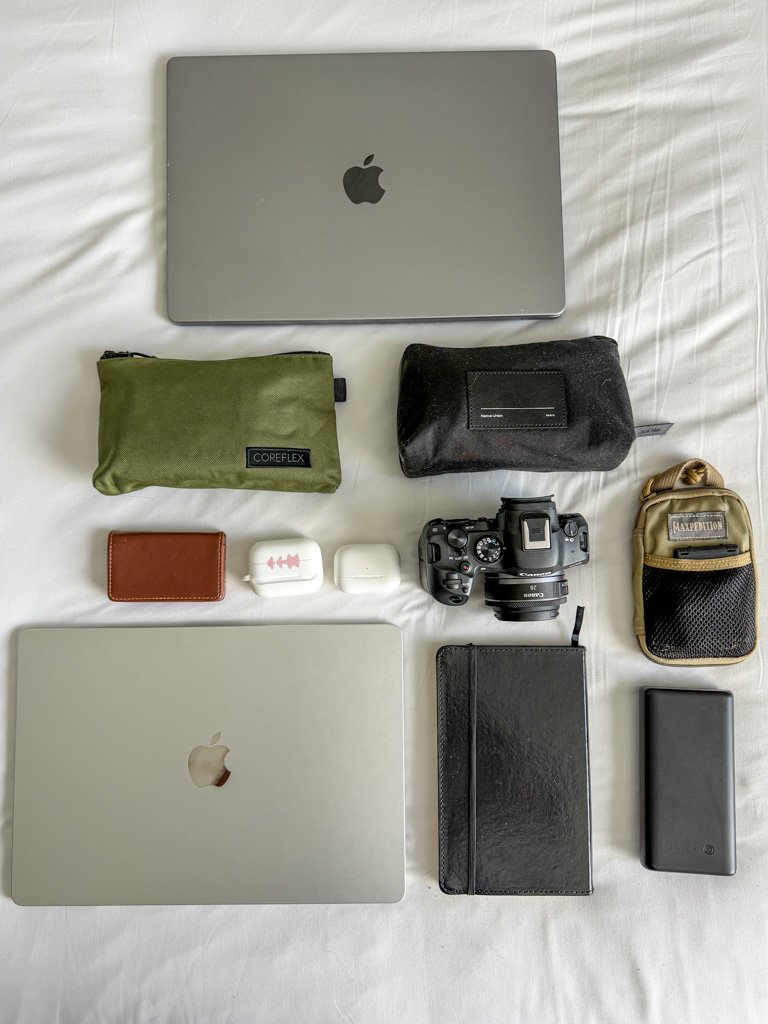
Everything small lives in a pouch, and every pouch has a job: one for writing and reading gear, one for comfort items, one for chargers and batteries. I know which pouch something lives in, so I can find almost anything in seconds, whether I’m at a crowded gate or on the go, without rummaging through the entire bag.
6. Convenience matters
I hate feeling weighed down, and my preferred way of moving around is light on my feet. That’s why I’m always conscious of the weight and bulk of every item that gets to live in my bag. Cluttered, heavy bags are annoying to lug through the airport or stuff under the seat in front of you. And the more clutter in the bag, the greater the chance a TSA agent sees something they can’t identify on the X-ray, which means an extra bag check. Fast and nimble is the motto.
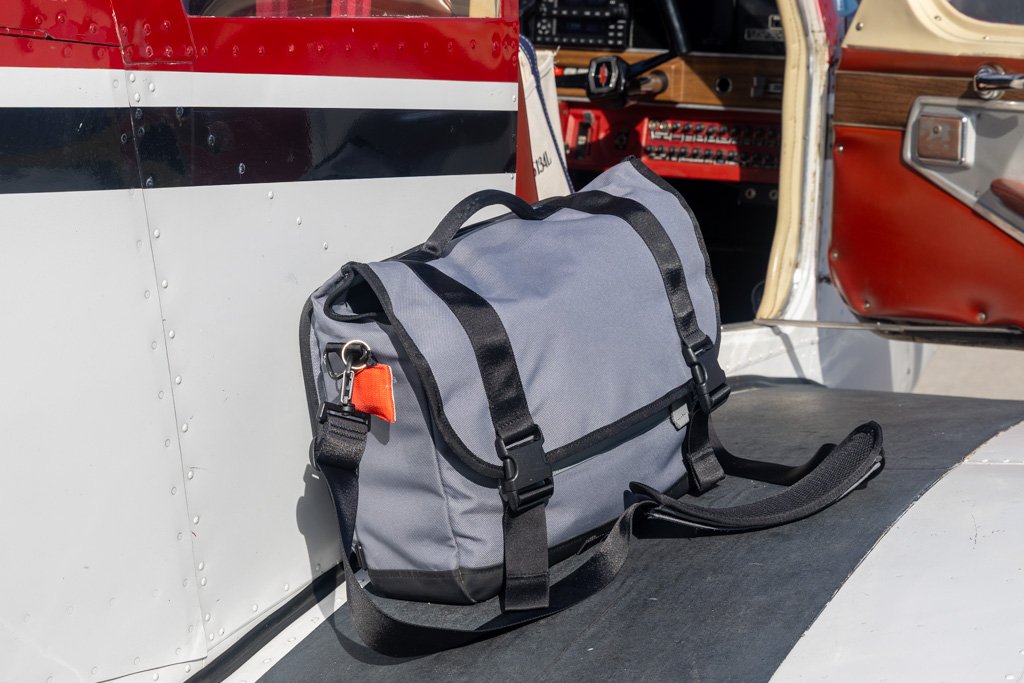
The Bag: Timbuk2 Commute Messenger Bag 2.0
Before I get into why this bag specifically, it needs to be said: after 25 years and many different bags, I can honestly say I love this bag.
I’ve carried backpacks, briefcases and leather bags that looked great but were ultimately uncomfortable or impractical. The Timbuk2 Commute Messenger 2.0 is the one that stuck. I’ve carried it every single day since 2019, across multiple countries, from campgrounds to boardrooms, and it still looks brand new. This bag is built like a tank.
Why a messenger, not a backpack
Speed and versatility, mostly. The flap opens and everything is right there, without taking the bag off. I can grab my notebook in a meeting, my AirPods at the gate or my battery pack from the right seat of a small plane. A backpack means swinging it around, unzipping and digging.
It also passes the every-office test from above. It fits under an airplane seat, it doesn’t look out of place at a picnic table by the lake, and it doesn’t look like I came straight from a campground when I walk into a DC conference. It feels more like a briefcase than a typical bike messenger bag, which is exactly what I want.
The details that sold me
- Luggage pass-through. It slides over a roller bag’s handle, so on trips my shoulder gets a break through the terminal. What I like even better is that it doubles as a quick-access pouch. It’s where I stick my wallet, watch, phone and whatever else is in my pockets when I go through security, without having to open the bag.
- Velcro silencers. You can quiet the flap, which matters more than you’d think in a hushed meeting room.
- Water-resistant bottom and wipeable liner. It gets set down on damp grass by the lake and on airport floors covered in the filth of thousands of feet. It wipes clean quickly and easily.
- Fits under airplane seats. Even loaded with my laptops, the bag fits upright under airline seats and leaves enough room for my feet. That extra bit of legroom makes all the difference when I’m squeezed into a middle seat.
- Lifetime warranty. Timbuk2 will repair defects for the life of the bag, which matters when you buy one bag to carry for years. After 7 years of fairly extensive travel, mine still looks and performs like new, so I can’t speak to their repair service, but it’s nice to know the company stands behind its product.
- Pockets and pouches everywhere. Looking for an easy-to-reach place for headphones and keys? It’s got it. Need to carry two laptops? It’s got it. Water bottle pocket? Yep. Hidden spot for a passport? It has that too. Everything has its own space, without going pouch crazy.
- Room to add things as needed. My everyday office setup takes up surprisingly little space, which makes it even nicer when I need to throw extra things in for the day: aviation headsets when I go flying with our daughter, the full zoom lens on day trips, or a sweater for a cold airplane cabin. This bag is pretty cavernous.
How I organize it: The system is simple. One laptop goes in the padded compartment and the other in the main bag. The Moleskine and the work pouch go in the pockets inside the main section. The comfort and charger pouches, battery pack and camera sit side by side in the main compartment, and the AirPods go in the organizer pockets under the flap. Everything has its own spot, so I know within seconds if something is missing, and I can grab things without fumbling around.
The one I carry: Timbuk2 Commute Messenger Bag 2.0, size Medium, in Gray. It comes in sizes matched to laptop size, so pick the one that fits your laptop rather than going bigger than you need.
One thing I’d change: While I absolutely adore this bag, I generally don’t carry it cross-body. The shoulder pad, while very comfortable, tends to slide down my shoulder quite a bit when I’m racing through an airport. A non-slip feature on the shoulder pad would cure that easily.
The Tech Stack
I used to hate traveling and working from laptops. None of them seemed to last long enough unplugged to be worthwhile, and they never seemed user-friendly enough for serious work on the road.
Over the last few years, though, my office-in-a-bag tech stack has come to handle about 90% of my needs. Whenever I’m not in a meeting, my work happens online, on a laptop or on my phone (which has nauseatingly high weekly screen time figures).
- MacBook Pro: This is my “work-work” laptop. It’s strong and powerful, and it’s what my employer gave me.
- MacBook Air: I resisted the Apple trend for a long time, having worked “grown-up jobs” since the late ’90s, when Microsoft was the gold standard. When I joined my current company, they sent me a MacBook Pro. I was skeptical and there was a bit of a learning curve, but man, I should have switched sooner. I love my MacBook Pro so much that I bought a MacBook Air for personal use. I love its ease of use, great ergonomics and massive battery life. I can go all day without needing an outlet. Its “always on” personality is also great when I just need to pull out the laptop for a second to reply to a message or adjust a spreadsheet.
- AirPods Pro (2x): Aside from the noise cancellation, which makes air travel an almost pleasant experience, I love how well they handle conference calls even with a lot of background noise. Why two pairs? I spend a lot of time on the phone, and there have been days when one set was dead by 1 p.m. The older pair has also been a bit quirky lately, so the second pair is a backup for its inevitable end of life.
- Battery pack, charger and cables: This is the modern version of my BlackBerry lesson: if the work depends on it, carry the power for it yourself. I carry one big battery pack instead of a small one. It holds enough for a few full recharges, so I’m not rationing battery at the end of a long travel day. Add a charger and a couple of short USB-C cables (long ones just tangle), and I’m set. Notice what’s missing most of the time: a watch charger. My Garmin Enduro goes so long between charges that I rarely need to pack one. That’s one less cable in the bag.
- iPhone 17: If the laptop is my desk, the phone is my nerve center. It runs Slack, email and every communication app I use, and it handles Google Meet calls with the AirPods in. It also doubles as a hotspot when there’s no Starlink or trustworthy Wi-Fi. The battery lasts all day, and the screen is readable even in bright sunlight, which I really appreciate when working outside.
The Power Pouch
Everything that plugs into a wall lives in one pouch, a black Native Union W.F.A Tech Organizer. I didn’t buy this one. It came to me as conference swag, and it turned out to be the missing piece that finally tamed my equipment.
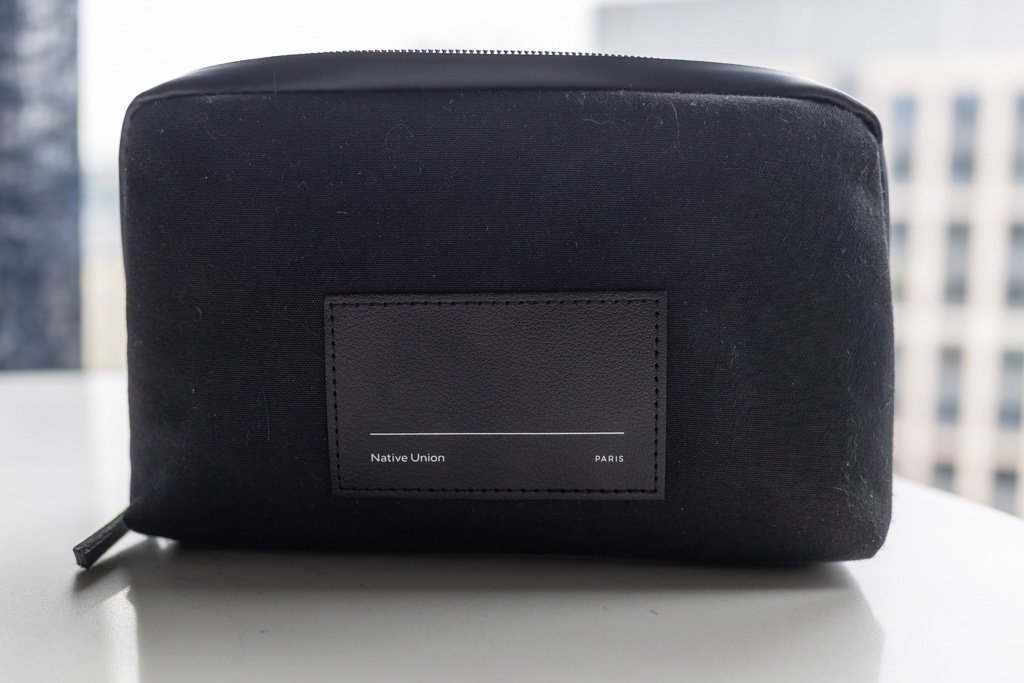
For years I carried a much bigger cable pouch stuffed with a different cord for every device. Now that almost everything runs on USB-C, that pouch was mostly empty space. The Native Union is small and soft, with flexible pockets inside that keep chargers and cables in place instead of balling up into a knot at the bottom of the bag. It’s made from recycled canvas with a water-repellent finish. Here’s what’s inside:
- Belkin 67W 3-port charger. One outlet charges the laptop, phone and AirPods at the same time. With three ports in a tiny package, it replaces several wall warts, and it’s the most useful thing in the pouch.
- Ecomxia lapel microphones. These inexpensive lapel mics come in a pair, and the receiver plugs right into your phone. At around $30 in a compact package, they make recording the occasional video with great audio a breeze.
- Canon charger and a spare Canon battery for the R6. A dead camera battery on the one day the light is perfect is its own kind of doozy.
- Charging cables: Two short USB-C cables, a MacBook cable and a Garmin cable for my watch.
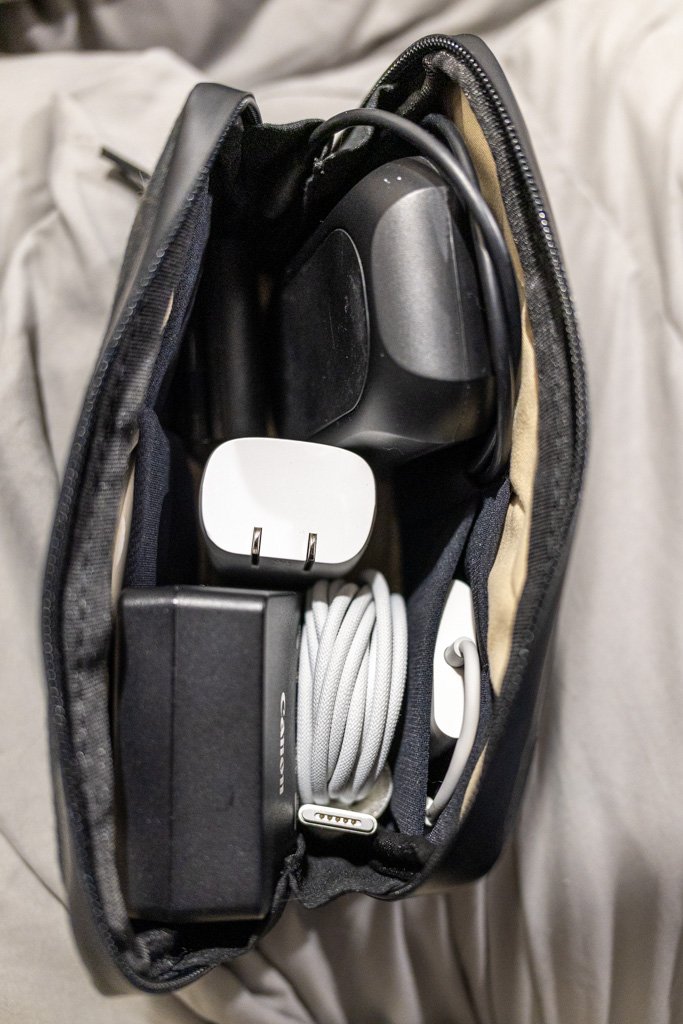
The real benefit is the routine. I learned that one the hard way when I recently left my Apple charger plugged into a hotel wall. Now, when I land, the whole pouch comes out and goes on the dresser. When I leave, everything goes back in the pouch and the pouch goes back in the bag.
The Non-Tech Stack
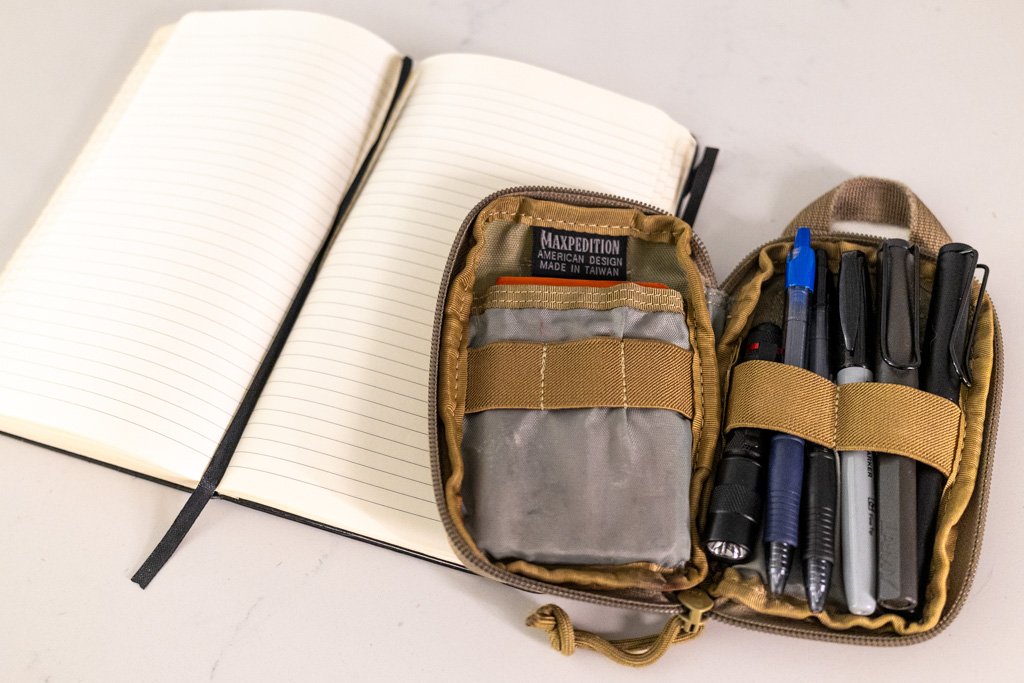
Moleskine Notebook
My Moleskine is the one thing in the bag I’d replace first if I lost it. In a one-on-one meeting, a laptop between you creates distance, while a notebook lets you jot down quick notes without being intrusive. It’s also where I do my best thinking. Strategy, outlines, even the first sketch of this blog post happen on paper, away from notifications. And it never needs to be charged.
The one I carry: Moleskine Classic Notebook, Large (5 x 8.25 in), ruled, hard cover, black.
Maxpedition Micro Organizer
This little organizer is where all my non-tech accessories live. It’s just big enough for pens and the other small items I reach for throughout the day, with several little pockets, elastic loops and slots that keep everything in place.
Why this instead of a soft pencil case? I wanted something rugged enough to pull out of the bag and stick in the back pocket of my jeans, or toss in the truck, without worrying about it. A pencil case lives in a bag. This goes wherever I go.
- Small but mighty. At about 3.5 by 5.5 inches and an inch deep, it slips into the main compartment of the bag or even a jacket pocket.
- Built tough. Water-resistant ballistic nylon and heavy-duty zippers. It has been with me for five years and it’s holding up great.
- Grab and go. The loop handle on the back means I can pull the whole kit out of the bag in one move and set it on a desk, a tray table or a picnic table.
The one I carry: Maxpedition Micro Pocket Organizer.
What’s inside:
Lamy Safari pens (yes, two)
The Lamy Safari fountain pen, loaded with blue ink, is my everyday writer, and the reason is a little embarrassing: I’m left-handed, and with a ballpoint my handwriting turns into chicken scratch. Lefties are usually warned away from fountain pens, but for me it’s the opposite. The nib glides instead of dragging, and my notes are actually readable later. It also makes signing anything feel a bit more special, and blue ink makes it obvious which copy is the original.
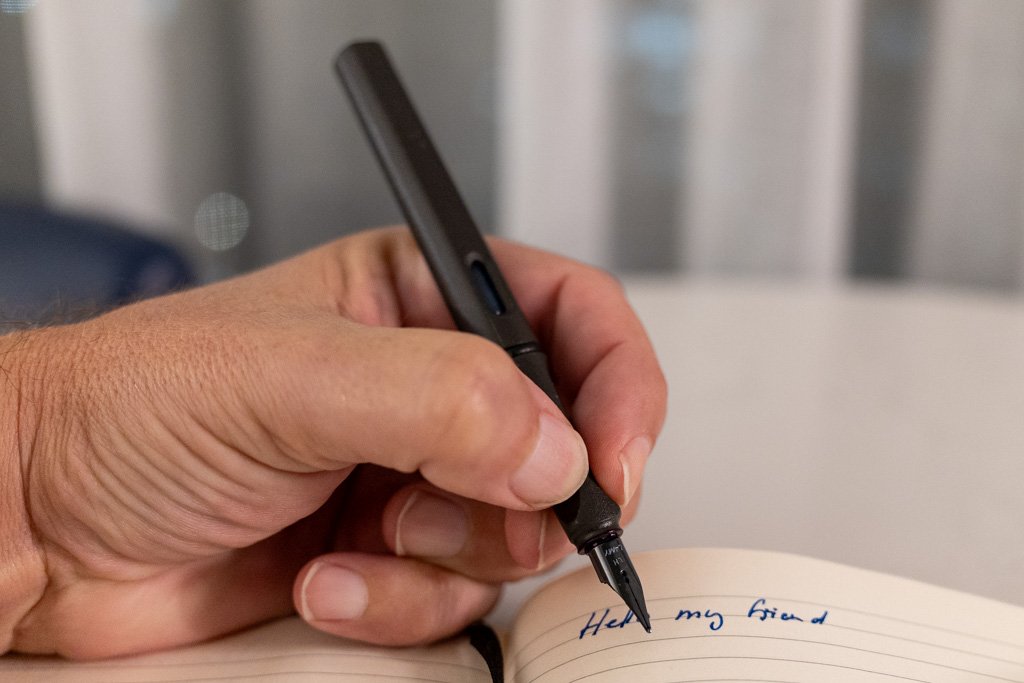
The black Lamy Safari ballpoint is the backup for less intense writing, quick jots and lending to someone who needs a pen. It’s also my flight pen, since cabin pressure changes can make fountain pens leak. Both share the same plastic body and triangular grip, so whichever one I grab feels familiar in my hand, and they’re sturdy enough that I don’t have to worry about them getting banged around in a bag.
Links: Lamy Safari fountain pen · Lamy Safari ballpoint · Lamy T10 blue ink cartridges
Sharpie and cheap pens
These are my just-in-case pens: a couple of cheap ones for the moments I don’t want to risk a Lamy, like lending one to someone anywhere a pen might walk off and never come back. If one gets lost, who cares? The Sharpie handles everything the fountain pen shouldn’t touch.
Tiny notebook
For years I carried a tiny orange notebook in my pouch. As I sat down to write this post, I decided to give it the boot. In theory it’s great: small enough to keep in the pouch when the rest of the office stays behind, and you can write a note and tear out the page. The problem is, half the time I needed to write something down, I forgot it was there.
Folding reading glasses
I’m pushing 50, and at some point the fine print on hotel registration forms started getting smaller, the restaurants got darker, and my arms somehow got too short. I resisted for a while, then gave in. Folding readers are my go-to. I can keep them in the pouch or tuck them in my pants pocket when I’m not bringing a bag. They fold up into their own case, about the size of a credit card (just a bit thicker).
The Comfort Pouch: The Stuff Nobody Talks About
Everything above is about making work life easier. The comfort pouch is what makes life on the road more enjoyable.
The pouch itself is nothing fancy: a simple Coreflex zipper pouch. Amazon currently sells a six-pack in assorted sizes for less than $20, which means you’ll have spares for cables, chargers and whatever else needs corralling. What matters is what goes inside. The contents are carefully curated to get me through life’s little hiccups on the go, and almost every item earned its spot after one doozy or another.
- Blister bandages. I mentioned these earlier, and they’re first in the pouch for a reason. Nothing turns a great roadshow day into a miserable one quite like a blister, especially when the day involves new shoes and a lot of walking between meetings. A blister bandage takes up almost no space and can save the rest of the trip.
- “Regular” bandages. Paper cuts and other small boo-boos happen, usually at the worst possible moment. A bandage is a lot easier to explain than blood on a stark white shirt five minutes before a meeting.
- An extra pair of contact lenses. Anyone who has ever blinked out a lens while traveling knows how unpleasant it is to go through the rest of the day half blind. A spare pair weighs nothing and turns a crisis into a two-minute fix in the restroom.
- Rohto eye drops. Along the same lines: itchy, dry eyes are miserable, and between recycled cabin air, dry hotel rooms and long days staring at a screen, mine get plenty of abuse. A few drops and I’m back in business.
- Basic meds. Carry whatever you personally need. I keep a few pain relievers and something for a runny nose, because a headache or a cold always strikes at the most inopportune moment, and hunting for a pharmacy in an unfamiliar city when you already feel like crap is no fun.
- Toilet seat covers. Yes, really. Using a public restroom is bad enough without having to engineer a seat cover out of shreds of toilet paper. A small pack takes up about as much room as a few business cards and comes in handy when nature calls before you can get home or back to the hotel.
- A small tube of sunscreen. An office by the lake means sun, and so does a Florida tarmac or a long walk between meetings in DC. A travel-size tube covers me without taking up much space, and it beats showing up to a meeting with a sunburned nose. I’ve never actually needed it for myself, but a few months ago an investor conference thought it was a good idea to put the one-on-one tables outside in the blistering Southern California sun. A friend who is the CEO of a tech company had already turned lobster pink by the time I found him at his table. He was eternally grateful for some SPF 30 on his bald head.
- Stain remover wipes. Tomato sauce on a white shirt right before a meeting is a rite of passage for every business traveler. A stain remover wipe won’t work miracles, but it can turn a disaster into something nobody notices across the room.
- Disinfectant wipes. Airplane tray tables, armrests, rental car steering wheels, hotel remotes. I don’t need to know what was on them before me. A quick wipe and I can stop thinking about it.
- Electrolyte powder. Long flights, hot Florida days and conferences with too few water stops all add up to feeling drained by mid-afternoon. A packet mixed into a bottle of water perks me right back up, and it’s a lot lighter than carrying drinks around.
The Camera: Canon R6 + RF28mm F2.8 STM Prime Lens
This one has absolutely nothing to do with my job, but I still love bringing it along: my Canon R6 mirrorless camera. It’s not really an ideal camera to tuck into a messenger bag. With its standard kit lens, it would be the heaviest, bulkiest and most fragile item in my work bag.
Ideally, I’d add a smaller compact camera here, but since I already own the R6 and a few lenses, I just can’t justify buying another camera. The other alternative is the iPhone camera, and trust me, I use it A LOT, but it’s just not the same as shooting with a “real” camera.
Over my travels, I found that I photographed most things at a relatively wide angle or fairly close up. That’s when I found the Canon RF28mm F2.8 STM. Its small size and light weight turn the R6 from a monster into a relatively compact camera, without sacrificing quality.
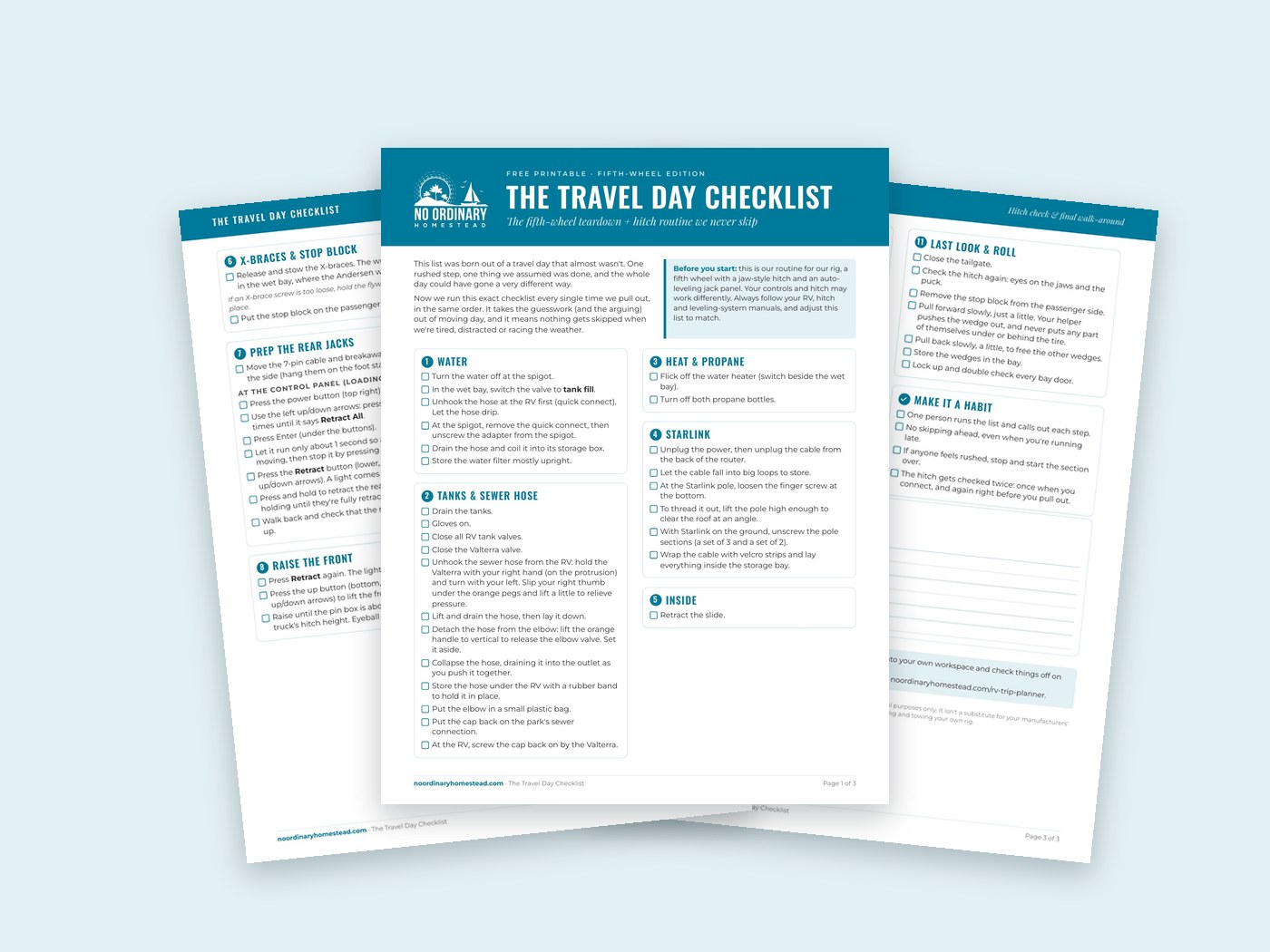
Free printable: The Travel Day Checklist
The same light-on-your-feet thinking, applied to RV travel days: our step-by-step list for hitching up, rolling out and setting up again. Grab it free:
What I Deliberately Leave Behind
Over the years, plenty of things have lived in my bag for a little while before getting ditched. A semi-light everyday office bag isn’t a list you write once. It’s a process of noticing what you actually reach for and being honest about what you don’t.
In fact, writing this post made me take a hard look at my own kit, and a few things went while I was writing it. Some I truly never use, like the tiny notebook. Others fall into a category I think of as “nice to have the one time”: things like a flashlight, where not having it that one time would be mildly annoying but never a real problem. My phone has a flashlight, and my Garmin watch has a (surprisingly strong) flashlight. Why carry yet another one? If an item only earns its spot once a year, and missing it wouldn’t hurt, it doesn’t get to come along every day.
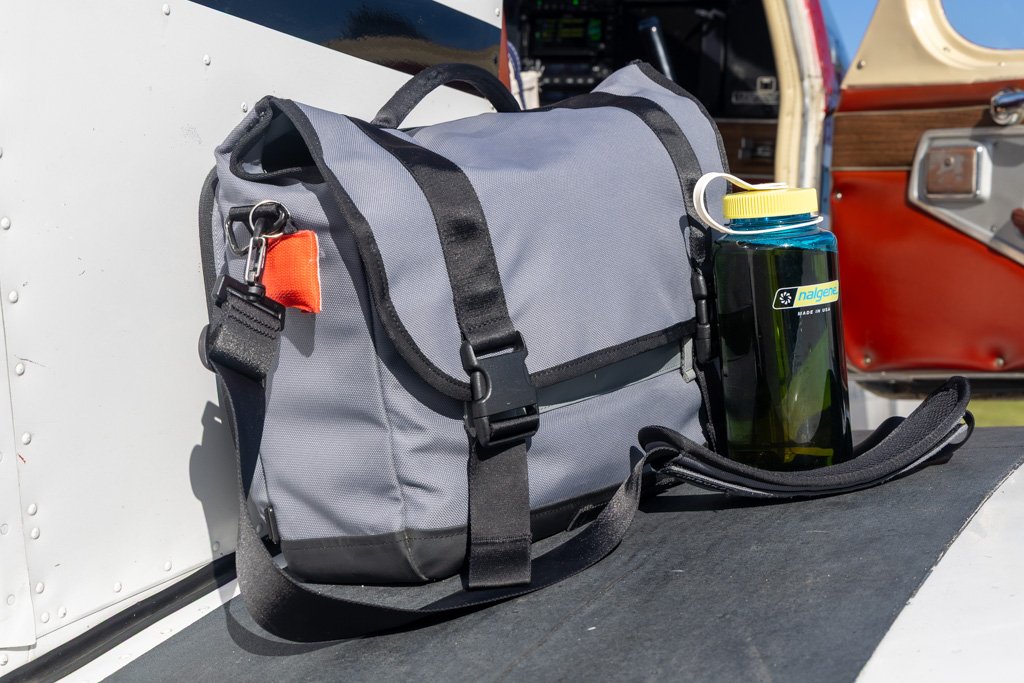
The water bottle
For a very short time, I carried an empty water bottle on commercial flights. The plan was to fill it after security and stay hydrated like a responsible adult. I never filled it once while traveling. It came in handy a few times at the hotel, but not nearly enough to justify the space it took up in the bag.
There is one exception. When the bag comes along on small-plane flights or car trips, where there’s no airport kiosk or hotel lobby to fall back on, I tuck a Nalgene inside.
The external mouse, USB hub and other office supplies
I had a wireless mouse in the bag for a few months and never used it once. The USB hub met the same fate. The trackpad on the MacBook Air is so good that I don’t even miss a mouse, and between my cables and the laptop’s ports, I never ran into a situation the hub would have solved. Both went back in a drawer, and I haven’t thought about them since.
Likewise, I stay away from travel gizmos and gadgets as much as possible. No laptop stands, no second screen to bolt on.
The full-size zoom lens
This one hurt a little. I have a camera insert for the Timbuk2 that holds the Canon R6 with the big zoom lens attached, and I’ve traveled with it that way. But when I looked at my photos, I realized I rarely zoomed in much at all. And as I mentioned earlier, the R6 with that lens is a behemoth. It took over the bag and made everything else harder to reach. Swapping it for the 28mm prime gave me back most of my space, and I haven’t missed the zoom on a single trip.
The Apple charger
This one got cut while I was writing this post. When I listed what’s in the power pouch, I realized I was carrying two chargers that do the same job. The Belkin 67W has more than enough power for the MacBook Air and charges my phone and AirPods at the same time. The Apple charger was just a backup taking up space, so it stays home now.

So that’s the bag. It’s been to the lake, the right seat of a Piper and conference floors, sometimes all in the same week, and it hasn’t let me down yet.
If you want more from the road, check out our honest review of Starlink for RV use (my remote office’s internet) and The Travel-Free Week That Wasn’t.
I’m curious what’s in your bag. What’s the one thing you never travel without, and what have you been hauling around for years without using once? Let me know in the comments. I’m always happy to borrow a good idea.