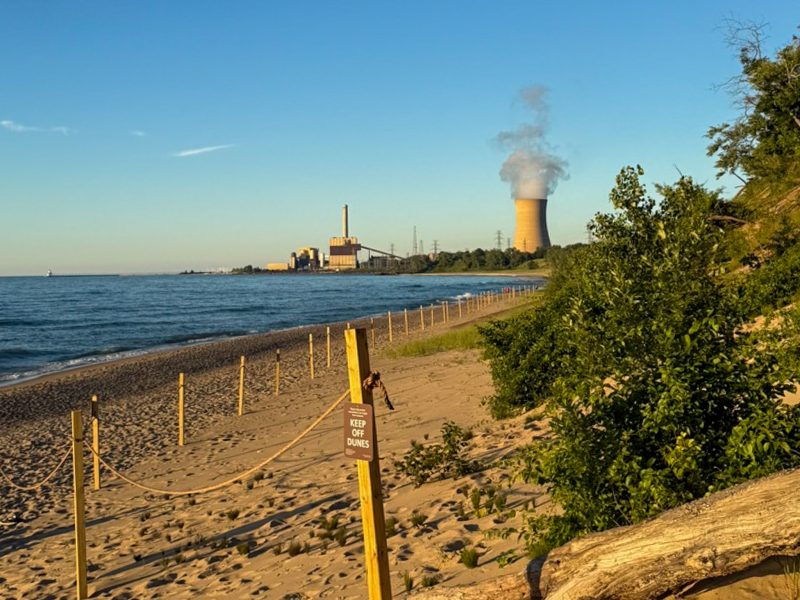
It was our first chance to walk on a beach bordering the Great Lakes or perhaps dare to dip our toes into the chilly water. We were excited and energized as we broke through the trees and saw the shoreline down below. But it couldn’t prepare us for the jarring sight of industry as we soaked up the beautiful lake views. And the industrial feel of the surrounding area, as we explored Michigan City, definitely elicited mixed reviews from our family.
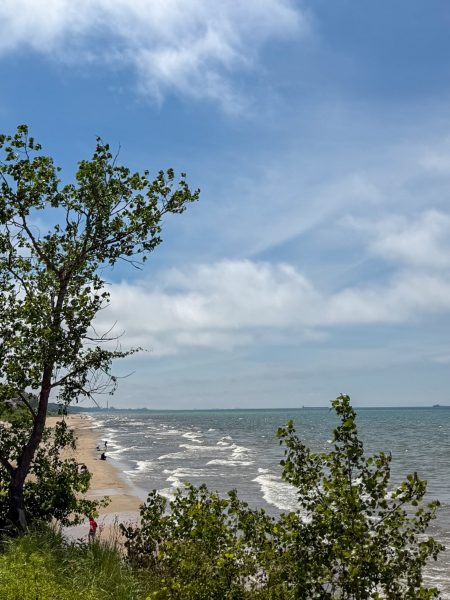
In many cases, this beach is beautiful and sandy; exactly what you expect to find at the end of one of the largest freshwater lakes on the planet. But it’s also bordered by an unusual marshy bog and some of the most industrial (i.e. not so beautiful) areas I’ve ever seen.
The Dune That Disappeared
Indiana Dunes National Park and the surrounding area have a rich history in manufacturing and industry, and when you visit, you’ll notice the contrasts between nature and commerce that began to emerge in the late 19th century. From the huge steel mills of Gary and the Ports of Indiana-Burns Harbor to the power plant in Michigan City, the national park is buffered by factories that blossomed due to the practical location on the lakeshore and access to numerous transportation arteries.
If you’ve ever seen a vintage blue Ball Glass canning jar in Grandma’s kitchen, Pittsburg Plate Glass sheets, or blue glass Hemingray insulators on an old phone pole, you’ve seen sand from this area put to work. The Hoosier Slide, once a 200-foot dune standing in Michigan City and one of the largest dunes in existence, was the source of the sand used. In the late 19th century, it was first a major tourist attraction for the area, both because of the view from the top and because people loved sliding down the dune’s face.
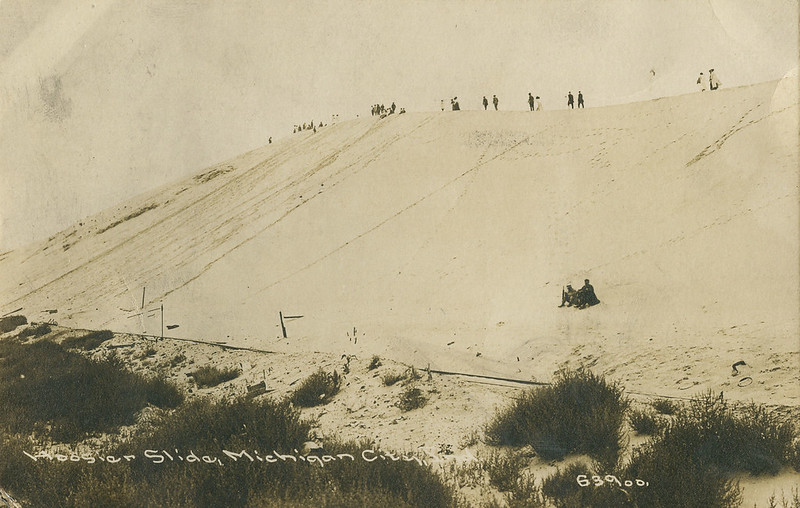
Postmark: December 4, 1914, Michigan City, Indiana. Postcard. C. R. Childs (#63900)
Then, once it was discovered that the iron-rich sand would make a light-blue colored glass, mining began. Between 1890 and 1920, about 13.5 million tons of sand were moved by rail, and eventually the “Slide” was completely flattened. So many tons were hauled off to Muncie, IN, that the Ball factory was able to continue manufacturing their infamous blue jars until 1937.
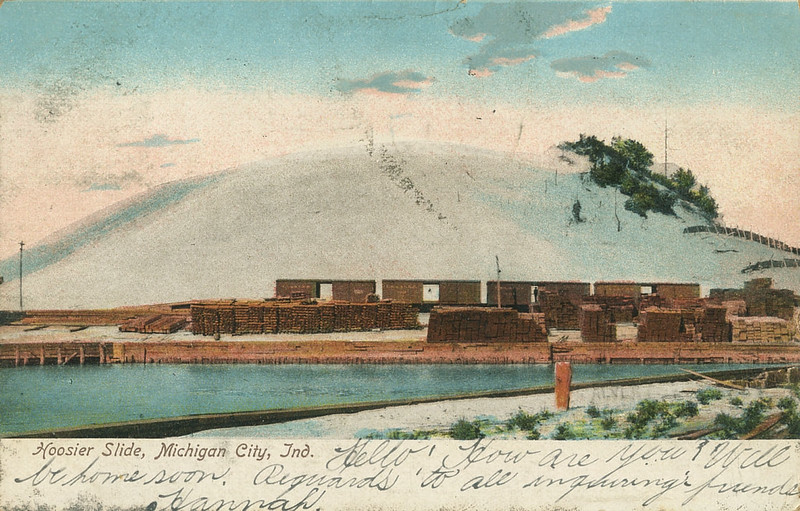
Hoosier Slide, 1907 – Michigan City, Indiana
Northern Indiana Public Service Co. (NIPSCO) bought the empty dune site shortly after it was flattened, and a large coal- and natural gas-fired power plant called the Michigan City Generating Station was built there. The station includes a hyperboloid cooling tower situated just a few yards from nearby houses, resembling a nuclear power plant, but have no fear, because there are no nuclear power sites in Indiana. The power plant is currently planned to be shut down in 2028 and then demolished, which would certainly change the look of the entire area.
.
Preserving What Was Left
As far back as 1899, there was a desire to establish the Indiana Dunes as a recreation area and to protect it from industrial sprawl. The work of botanist Henry Cowles at the University of Chicago was the first to champion the lakeshore. He published an article about the Dunes in 1899, which gained attention and eventually established him as “the father of plant ecology” in North America. It drew significant attention to the dunes’ intricate ecosystems, and organizations were formed to promote their protection, but large industries such as steel mills and power plants were already establishing themselves in the area by 1916.
In late 1916, shortly after the National Park Service was established, a push was made to create “Sand Dunes National Park,” and it met no opposition at all… until the United States entered the First World War. National priorities changed, and the country ultimately moved from war to a depression, leaving funding obsolete and hopes of saving the dunes shelved.
In 1926, after a ten-year petition to preserve the dunes, the Indiana Dunes State Park was opened to the public. But the park’s size and scope left much of the ecosystem unprotected, so the battle for conservation continued. In 1949, Dorothy Buell became involved with the Indiana Dunes Preservation Council, and her efforts later led to the formation of the Save the Dunes Council in 1952.
The battle escalated when federal funding for economic development of the “Port of Indiana” was obtained, with the hope of linking the Great Lakes to the Atlantic via the St. Lawrence Seaway. The Save the Dunes Council rallied and launched a nationwide campaign to purchase the land they were desperate to protect – and succeeded in acquiring 56 acres in Porter County, including the Cowles Tamarack Bog.
The council gained the assistance and support of Senator Paul Douglas, who introduced his first bill to establish Indiana Dunes as a National Park Service area, but this would not give them even a taste of victory for years to come. In fact, it was just the beginning of one of the most prolonged legislative battles in U.S. history to protect a particular landscape.
By 1962, most of the dunes had been sold off to private industrial companies, and they had the authority to clear what they owned. So, while there was interest in protecting the dunes, the corporations pushed ahead and continued to develop. Bethlehem Steel contracted 2.5 million cubic yards of sand to be hauled away from the Central Dunes to Northwestern University in Evanston, Illinois. Ironically, the dunes had been used in the past for educational excursions by university students. News of the destruction was called “an infamous Pearl Harbor for conservationists everywhere.”
Ultimately, the heart and soul of the ecosystem that everyone had fought to protect had been destroyed, along with the biodiversity and the moving-dunes landscape on which the initial research was conducted. A small compromise was conveyed when the Kennedy Compromise, proposed in 1963 and signed into law by President Johnson on Nov 5, 1966, established both the Port of Indiana and the National Lakeshore.” (NPS)
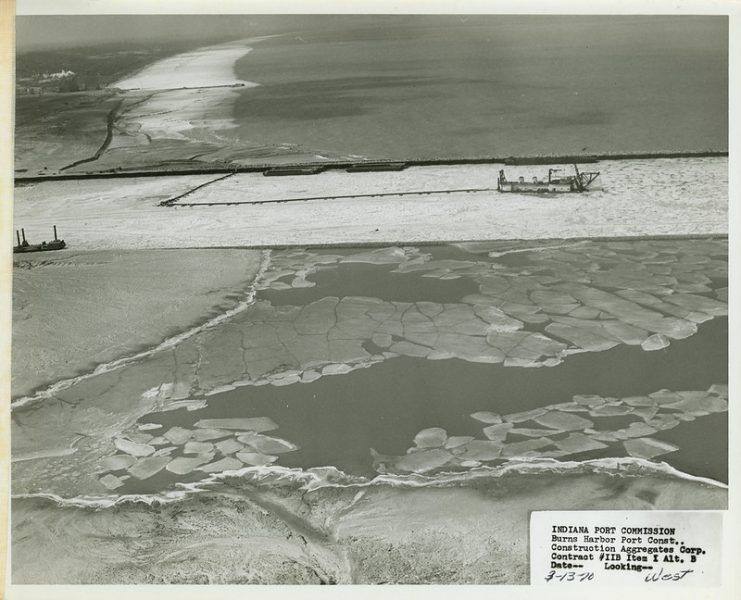
Port of Indiana-Burns Harbor Construction, March 13, 1970 – Burns Harbor, Indiana
While Senator Douglas and Save the Dunes were disappointed because the original land they’d fought to protect was gone, they preferred to secure something rather than risk having nothing. Four subsequent bills have been passed to expand the park from its original 8,330 acres of land and water to more than 15,000 acres, but the park has not yet acquired everything.
The lakeshore became America’s 61st National Park on February 15, 2019, with over 1400 plant species (making it eighth among all National Park System units.
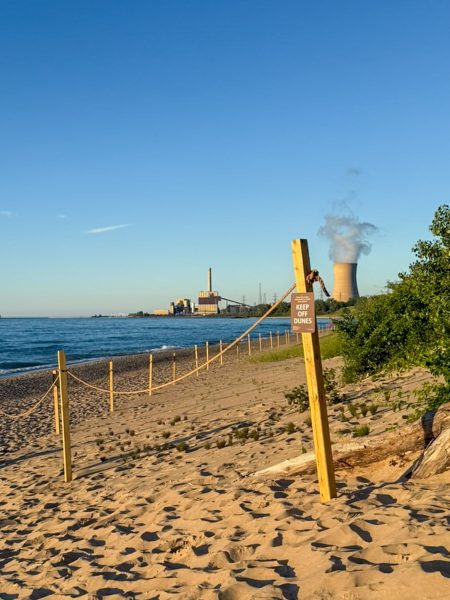
What to Expect at Indiana Dunes National Park
Mount Baldy is a bare, moving dune and a lasting reminder of what makes this location and its resources unique. For preservation reasons, you’re not allowed to walk on it (except for a few special occasions with a park ranger), but you may notice that the sand is creeping into the street by the parking lot, always on the go due to the local winds.
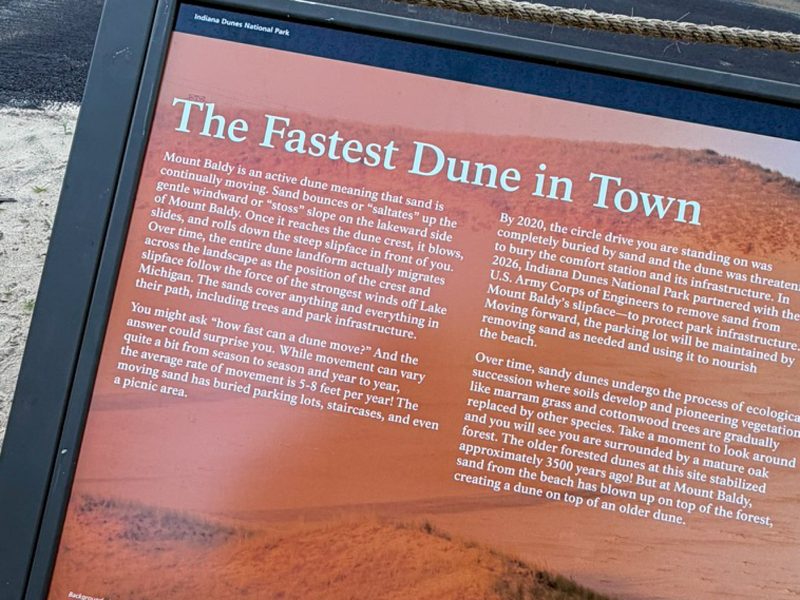
As you arrive at the parking lot at Indiana Dunes, you’re greeted by Mount Baldy and the “Keep off the Dunes” signs. Walk away from the shoreline and parking lot into the forest and up to the top of the unprotected part of the dune where you’ll be rewarded with a beautiful view of Lake Michigan.
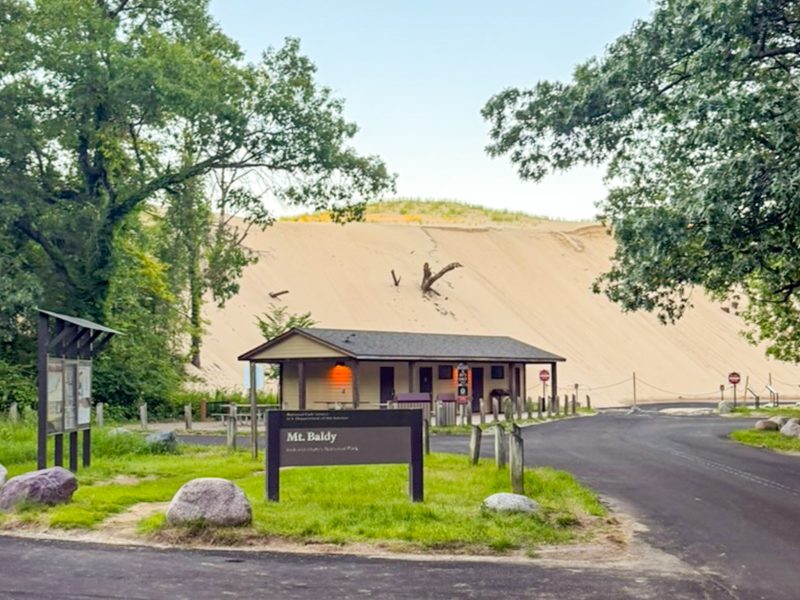
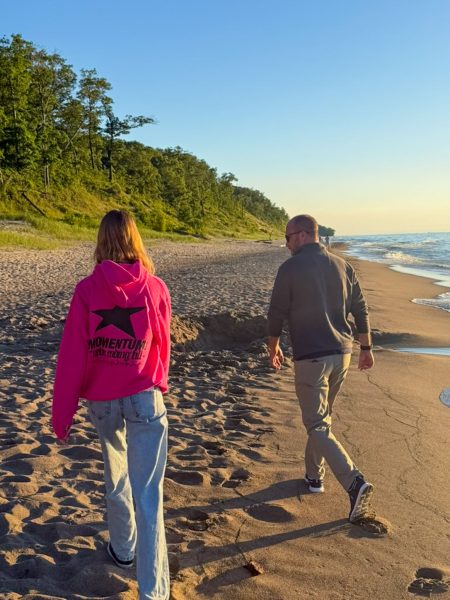
We visited during golden hour, and the lighting was beautiful.
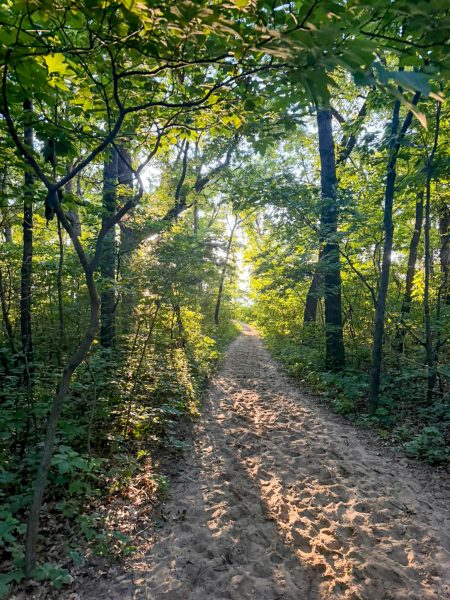
The 15 miles of shoreline are what you’d expect, with crashing waves and driftwood logs. But when you look beyond to the west you’ll see the steel mills toward Gary and the cooling tower to the east.
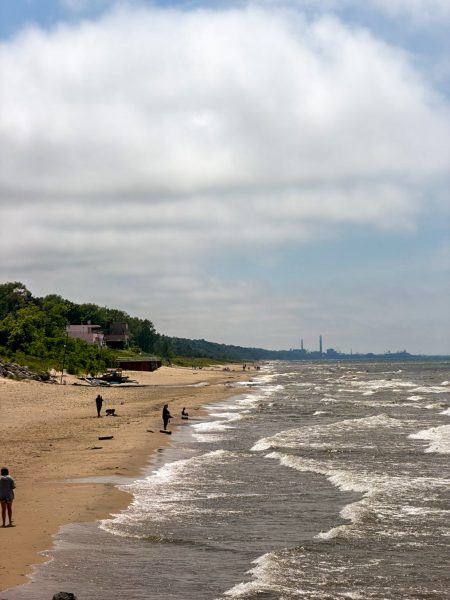
A Side Trip to Beverly Shores
If you stop at the dunes, be sure to also take a short trip over to the five “Homes of Tomorrow” from Chicago’s 1933 Century of Progress World’s Fair, which are now part of the National Park. Built well ahead of their time, these homes were featured at the World Fair and later moved by barge as a basis for a community of the future.
The homes are currently in various states of repair, and the pink Florida Tropical House is among the most striking and well-maintained. It also happened to be available for a long-term lease at $2.5 million on the Indiana Landmarks website… plus repairs and upkeep of the home, of course.
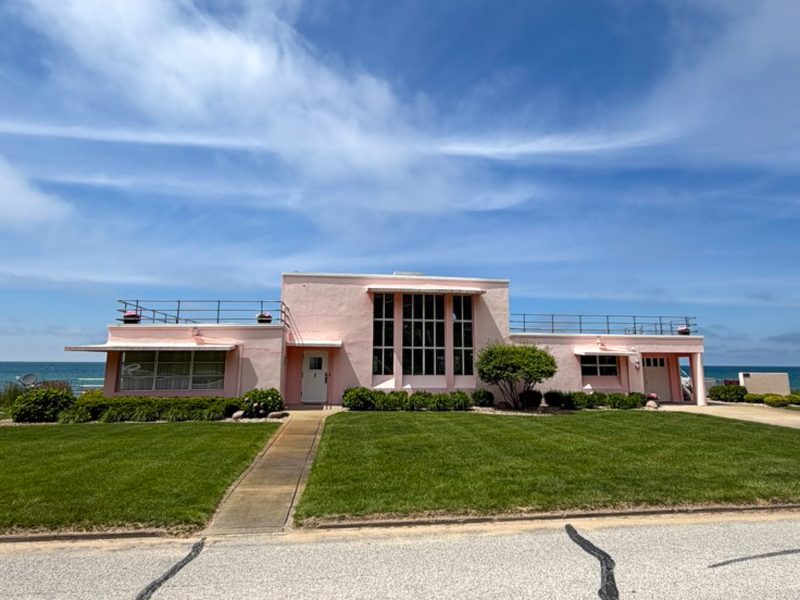
There is also an interesting 12-sided glass house called the House of Tomorrow, which is under restoration.
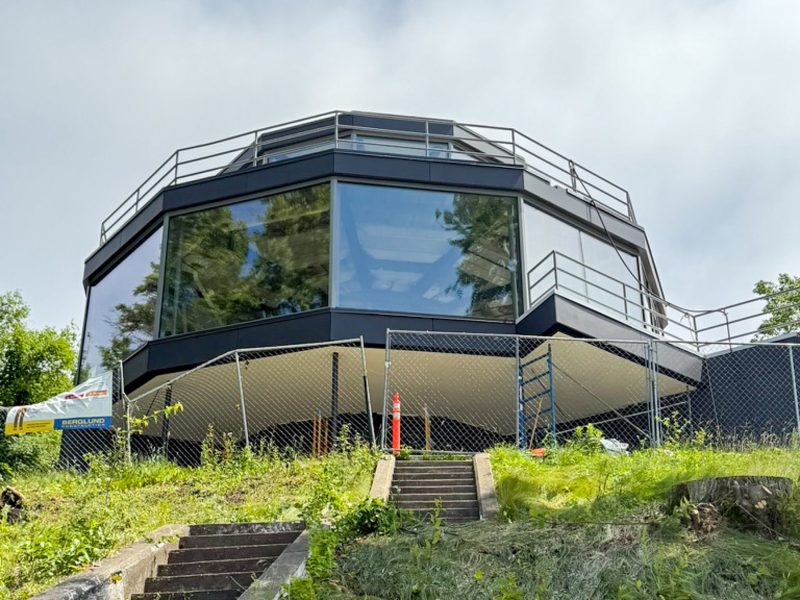
If you happen to be in the area on the last week of September, you can also join the annual tour. Be sure to grab tickets on nps.gov in early August when they go on sale. The website says they sell out within an hour!
On a clear day, you might even catch a glimpse of Chicago across the lake.
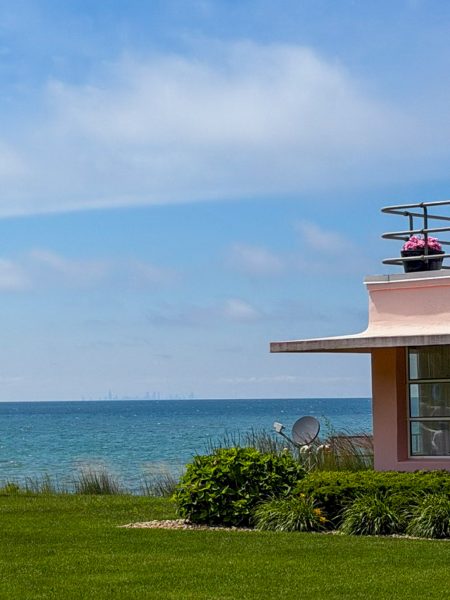
Many other beautiful multi-million-dollar homes are in the area as well, so take a drive down the shore or up some of the steep streets heading toward Michigan City. There are also additional places to pull off for a view or to walk down to the water, even with rockier access.
Things to Know if You Visit
- Where to Park: When you visit the national park, there is a small parking lot at Mount Baldy just off US-12. Be sure to watch for the signs, because when we were there, Google Maps wasn’t aware of the new approach to this area.
- Best Time: During the summer months, it gets into the 80s with lows in the upper 60s. The winter months will be cold and blustery. We enjoyed a visit about an hour before sunset, with a beautiful golden-hour approach.
- What to Bring: You might not expect it, but people visit the beaches in this area during the summer just like you would any other beach. So, if you want to bring chairs, towels, or even a picnic, you will not be the first one. We saw families with beach toys as well just hanging out for a while.
- Mt Baldy Summit Hikes: On the first Friday of the month, you can join the Mount Baldy Open House and Sunset on the Beach events which allow you access to the normally restricted summit of Mount Baldy. https://www.nps.gov/indu/planyourvisit/programs-events.htm
- Visiting via RV: Michigan City Campground was a good RV base nearby with a mix of residents and visitors. But if you’re staying for a moment, watch out for their buddy sites near the office, which make you face your neighbors.
- Work Travel from Chicago: If you need to be near a major airport, O’Hare is about a 1.5-hour drive, or there’s a commuter train called the South Shore Line that you can take instead, which takes about the same length of time.
Final Thoughts
Although we lived in Indiana for about 5 years, we never made it as far north as the Great Lakes or Indiana Dunes National Park. During our “Oshkosh or Bust” summer tour, we finally put it on our list and stayed in Michigan City during late June 2026. So, as part of our mission to visit all the National Parks in America, #9 on the list was Indiana Dunes National Park in Porter, IN.
While we thought this was an interesting urban national park, it won’t be at the top of our favorites list for multiple reasons. The park is kind of a non-event when you visit, with no formal entrance. Because it’s very intermingled with civilization, it’s just a very unusual park experience that makes it feel like you’re just stopping at a few roadside attractions. I did enjoy learning more about the area’s history and diverse ecology, as well as exploring Beverly Shores. And I hear that it’s amazing for birding.
We weren’t impressed by Michigan City or the urban sprawl surrounding the park in general. We stayed here for a week since we wanted to be close to Chicago for work, and it has most of the conveniences for restocking, like grocery stores, sporting goods stores, and so forth. But we probably wouldn’t do that again. If we need to stop here on our way north, we’d only stay a night or two as we pass through. It’s practical since you’ve got access to both Illinois and Michigan from Indiana, but the numerous cannabis billboards encouraging folks to visit Michigan and the winding concrete highways everywhere get to be a little overstimulating.
Have you been to Indiana Dunes National Park or Michigan City? If so, what did you think? If not, do you look forward to visiting?
Have you ever visited this national park? What did you like or dislike about it? If you haven’t been yet, would you like to see it? We’d love to hear your thoughts in the comments below.