There’s a moment in every big downsize when you’re standing in a room you’ve lived in for years, holding something you haven’t touched since you unpacked it, and you realize the decision isn’t really about the thing. It’s about who you think you’re going to be next.
That was us in the fall of 2025. We’d decided to give up our rental house in The Woodlands, Texas, move into our fifth wheel full-time in December, and spend the next stretch of our lives on the road. That meant every single thing we owned needed an answer: does it come with us, does it wait for us, does it pay us, or does it go?
If you’re thinking about downsizing to full-time RV life, or you’re just staring at a house full of stuff and wondering how to start your next chapter, here’s how we did it: the rules we used, what we’d do again, and where we let ourselves off the hook.
The short version: our four piles
Every item in the house went into one of four buckets:
- Keep: it comes in the RV, and it has to earn its space.
- Store: it goes into climate-controlled storage for our next home base.
- Sell: it’s worth enough money to be worth the hassle.
- Let go: it gets given away, donated or (sometimes) tossed.
Simple on paper. The trick was the questions we asked to decide which pile something landed in.
We’d had some practice (and that helped a lot)
This wasn’t our first big purge. Stefan and I met in college and moved our lives overseas right after graduation. Our living spaces kept getting bigger, and after a few years in Germany we fell in love with an antique farmhouse full of someone else’s stuff.
That was our first experience decluttering a collector’s house. It was fun at times, but often overwhelming. We didn’t really know what we were doing or what we were getting ourselves into. We just knew we needed to clear out spaces in a hurry, and we ended up on the dumpster company’s Christmas card list for being such great customers.


After nearly a decade, it was time to move on to our next home, which meant clearing out what remained in the farmhouse attic and barn. It was no small task, but we knew no one else would be crazy enough to buy a home full of antiques and random junk.
Those items had little value at the time, so we gave many things away on Freecycle… and found out later we probably could have sold them for thousands if we’d shipped all the Singer sewing machines and horse-drawn sleighs to the U.S. But who has the time and money for all that?
You might say we’ve become experts at moving. Stefan and I have lived in 11 “homes” over the years, from Europe to the U.S., including the RV. And although we’ve told ourselves a few times that we’d finally settle down, it’s just not in our DNA.
When we moved to Berlin years ago, and later across the ocean to Florida, we shed a lot of things we didn’t need. Not long before this move into the RV, we’d packed up our life in Indiana and moved across the country to Texas. Paying to move stuff we weren’t using or in love with never made sense, especially when you’re paying by the pound.
So by the time we were getting ready to go full-time, we weren’t starting with 25 years of untouched closets. We’d already pared down a lot. If you’re starting from a fuller house, give yourself more time than you think you need. Seriously.
We gave ourselves about 5 months to declutter, sort and pack up everything in our 3,800 sq ft house in Texas. I took the lead on that mission while Stefan worked a full-time job and traveled for work. We decluttered for the first month and started packing nonessentials.
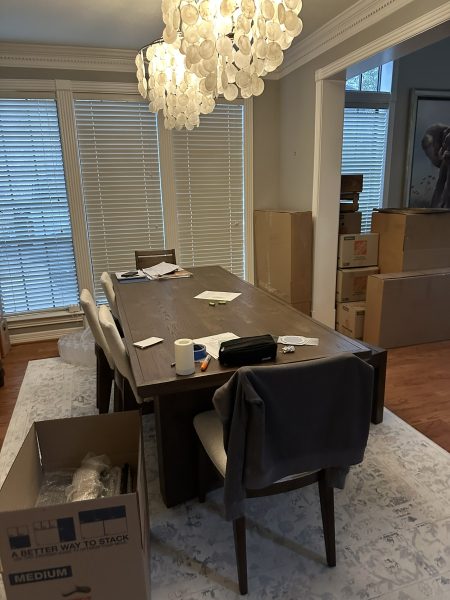
We packed everything ourselves. By now we know how to do it well, and we haven’t had great experiences with other people packing our stuff. So we started early and lived with fewer items on the shelves and tabletops around us. We kept the boxes upstairs for the first few months and then started filling up the unused rooms in the house.
We packed the really funky and fancy items, like art and the glass tops from our office desks, in the final weeks. Then, in our last week in the house, we moved everything that was coming with us into the RV. We also planned a few overlap days with the RV parked at a nearby RV park while we finished moving out and cleaning the house, which made the transition so much easier. That’s something we learned when we sold our house in Indiana a few years ago.
The one question we asked about everything
Years ago, when I was teaching decluttering, I’d tell people to ask: “If we were moving, would I pay someone to move this for me?”
This time we really were moving, and the question got sharper: “Is this worth the space, the weight or the storage fee?”
In an RV, every item costs you space and weight. In a storage unit, every box costs you rent, month after month. Once you think of your stuff that way, a lot of decisions make themselves.
Pile 1: What we kept (in the RV)
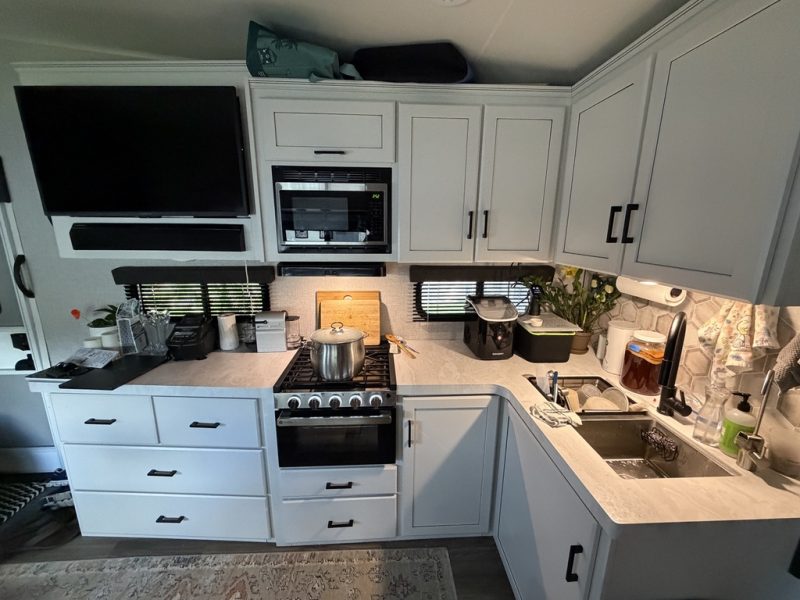
Our rig is a 2024 Jayco Eagle fifth wheel, and it holds three people, a Great Dane, and our cats. There’s no room for “just in case.”
Here’s what earned a spot:
- Things we use every week. If we reached for it weekly in the house, it was a contender.
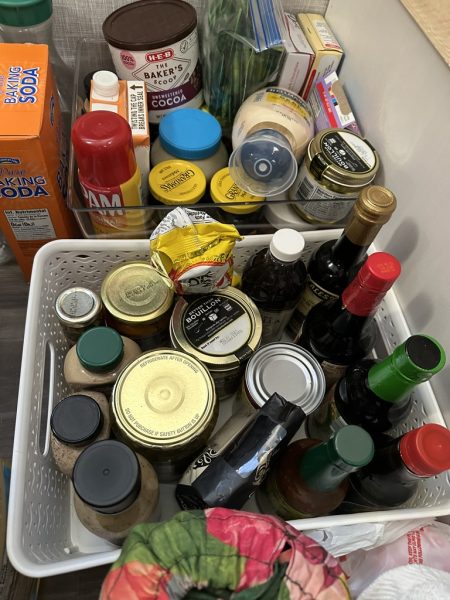
- Things that do more than one job. Our Ninja air fryer, our Nespresso Pixie and a good handheld frother cover a lot of ground in a small kitchen. We use our sous vide at least once a week, and we brought plenty of our fancy cooking items, as long as they fit in a tote.
- Work gear. We both work from the road, so laptops, chargers and the gear that keeps us connected weren’t up for debate. Neither was a healthy amount of photography gear.
- A few things that make it feel like home. Not a lot, but enough: real plants, glasses and ceramic plates, rugs, the espresso machine and a few tweaks along the way that made us love our RV even more. (I wrote more about that in 7 Ways We Make Our RV Feel More Like Home.)
- The pets’ stuff. Claire’s bed alone takes up real estate, and we don’t regret it. Our pets are part of the family, so space for their bowls and beds was never optional.
One thing we wish we had more time to use right now: our paddleboards. We love them, but we tend to play Goldilocks about getting them out, claiming it’s too hot, too windy, or we’re just too busy. Maybe we’re still too new to them to feel really comfortable, but we think they’ll get more use once we’re not working such long hours.
What we’d rather have with us instead? Our Ooni pizza oven (it’s in storage in Texas) and a small folding table. There’s always something to tweak, right?
Our rule: if we were on the fence about something for the RV, it went to storage, not in the rig. You can always grab it the next time you’re near your unit, but you can’t get the space back once it’s packed full. Overall, we’ve found we need far less than we thought, including clothes for work and play.
Pile 2: What we stored (and why we chose two units)
This is the pile people ask about most, and the one I’d tell you to think hardest about.
We rented two 10×20 climate-controlled units in Texas. Climate control wasn’t optional for us. Texas heat and humidity are rough on furniture, photos, paper and anything with electronics in it.
We weren’t new to these units, either. When we first moved from Indiana to Texas, our stuff went into storage at the same place. It’s close to my dad, so he was able to lend a hand when our movers delivered everything that first time. Having family nearby who can check on things or meet a delivery is worth a lot when you’re living hundreds of miles away.
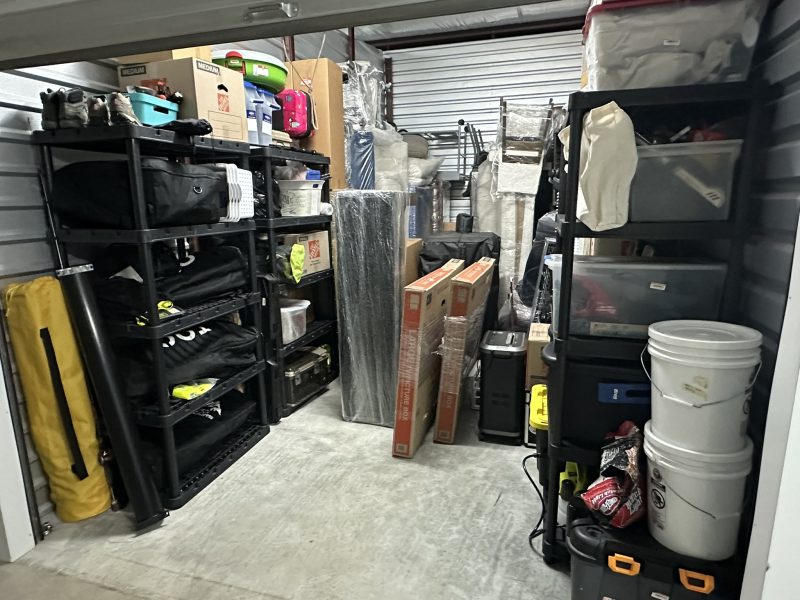
What earned a spot in storage:
- Things that would be expensive or hard to replace when we settle into a home base again, like good furniture. Right before we decided to go full-time, we’d bought a beautiful sofa set and dining room set. We enjoyed them for about a year, then moved them into storage.
- Things that can’t be replaced at all: photos, family pieces, our daughter’s keepsakes and important papers.
- Things we know we’ll want in the next chapter. With empty nesting on the horizon and a Florida home base in the mix, we’re keeping the pieces we’d buy again. Our daughter’s things are actually already in Florida, where she uses them when she visits family. They’ll all get moved again when her college chapter begins.
What didn’t earn a spot: anything we were keeping out of guilt, “someday” projects, and things that would cost more to store for a few years than to buy again later.
How we moved it
We hired movers to take the bulk of it to storage. The fragile items and the things we wanted to keep track of ourselves, we moved on our own. Paperwork, family heirlooms, anything we’d be heartbroken to lose in a mix-up rode with us.
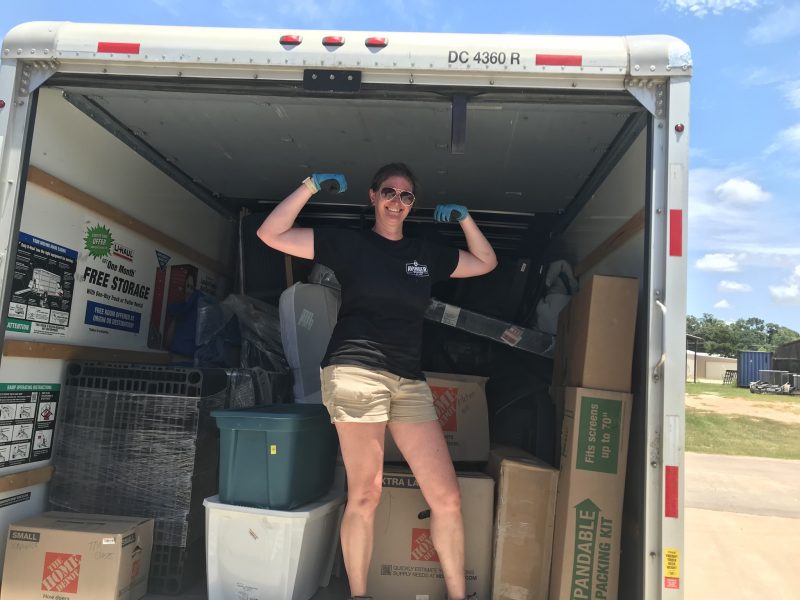
That split worked well: movers for the heavy stuff, our own hands for the irreplaceable stuff. And the things we knew we’d want to swap out or grab when we stopped in to restock went on shelves right at the front of the units.
We pay $350 a month for the two units. We could have packed everything in tighter and used just one… but we wanted room to move things around and get to what we need, since we don’t know yet when we’ll take everything out again. We’ve got everything we’d need to furnish a one-bedroom home in there.
Pile 3: What we sold
Start early. That’s the biggest thing I can tell you. If you are thinking about moving out of a home you’ve lived in for more than a decade to a smaller space, it’s never too early to get started. We began listing things on Facebook Marketplace as soon as we knew we were going on the road, well before move-out day, while we still had the energy and the time to answer messages, schedule pickups, and deal with no-shows.
Then, in the final two months or so, we changed the rules: we only sold items worth more than $100. Everything under that went to the give-away pile.
When I was teaching decluttering years ago, my line was $20. If something was worth less than that, it wasn’t worth the photos, the listing, the questions and the waiting. But when you’re down to the last couple of months, with a move-out date and an RV move-in date bearing down on you, your time is worth a lot more. Raising the bar to $100 saved our sanity.
A few things that made selling easier:
- Bundle small stuff. A box of kitchen odds and ends sells (or gets claimed) faster than ten separate listings.
- Price to move, not to profit. The goal was an empty house, not top dollar.
- Set pickup windows. Batching pickups into a few time slots kept us from being on call all day.
- Use your front porch. For freebies and low-cost items, I’d often just set them on our covered front porch or by the garage for quick, no-contact pickups.
Pile 4: What we let go
This is where our local Buy Nothing group on Facebook became our best friend. So many things found new homes there: small furniture, kitchen extras, decor, kids’ stuff, pantry excess, and half-used supplies from the garage. Someone in the neighborhood needed nearly everything we offered, and it was so much easier than another drive to the donation center. We’ve given things away this way in Germany, Indiana and Texas, and it’s always worked well. Look for a group in your area, and always put personal safety first (porch pickups help).
Whatever didn’t get claimed went to donation. And yes, some things went in the trash. I made sure to fill our trash cans to the brim for every pickup. I’ve always said that if you’re overwhelmed and your peace of mind is on the line, it’s okay to let something go the fast way. You can feel bad about it later, or not at all.
The hard stuff nobody talks about
The practical decisions were the easy part. The emotional ones are harder, but after so many moves, we don’t have many of those left. For us, most of it came down to what would really be practical and useful for our life on the road.
What has helped us make those decisions over the years:
- Take a photo, keep the memory. For a lot of sentimental items, the photo was enough, like some of our daughter’s early artwork that was special but not something we’d hang.
- Keep the best one, not all of them. One special piece says more than a box of them.
- Give it to someone who’ll use it. Watching a young family haul away a table we loved felt a lot better than storing it in the dark for years.
- Don’t decide the hard things on a hard day. If a box was making us emotional, we set it aside and came back to it.
If you’re also helping a parent through their own downsizing, I wrote about that season of life in The Midlife Reality Nobody Warns You About.
What we’d tell you to do (and what we’d do differently)
Almost a year into full-time RV life, here’s what we’ve learned:
- Start selling sooner than feels necessary. The last two months go fast.
- Set a money threshold, and raise it as move day gets closer.
- Be honest about storage. It’s easy to store your way out of making decisions. Ask whether you’d pay the monthly fee for that exact item.
- Pack the RV lighter than you think. You’ll still find you brought too much. Everything needs to stay organized and easy to find, or you’ll never use it.
- Schedule a storage check-in. We travel in “seasons,” and after just 3 months on the road we headed back to Texas to visit our stuff and reset. We’d been cruising along the Gulf Coast, getting our bearings in the RV full-time, and wanted to see the family and friends we’d left in Texas, too. We’re more than ready to swap out more stuff, and we’d planned to stop in Texas again before heading back to Florida this fall… but our plans changed, and now we may not get back there until next fall.
Downsizing is really a reset
Here’s what surprised me most: getting rid of stuff wasn’t the point. Making room was. Room in our schedule, in our budget and in our heads for the life we wanted next.
If you’re in that place where you know something needs to change but you’re not sure where to start, our free 10-Day Midlife Reset is a good first step. It’s a short, doable checklist to help you clear some space (in your home and your head) and figure out what your next chapter looks like.
And if you’re still deciding whether full-time RV life is for you, read the 5 questions we asked before hitting the road.
What’s the one thing you’d have the hardest time letting go of? Tell me in the comments.

Free guide
The Midlife Reset
A short, doable reset for when life feels cluttered: your home, your calendar and your head. Grab it free: