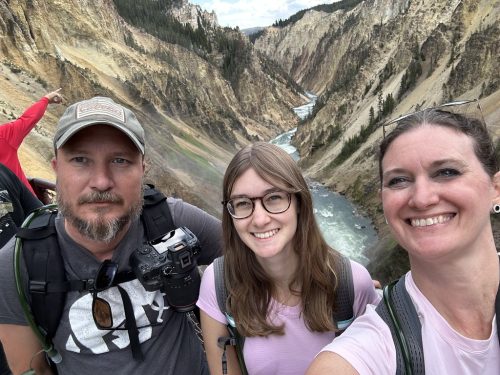
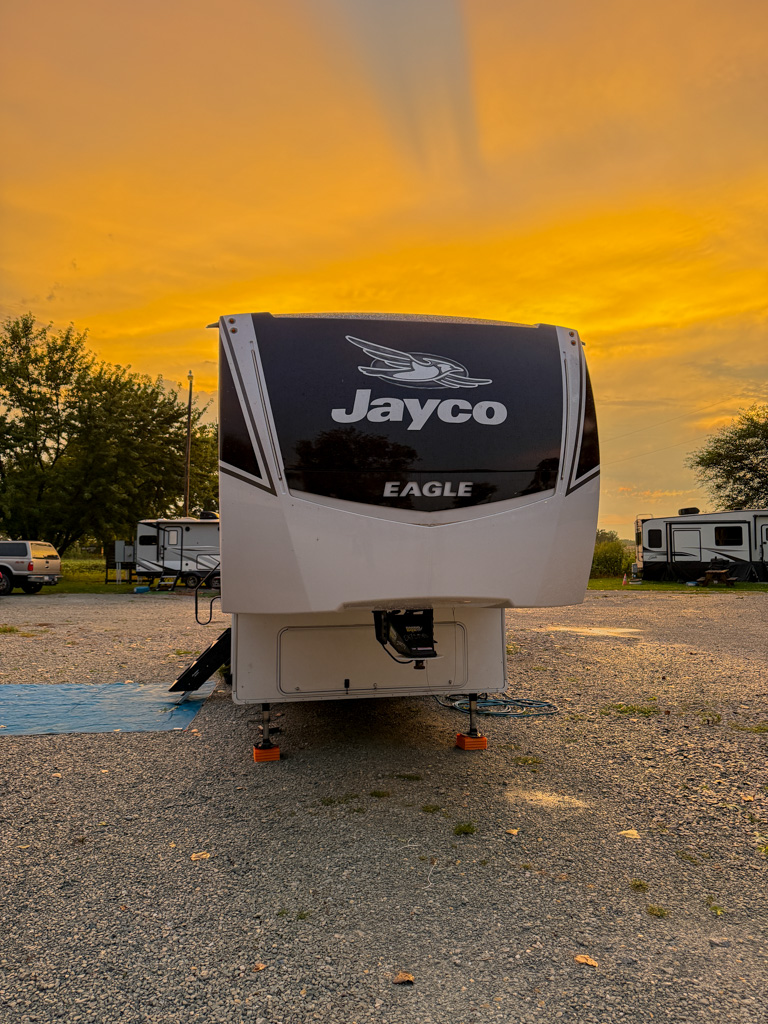
We travel full-time in a Jayco Eagle fifth wheel pulled by a Ford F-350, with two cats and a Great Dane (and our daughter Mackenzie, when she’s home). This is how we set up camp, every time.
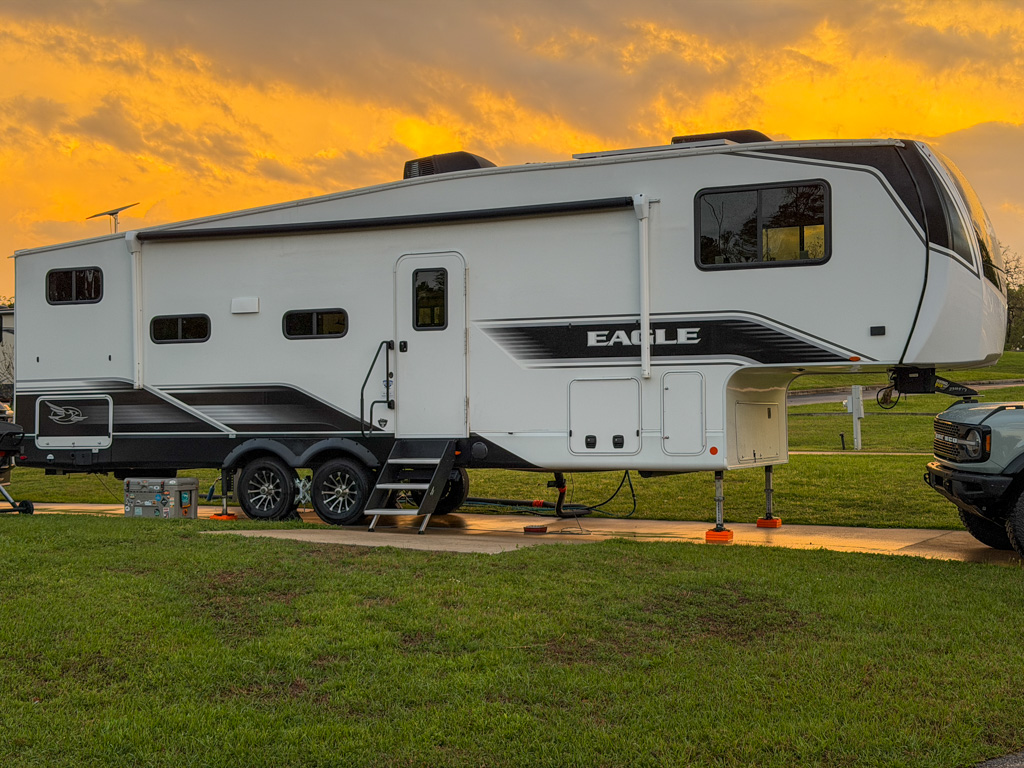
When people picture an RV campsite, they picture string lights, an outdoor rug and a full patio set. Ours is… not that.
It’s something we’ve noticed all over the country. Vacationers and weekend warriors tend to go all out on the outside setup: tables, grills, bikes, you name it. They come equipped for fun, and honestly, good for them. Full-time travelers, on the other hand, tend to stay a lot more compact. When everything has to pack up and move every week or two, you get picky about what earns a spot.
Our setup is simple, and it goes up fast. That’s on purpose. When you move as often as we do, the setup that works is the one you’ll actually do every single time.
Here’s what comes out, who does what, and the few things we’ve learned along the way.
Before We Even Pull In
Before we back in, we check the site. Overhanging branches, low limbs, posts, anything that could meet the roof or a slide. Then Stefan backs in and I direct. (Yes, we still like each other afterward.) I also make sure the slides will clear everything once they’re out.
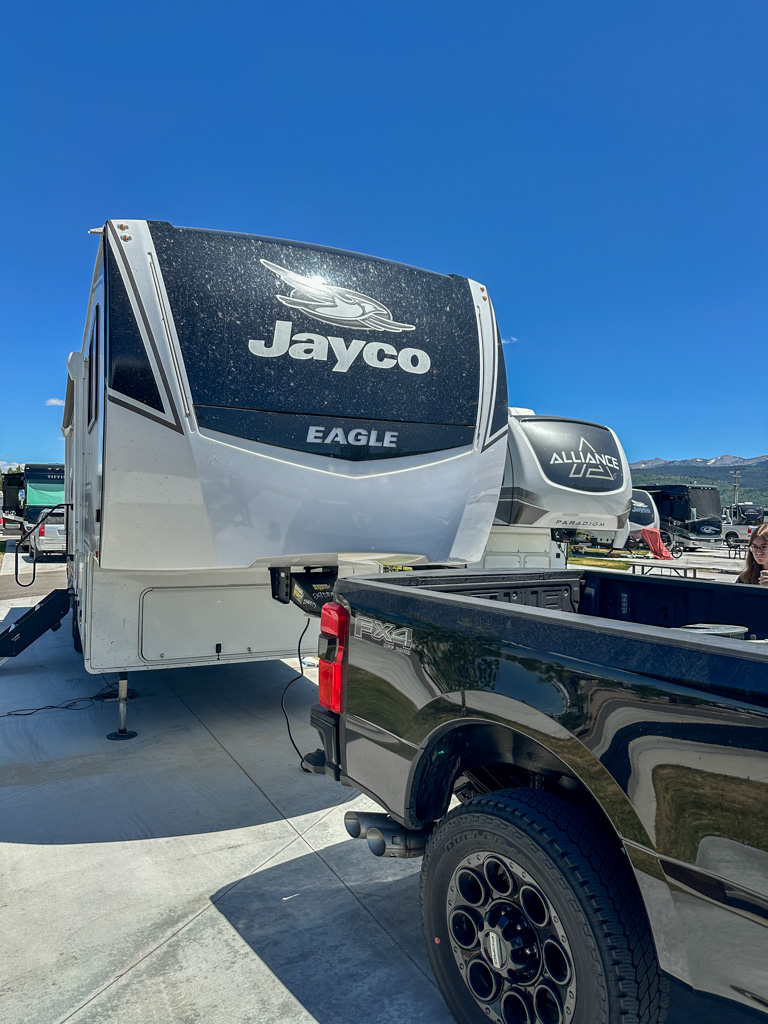
We park as far to the driver side as the site allows. Our stairs and door are on the passenger side, so that’s where we want the room. That’s our front yard.
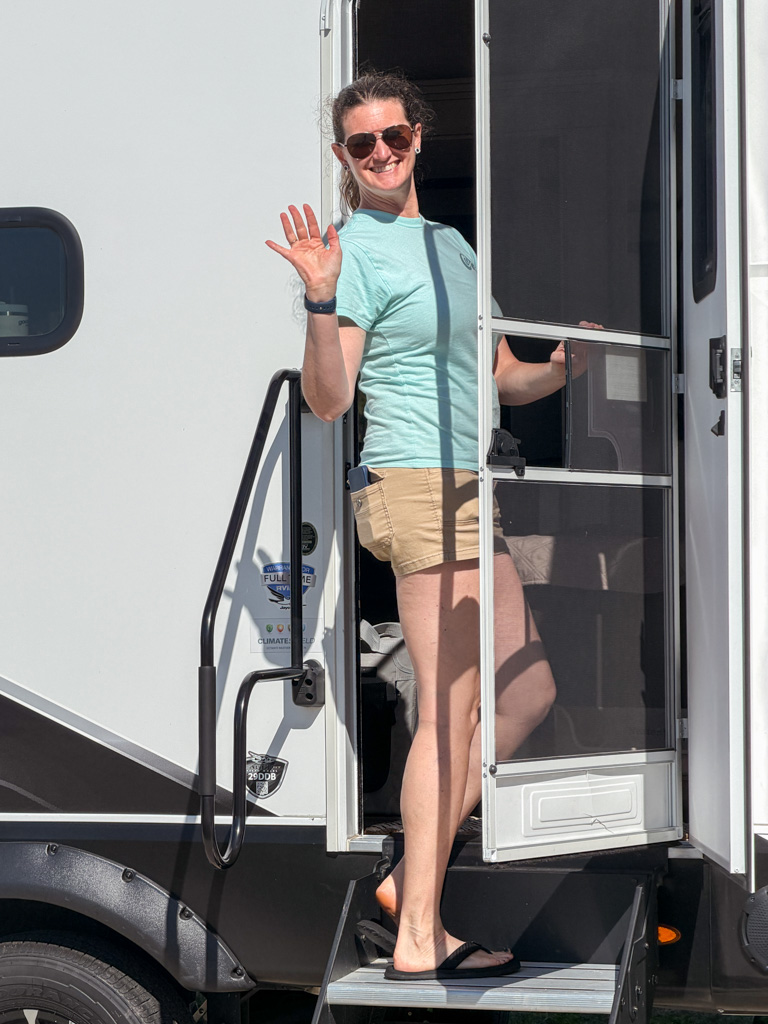
Our Arrival Routine (and Who Does What)
Once we’re in position, it goes like this: unhitch, level, X-braces down for stability, then power.
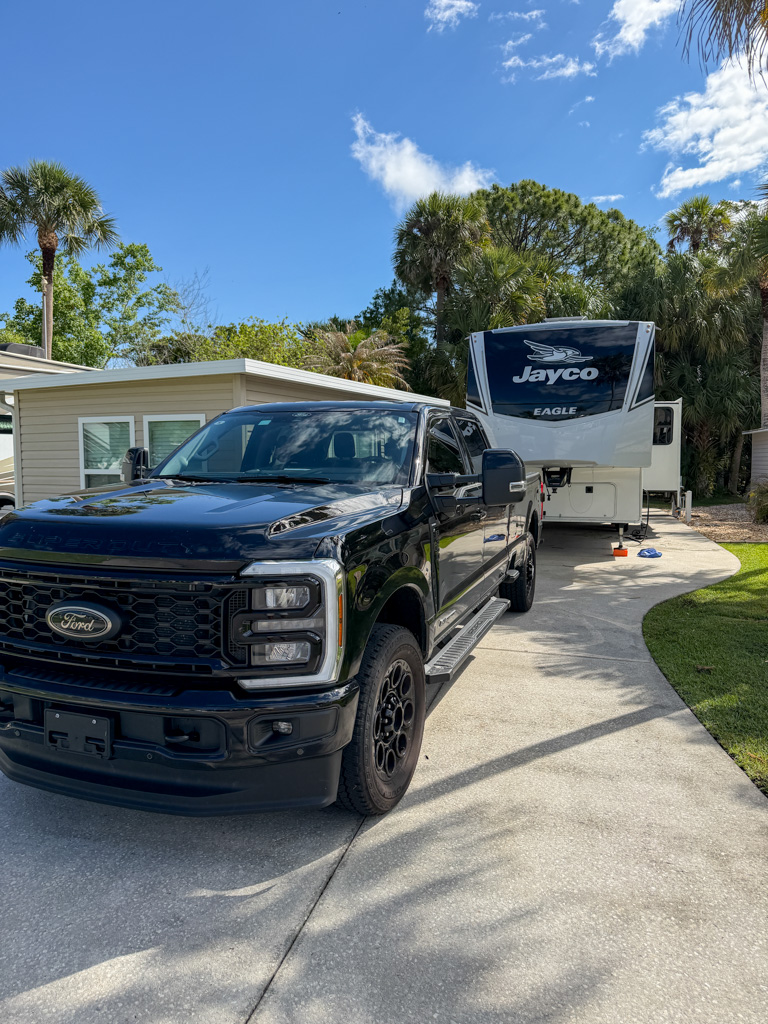
Then we split up. I head inside, run out the slides and turn on the A/C. Stefan handles water, sewer and Starlink. (Sewer only if we need it. Sometimes we just wait until the tanks are full.)
While I’m inside, I do a quick damage check to see if anything came undone on the drive. Every rig has its quirks. For a while, the sliding door on Mackenzie’s bedroom liked to pop open on travel days. New hardware and a MacGyver-style cable tie on the latch seem to have fixed that. These days, it’s the kitchen sink drain pipe that likes to come loose. There’s always something.
Once the inside is ready (indoor plants back in place, water bowls filled, dog bed set up), we bring in the animals. The dog goes first, because she is way too excited to wait her turn. Then the cats.
The whole routine, from check-in to “we have arrived,” takes us less than 30 minutes. Even less when it’s a nice, level pull-through that doesn’t need leveling blocks.
Our tip: Do your inside walk-through right away, before you unpack anything. It’s a lot easier to spot a problem before life gets spread out. Our free Travel Day Checklist covers the rest.
Our Arrival Checklist: Travel Day in Reverse
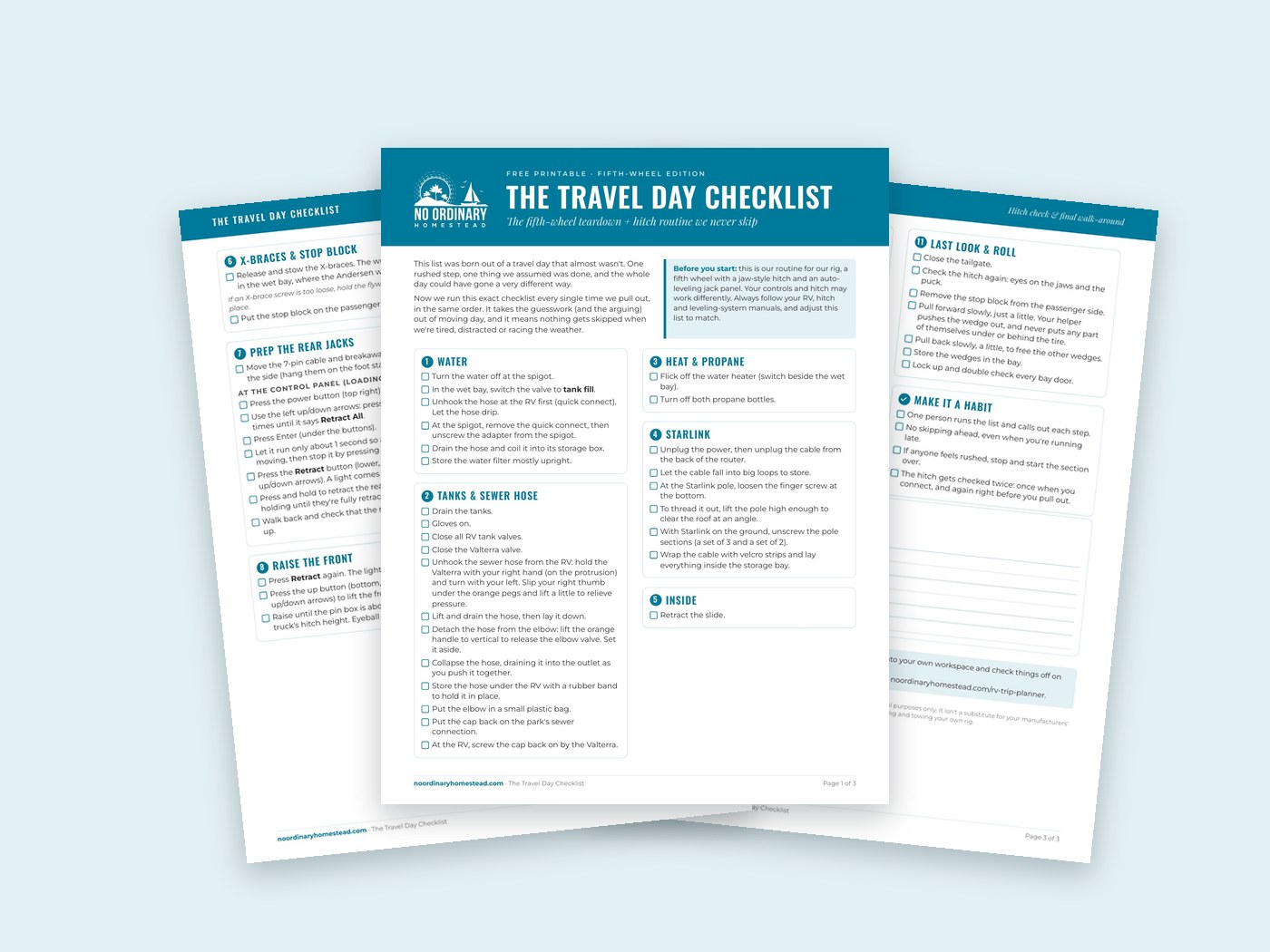
Our Travel Day Checklist was born out of a travel day that almost wasn’t. One rushed step, one thing we assumed was done, and the whole day could have gone a very different way. Now we run it every single time we pull out.
Setting up is basically that same list in reverse, and we follow the same rules. One person calls out each step. Nobody skips ahead, even when we’re tired, running late or racing the weather. If anyone feels rushed, we stop and start that part over.
Here’s how it shakes out for our rig, a fifth wheel with a jaw-style hitch and an auto-leveling jack panel:
- Unhitch: Andersen wedges under the tires if we need them for leveling (not every site does), then a stop block on each side. Then unplug the 7-pin, unhook the breakaway cable, drop the front jacks onto their orange pads, open the hitch and ease the truck forward.
- Level and brace: Let the auto-leveler do its thing, then set the X-braces. (The wrench lives in the wet bay, right where the wedges go, so it’s always where we need it.)
- Power: Plug in. Then the slides go out and the A/C goes on.
- Water: Adapter and quick connect on the spigot, water filter on, hose to the RV. Make sure the valve in the wet bay is set for city water, not tank fill.
- Sewer (only if needed): Gloves on. Elbow into the park’s sewer connection, hose to the Valterra on the RV. We keep the tank valves closed until it’s actually time to dump.
- Propane and hot water: We only turn on the bottle we’ve been using. We run one until it’s mostly empty, then switch, get the empty one filled and keep it as our reserve. Then the water heater (the switch is right beside the wet bay).
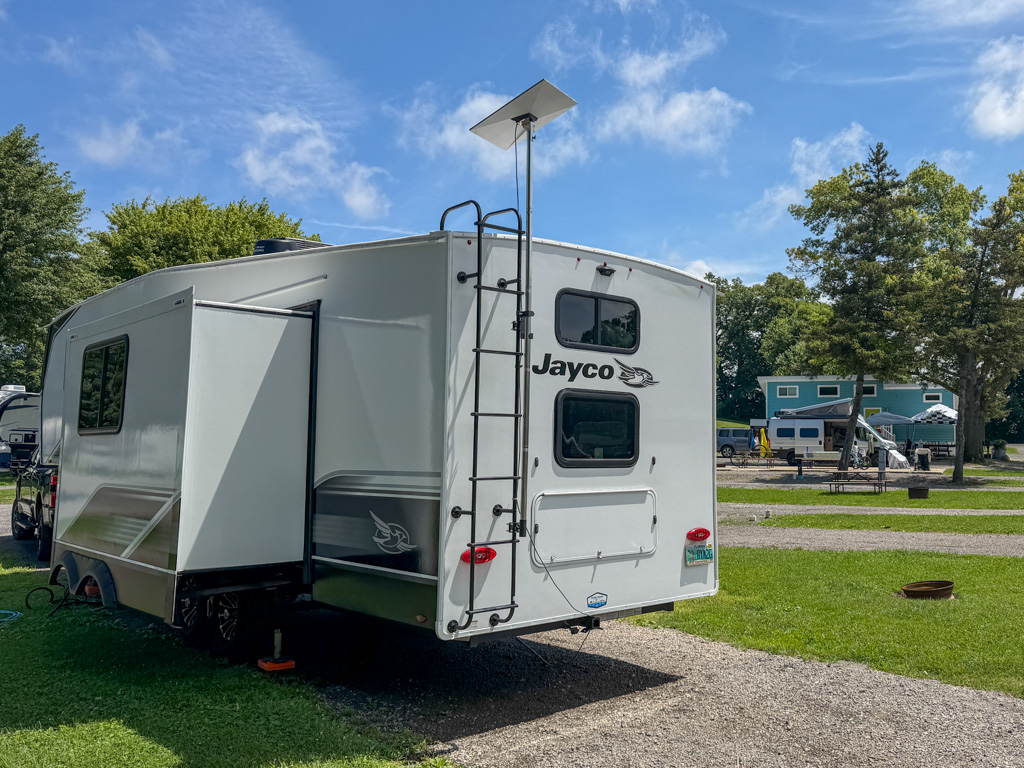
- Starlink: Screw the pole sections together (a set of three and a set of two), thread the dish up past the roof, tighten the finger screw at the bottom, then run the cable to the router and plug in.
Every rig is different, so follow your own RV, hitch and leveling-system manuals and adjust to match. Our free Travel Day Checklist has a notes section for exactly that.
What Comes Out: Our Outdoor Setup
Three things come out of the truck bed: our Blackstone griddle, our Ozark Trail cooler and our “car emergency box.” The griddle goes up near the back of the rig. The emergency box gets shoved under the fifth wheel, out of the way. The cooler sits next to the griddle, where it doubles as Stefan’s cooking table.
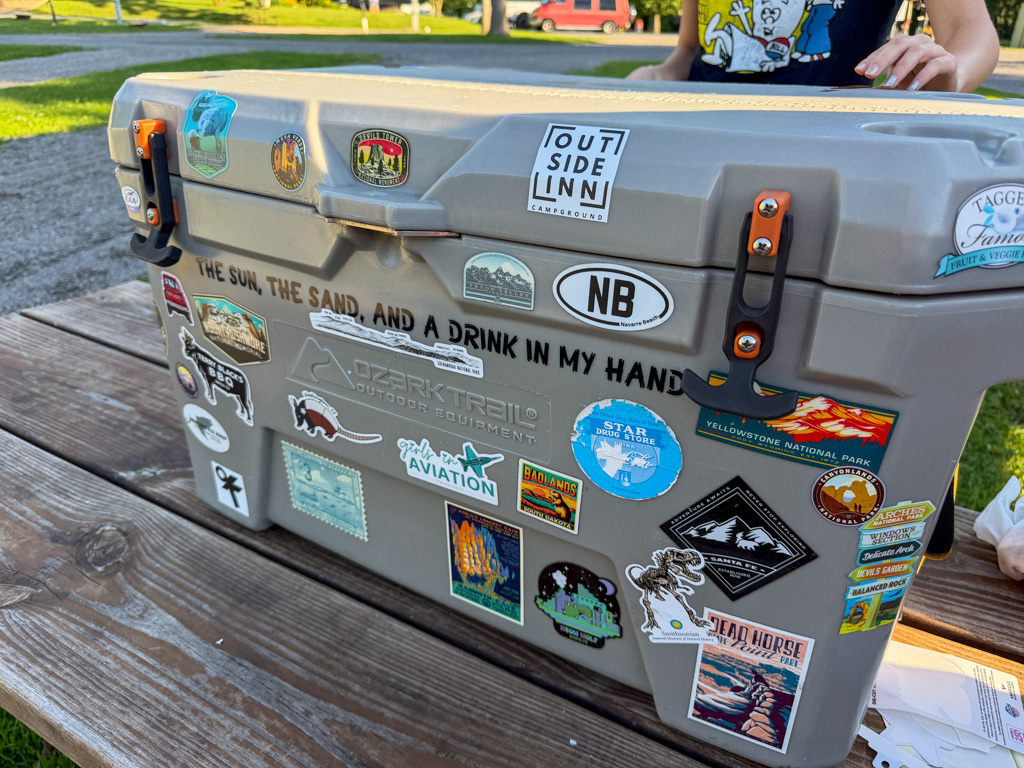
That’s it. Most of the time, that’s the whole outdoor kitchen.
The Outdoor Kitchen: Blackstone and Ooni
Our Jayco came with a small “outdoor kitchen” near the back. That’s where our Blackstone (the 22-inch 2350 with the hood) sets up now. The best part: we hook the griddle directly into the RV’s propane line, so we don’t have to carry a separate tank.
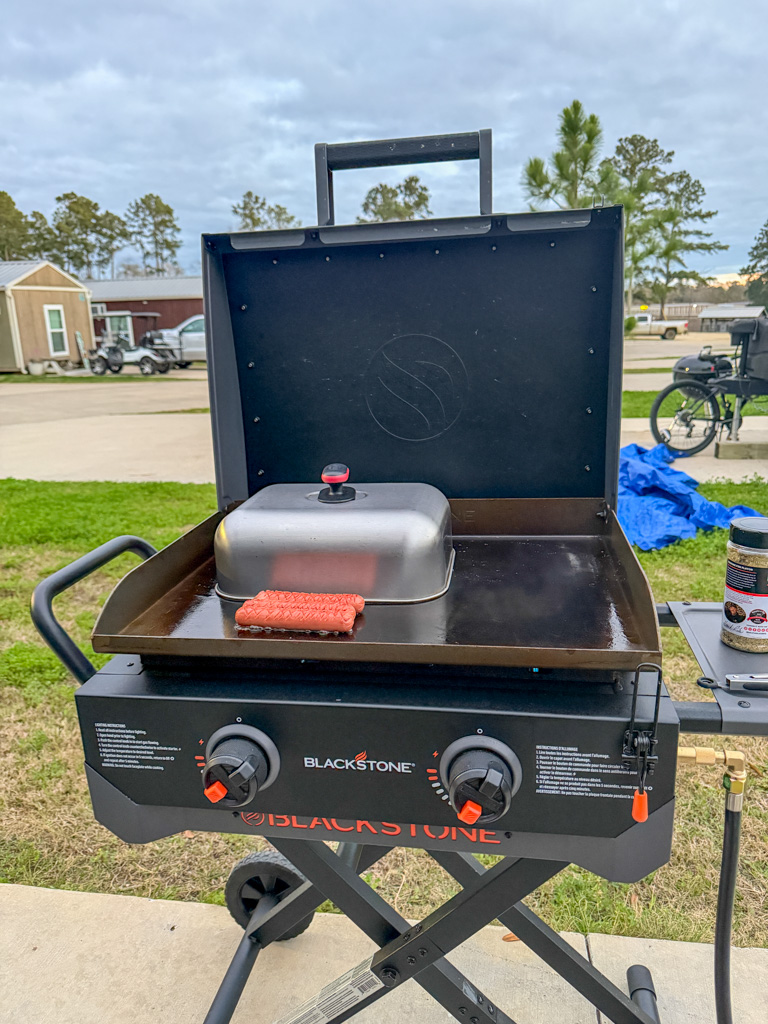
The Ooni is a bit of a sore subject. After our first trips as full-timers, we left it behind in storage because we weren’t using it enough. And now we miss it dearly. When it does come along, it rides in its own carry bag in the back storage hatch and only comes out on pizza nights.
Prep space is still a work in progress. Right now the cooler does double duty as Stefan’s side table, and the Ooni usually ends up sitting on the ground. We’re still on the hunt for a compact table that can hold both the Ooni and everything we need while cooking.
Our tip: Not every rig has an outdoor propane port, and the fittings vary. Check your RV manual before you buy a hose or adapter for your griddle, and do a quick leak check (soapy water on the connection works) any time you hook something up.
Seating, Shade and Keeping the Dirt Outside
We keep this part simple, too.
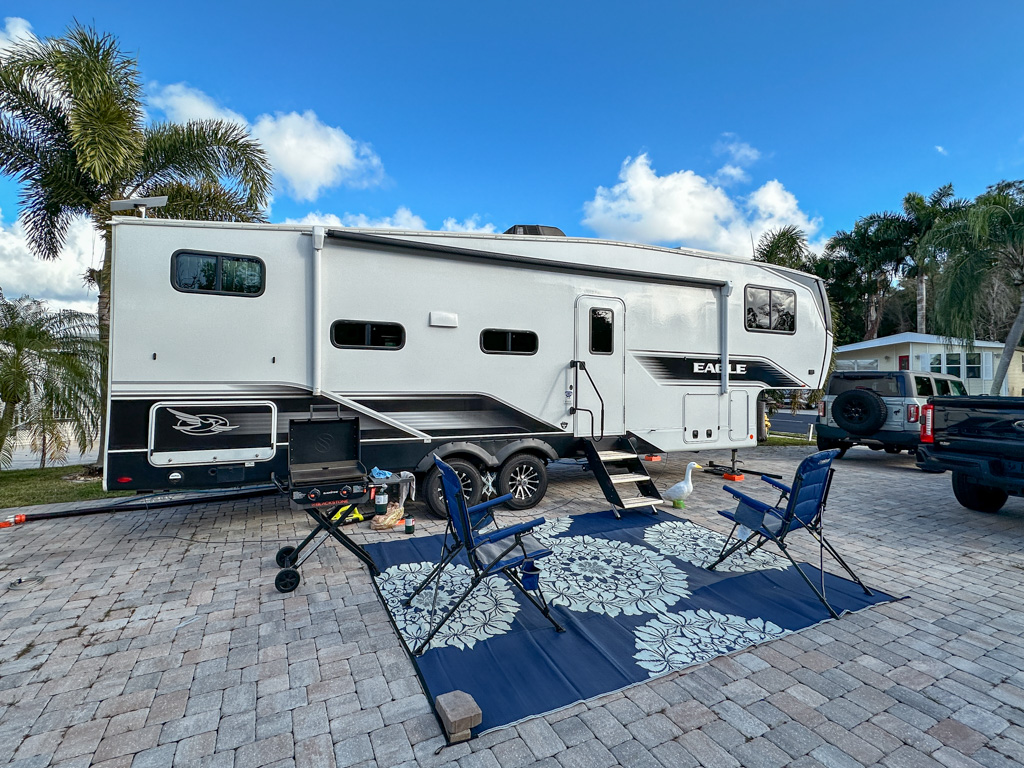
- Table: Most sites come with a picnic table, so we don’t travel with our own.
- Chairs: They live in the basement and come out when we need them. They’re simple folding chairs we bought for Oshkosh, replacing our beefier ones that were a pain to store.
- Mat: When the ground is sandy or gravel, we put down our CGear sand-free mat. It’s great at keeping the outdoors outdoors (and the dust down).
- Awning: Ours goes in and out as needed. We’re careful about wind, because an awning repair is one expense we’d happily skip.
Our tip: If you’re heading out for the day or there’s wind in the forecast, bring the awning in. It takes a minute. A bent awning arm takes a lot longer (and costs a lot more) to fix.
Campsite Setup With a Great Dane
People always ask what we do for the dog. Honestly? Not much. She has her “blankie,” a small picnic blanket that also comes along on hikes. She loves drinking straight from a faucet, so when she’s thirsty, we just turn on the outside tap.
We don’t use a tie-out. Our old bumper pull had a tie-down point, which was handy, but she’s a good girl. When we’re sitting outside, we loosely hold her leash or loop it around a chair. She’s never outside alone. Most campgrounds require dogs to stay leashed (often on a six-foot leash or shorter) and not be left alone outside, so it’s worth a quick look at the park rules when you check in.
Overnights vs. Longer Stays
Our setup barely changes. On a quick overnight, the griddle, cooler and emergency box may just stay in the truck. When we’re staying put for a while, everything comes out.
Where It All Rides on Travel Days
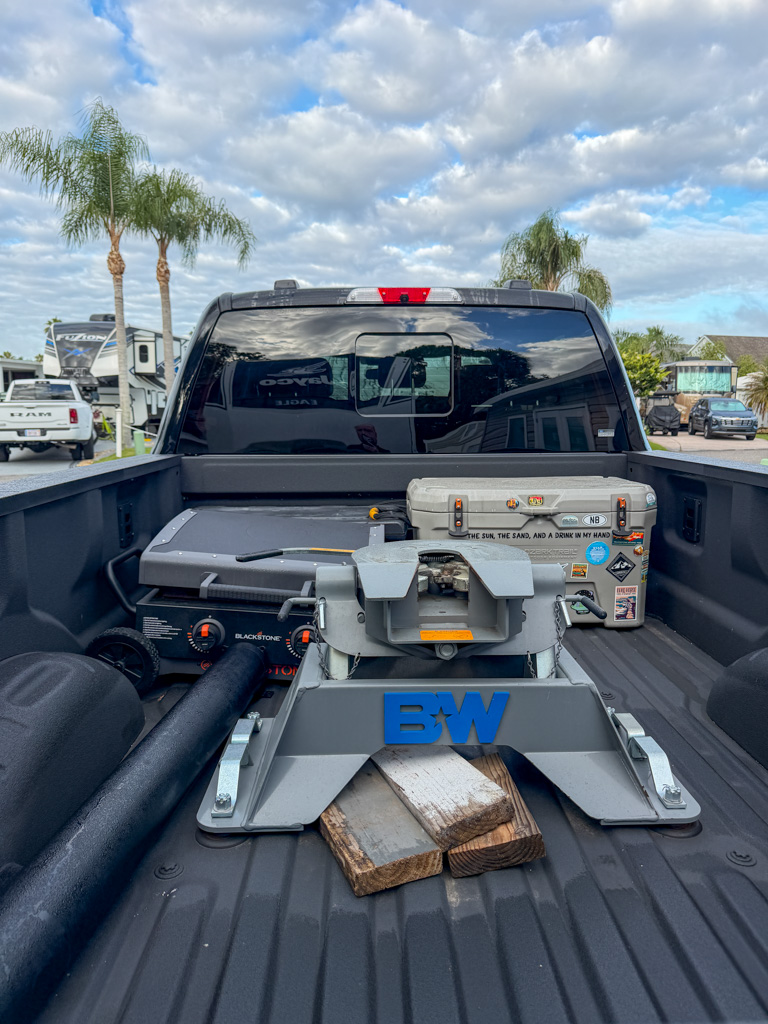
- Truck bed: griddle, cooler, emergency box, power cable and chock blocks
- Back storage hatch: the Ooni, in its carry bag (when it’s along)
- Basement: the chairs
What We Don’t Bring Anymore (and What We’d Buy Again)
Back in our early 20s, we tent-camped our way around Europe: the Netherlands, Germany, Italy. Our camping furniture back then? Two inflatable lounger seats and a blow-up three-person sofa. We pumped up every one of them by hand.
They were cool. Funky looking. Not super comfortable. But fun.
Our favorite memory: we were camping in the Netherlands with friends, lounging in our inflatable chairs in front of the tent after breakfast, when a full-on marching band came walking down the campground road. Surreal, to say the least.
As fun as they were, the inflatables didn’t make the cut for full-time RV life. Our Dutch oven is in storage for now, too. We used to use it a lot more, but it hadn’t come out in a while. What would we buy again in a heartbeat? The griddle, and Starlink. We used to rely on hotspots, and it definitely made us nervous whenever a deadline or a call was coming up and the connection was spotty.
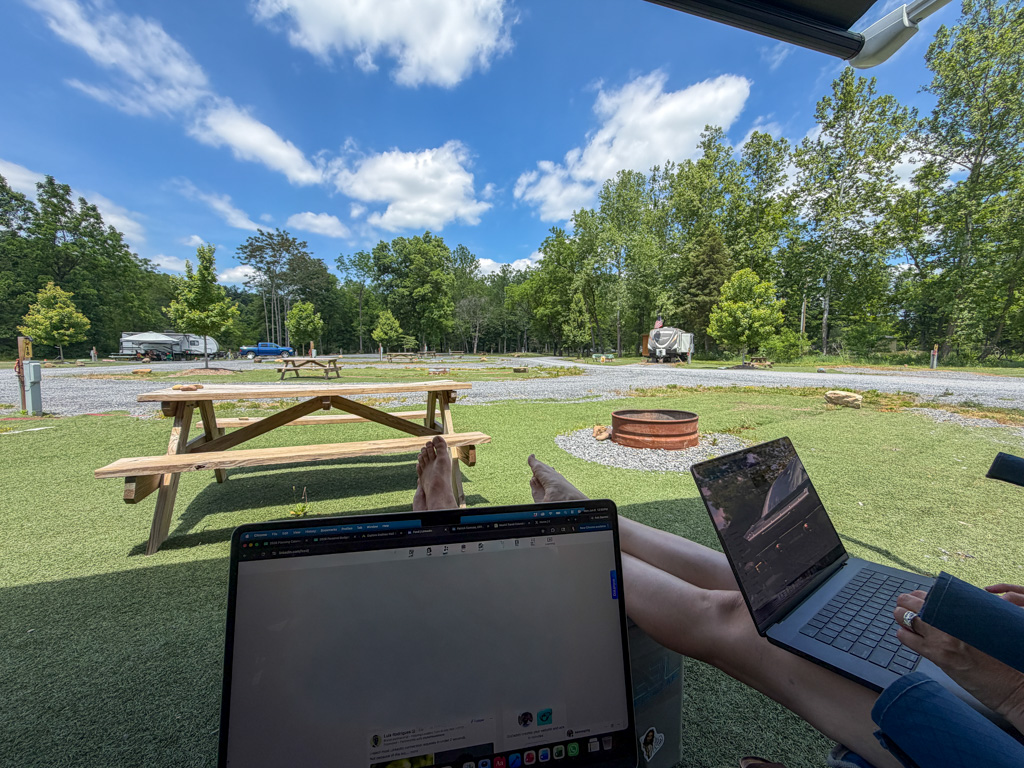
What Makes a Great Campsite (to Us)
We’ve loved a lot of different sites. Our favorites have one thing in common: the park makes it easy. Wide, level spots. A table. Room for a paved front yard, which keeps the RV so much cleaner when it rains.
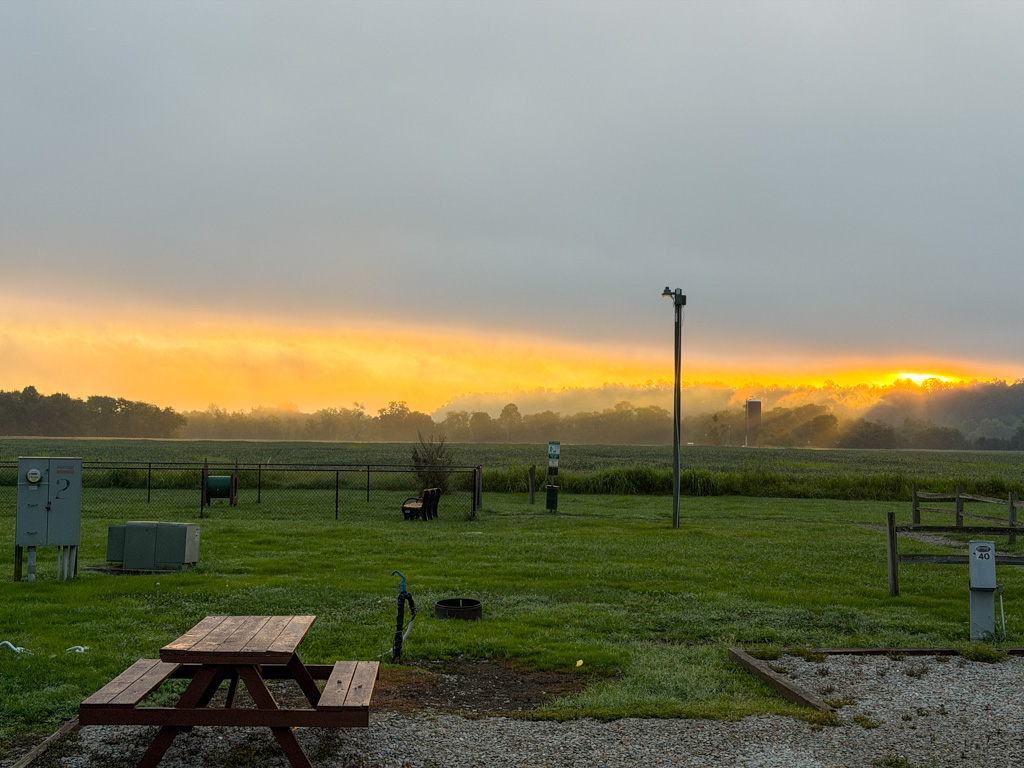
Nice wide spacing between sites helps too, for a little nature feeling. That always depends on where you are, of course. A city park, a beach park and a country campground are three very different animals.
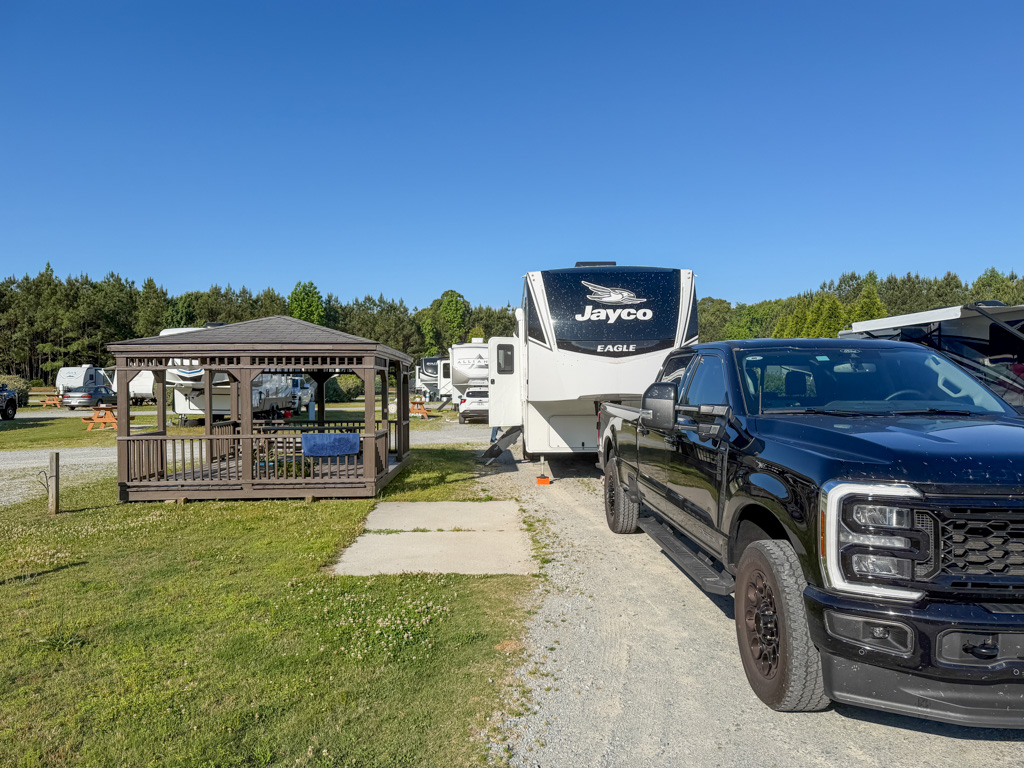
When we’re choosing where to stay, location comes first. Is it convenient to where we actually want to go? Then we look at what kinds of parks are around. An RV resort and a “last resort” are two very different things, especially when it comes to safety and the neighborhood.
After that, it’s the practical stuff. How easy is it to get in and out with a big rig? Is there heavy tree cover? (Shade is lovely. Starlink disagrees.)
Our tip: Before you book, pull up the campground map and a satellite view. You’ll spot the tree cover, how tight the loops are and what’s next door. Then read the reviews for the vibe. Comments about safety, noise and how easy it is to get a big rig in and out tell you a lot more than the photos do.
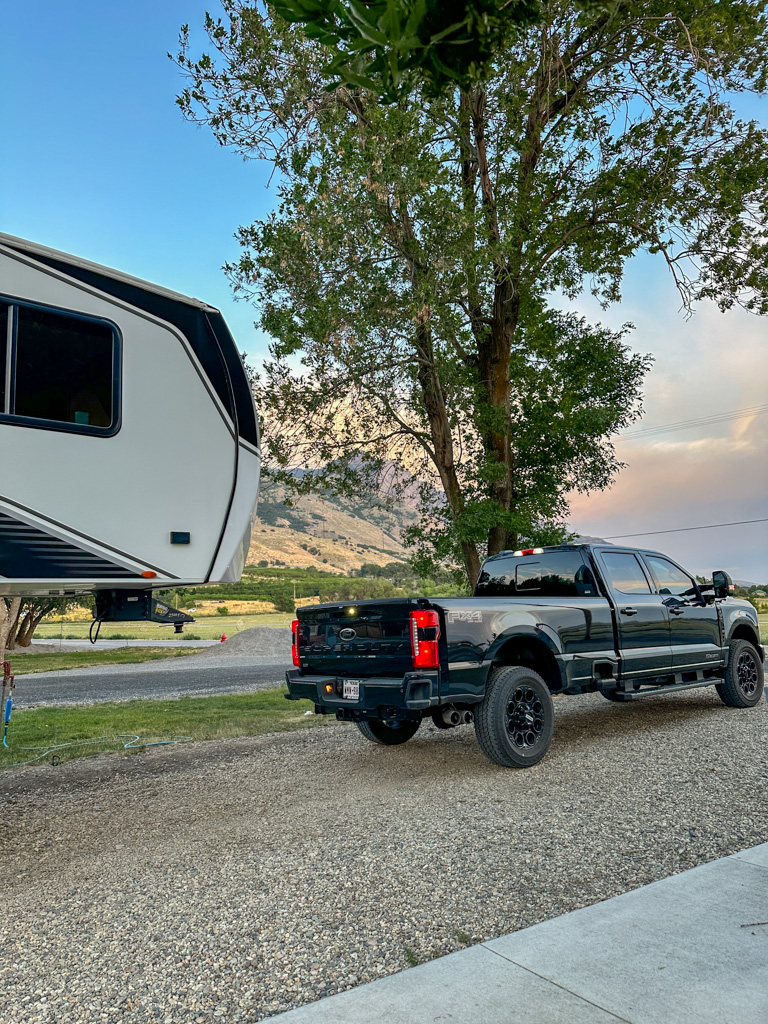
Our RV Campsite Setup Checklist (Quick Version)
Here’s the whole routine on one screen. Screenshot it, print it or tape it inside a cabinet door.
- Walk the site before you pull in: branches, posts, hazards and slide clearance.
- Back in, as far to the driver side as the site allows.
- Wedges (if needed) and stop blocks, unhitch, level, X-braces, power.
- Inside: slides out, A/C on, quick damage check.
- Outside: water, sewer (if needed), propane and water heater, Starlink.
- Plants in place, water bowls filled, dog bed down. Then the animals: dog first, cats second.
- Truck bed: griddle, cooler and emergency box come out. Hook the griddle to the RV’s propane.
- Sand mat down if the ground is sandy or gravel. Chairs out of the basement.
- Awning out, if the wind allows.
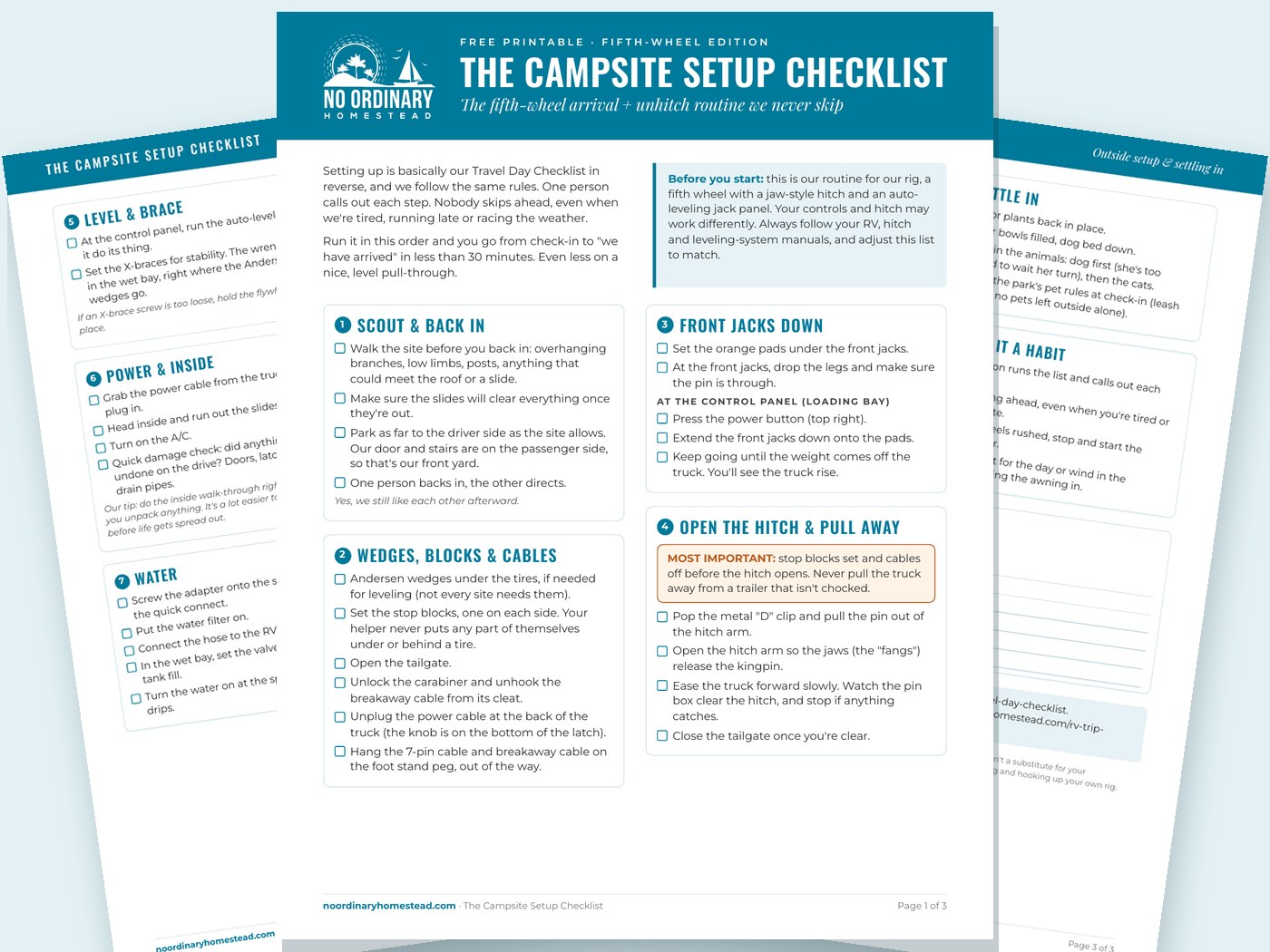
Free printable: The Campsite Setup Checklist
The full version of this list: every step of our fifth-wheel arrival, from wedges and stop blocks to hookups and the outside setup. Three printable pages, plus a notes section for your own rig.
Packing up? That’s what our free Travel Day Checklist is for.
RV Campsite Setup FAQ
How long does RV campsite setup take?
For us, less than 30 minutes from check-in to “we have arrived,” and even less on a level pull-through that doesn’t need leveling blocks. Having a routine (and doing it in the same order every time) is what keeps it quick.
Do you need an outdoor rug for your RV campsite?
Not necessarily. We skip the decorative rug now and bring a sand-free mat instead, and it only comes out when the ground is sandy or gravel. It keeps the dirt (and the dust) outside, which is really the whole point.
Can you run a griddle off your RV’s propane?
If your rig has an outdoor propane connection, often yes. Ours does, so our Blackstone hooks right into the RV’s system and we don’t carry a separate tank. Check your RV manual for the right fittings, and leak-check every time you connect.
Should you hook up the sewer as soon as you arrive?
We don’t always. On shorter stays, we often just wait until the tanks are full. When we do hook up, the tank valves stay closed until it’s actually time to dump.
What stays packed on a quick overnight?
For us, the griddle, cooler and emergency box usually stay in the truck bed. We still level, plug in and do the inside check, every time.
What makes campsite setup easier?
Doing it the same way, in the same order, every single time. Simple gear helps. A checklist helps more.
Final Thoughts
A campsite setup doesn’t have to be fancy to feel like home. Ours takes a few minutes, uses gear that earns its space, and leaves room for the good stuff: dinner off the griddle, the dog on her blankie and a chair outside.
Want to see the gear we actually use in our RV kitchen? It’s all on our No Ordinary Kitchen page. And if you’re planning where to set up next, browse our campground reviews.
What’s the one piece of gear that always comes out at your campsite? Tell us in the comments.