Hurricane Irma hit Southwest Florida in September 2017, back when we lived in a condo in Naples. This is part two of our story. Part one covers how we prepared and evacuated.
After 16 hours on the road, we pulled into the Sandestin Resort in Destin around 3 p.m. Nobody was happier to arrive than Ayla, our senior Newfoundland. She took a potty break, plopped down in the grass and refused to walk another inch.
Here’s what it was like to wait out Hurricane Irma 575 miles from home, drive back into a disaster zone, and slowly get back to normal.

Waiting at Sandestin
We’d been awake for more than 30 hours, so getting checked in and the pets settled felt like a huge sigh of relief. Still, with Irma’s track pushing up Florida’s west coast, we didn’t know how long we could stay. A resort on a barrier island isn’t the smartest place to ride out a hurricane.
The room turned out to be a lucky surprise. In all the excitement, we’d booked a suite: a bedroom, a big living and dining area, a small full kitchen, a patio over the golf course and even a washer and dryer. The resort also had a little village of restaurants, bars, shops and an arcade within walking distance, so we barely needed to leave.

That first night, our whole motley crew headed to Hammerhead’s Bar & Grill for beers and food. By 8 p.m., every one of us was sound asleep.
On Saturday, about 36 hours before Irma was forecast to hit Naples, Stefan and our friend Luke went looking for gas cans and other supplies. Even in Destin, they came back empty-handed. Irma was so big it covered the whole width of the state, and it was still forecast to move up the middle of Florida, possibly right toward us. We started mentally listing friends across the country who might take in our crew of humans and pets.
The mood swung from sad to worried to straight-up gallows humor. When other guests asked where we were from and we said “Naples,” they recoiled: “Oh man, I’m sorry.” Not the usual reaction to Naples. That night, the resort told guests to be prepared to evacuate if the hotel had to close. We quietly made a plan B: friends and family in New Orleans or Texas.
The Day Irma Hit
Sunday started with another failed gas can run and a big breakfast for both families. Watching the coverage of Irma’s damage in the Caribbean, nobody was very hungry. It felt more like a last supper than a family breakfast.
Watching a hurricane approach on live TV is like watching a slow-motion train wreck. The national networks sensationalized every development, with reporters standing in Naples almost excited about the coming devastation. The local news teams streaming online did an outstanding job of sharing the facts without the hype.
We watched the storm knock out the webcams in Key West, saw water rising in the streets of Miami and worried about friends who’d stayed behind. The kids, meanwhile, were thrilled that no one was limiting their screen time. Stefan never naps and I rarely do, but we both fell asleep that afternoon right before Irma reached Naples. I think the stress of the week finally caught up with us.
By Sunday evening, it was clear Naples had taken a hit but not a devastating one. Irma weakened as it came ashore, and the predicted 15-foot storm surge never came, though watching Naples Bay drain completely before the storm was pretty terrifying. Sandestin would get some wind but no real danger. We ended the day at the arcade with the kids and a round of drinks for the grown-ups.

The Day After
With only tropical storm conditions in the Panhandle, our job was to gather intel and figure out when we could go home. Power was out across Southwest Florida, so we decided to stay put until one of our homes had power. We’d signed up for power company alerts and kept checking in with neighbors who had stayed.
Gas was still the problem. Stations in Sandestin had fuel, but driving south meant carrying our own, and gas cans were nowhere to be found. After a three-hour stakeout at the back of a Walmart waiting for a delivery truck, we finally found a Walmart in DeFuniak Springs, 41 miles inland, that had some. We drove like bats out of hell and came home with 10 brand-new gas cans, enough for a full tank in each car.
A few hours later, sitting down to dinner, we got a text from a neighbor: the power was back on at home. We planned to leave the next morning.
Driving Home Into the Unknown
Our two-car convoy headed out around 10:30 a.m. on September 14. The miles were the same, but there was a lot less urgency. Damage got worse with every hour south, and gas was still limited, so we topped off whenever we could. By Tampa and Sarasota, the ports had reopened and tanker trucks were resupplying stations.
We made it back just after the 9 p.m. curfew. Stefan, ever the rule-following German, had already texted a friend at the Collier County Sheriff’s Office, who told us to show our IDs and explain we were returning evacuees if we got stopped.

With the power still out south of Tampa, I-75 was pitch black. Not one highway sign at our exit was still standing, and every traffic light and streetlight was out. When we pulled into our neighborhood, we thought our neighbor had been wrong about the power. The streetlights were down (we found them the next day, scattered across the road like pick-up sticks), and every home still had its shutters up.
Stefan grabbed a flashlight and went in first. He came out grinning. Not a single thing was broken, not even the ugly patio table he’d secretly hoped would blow away. His parents’ condo across the street: no damage. Two friends’ units: no damage. Even with peak gusts of 142 mph measured about 2 miles away, our buildings had come through with virtually nothing.
Then the kids came running out to show us a funny video. Stefan had locked YouTube on cellular because our data was nearly gone. “Oh no, Daddy, we were in the house and it just worked.” We had power and internet. We moved our friends, and their parents, whose home had tree damage and was surrounded by two feet of water, into Stefan’s parents’ empty condo. After a quick celebratory drink, I slept more deeply than I ever have.
Surveying the Damage
At sunrise, we started taking down shutters and looking around. We drove as little as possible. Gas lines were hours long, and even with constant warnings from the Sheriff’s Office to treat every dark intersection as a four-way stop, people plowed right through. The first three or four days were the most dangerous on the roads. Our office was untouched, too.
The rest of Naples looked like a war zone. Trees were down, power poles had snapped like twigs, and every tree left standing looked like it had gotten a terrible haircut.

With highs in the upper 90s and muggy nights in the mid-80s, everyone without power was miserable. Stores that reopened had limited stock, there was a boil-water notice, and with most sewer lift stations out of power, everyone was asked to stop flushing, washing and running water. Boy, were we glad we’d done all our laundry at the resort.
An Unexpected Cruise and a Drone Job
Months earlier, we’d booked a seven-day cruise with our friends to celebrate them both turning 40. It was scheduled to leave from Miami on September 16, exactly one week after Irma. The cruise line confirmed the port was open and the cruise was on.
We almost felt too guilty to go, until we made a list. We’d spent a lot of nonrefundable money. The ship had power, drinkable water, working toilets, laundry and plenty of food. We’d even packed our cruise bags when we evacuated, just in case. We’d be far more comfortable on the ship than in a disaster zone.
Meanwhile, an insurance company up north had found Stefan through a Google search. He’s a licensed drone pilot, and they needed aerial photos of their properties to assess damage. Travel was still risky and gas was short, but they paid very well. Our friends watched Mack while we spent Friday driving from Cape Coral to Marco Island, photographing building after building. That one job ended up covering more than all of our preparation and evacuation costs.

And Ayla? Our dog sitters had their power back a day after the storm, and she was already booked to stay with them. Before we left for the cruise terminal, we handed out our leftover ice, water and gas to friends and neighbors.
Two Weeks Later, and Six Months Later
By the time we got back from the cruise, things were mostly back to normal. Blue tarps covered roofs everywhere and debris piles sat on every corner, but restaurants were open and the last homes had power. With so many trees cleared, we saw houses along familiar roads for the very first time.

Still, neither of us could shake what we called the post-hurricane funk. Everyone we talked to felt it, and it lasted four to six weeks before life kicked back into high gear.
Six months later, Naples was stronger than ever. A few business signs were still missing a letter or two, and a few blue tarps remained, but life was back to normal. Naples was still paradise, and I think we appreciated it even more.
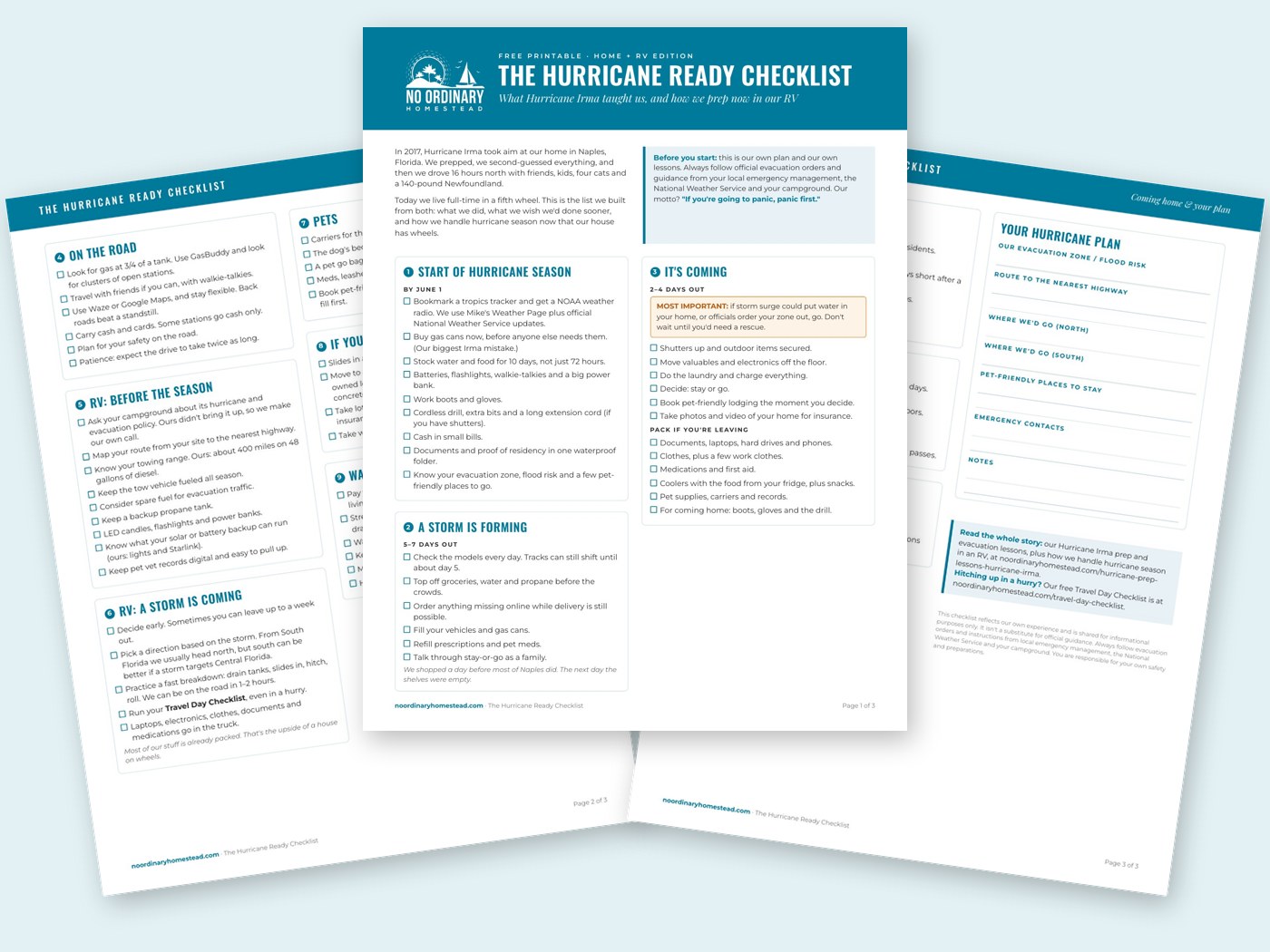
Get our free Hurricane Ready Checklist
Our prep and evacuation lessons, plus how we handle hurricane season now in our RV, on three printable pages with a fill-in plan page. Pop in your name and email and I’ll send it right over.
What We Learned From Riding It Out (and Coming Home)
- Pay for a little more space. You’ll be cooped up for days. A suite with a kitchen and living area made it so much easier for two families to cook, relax and not kill each other.
- Bring comforts from home. Our coolers of food from the fridge, plus games, laptops and gadgets, helped pass the time.
- Stream your local news. National networks thrive on drama. Local stations gave us the facts.
- Watch out for rumors. Social media spread worst-case scenarios like wildfire. The Collier County Sheriff’s Office did an amazing job of shutting down false reports fast.
- Bring a big power bank. Four of us lived on our phones, and the large power bank from Stefan’s camera bag kept everyone charged all day.
- Make time for family fun. Dinners, games, the arcade and exploring the resort made the waiting bearable, and sometimes even fun.
- Be ready to move on. We had a plan B if the resort closed, and some hard conversations about where we’d go if there were no home to come back to.
- Everything takes time. Clearing roads, restoring power and restocking stores took a huge effort from linemen, truck drivers and grocery teams. Two weeks without power in Florida is a long time, but patience is the only way through.
- Leave the shutters up a few extra days. Right after the storm, everyone who could remove high shutters found better-paying cleanup work. A few weeks later, help was easy to find and affordable.
- Support local businesses. The ones that reopen fast still have employees to pay and losses to cover. Spend your money close to home.
- Expect the post-hurricane funk. Even when everything turns out fine, it can take weeks to feel normal again. You’re not alone.
Getting ready for hurricane season? Read our hurricane prep and evacuation lessons from Hurricane Irma.
Have you ridden out a hurricane or evacuated from one? What surprised you most when you came home? Tell us in the comments.