Hurricane Irma hit Southwest Florida in September 2017, back when we lived in a condo in Naples. This is part one of our story: getting ready and getting out. Part two, riding out the storm and coming home, picks up where this one ends.
Living in Naples, we got to enjoy beautiful, tropical weather almost every day of the year. But everything in life has a yin and a yang. In Florida, that means every once in a while we get to “enjoy” a tropical storm or even a hurricane.
Stefan and I had both been through a few smaller hurricanes during our University of Miami days. Those mostly ended in a hurricane party. Irma was different.
The week before September 10, 2017, the forecast models started pointing to a potentially devastating storm making a direct hit on Naples as a Category 4 or stronger. Thankfully, Stefan is a bit of a weather junkie, so we were on top of it from the very beginning.
Here’s how we prepared, how we decided to leave, what the 16-hour evacuation drive was really like, the lessons we still use every hurricane season, and how we handle hurricane season now that we live full-time in an RV.
One Week Out: Getting Ahead of the Crowd
It was Sunday, September 3, the end of a long Labor Day weekend, when Stefan noticed the models shifting west toward Naples. Our first plan was to stay put. Traveling with a 140-pound Newfoundland and a newly blind cat didn’t sound easy.

We already had quite a bit set aside with our camping gear, but we went grocery shopping to top off our food and water. People looked at us a bit funny when we rolled up to the Publix checkout with a cart overflowing with cases of water and canned soup. Nobody else seemed worried yet.
That changed two days later. On September 5, the models moved even closer to Naples, and it seemed like the whole city rushed out at once for gas, food and water. When we stopped at Walmart for propane and gas cans, those basics were already running out.

Next question: should we put up our hurricane shutters? Nobody else was doing it yet, but how soon is too soon? With every model looking worse, we got moving. We’re on the first floor, so we put up our own and found help for the upstairs units belonging to friends and family.
We were lucky to find two very entrepreneurial young guys who weren’t cheap, but they showed up three days in a row and put up shutters on hard-to-reach second-floor condos and for owners who couldn’t do it themselves. I think those boys paid for at least a year of college tuition that week, and they deserved every penny. Putting up shutters is hot, heavy work.


Once our home was secured, we turned to our office. The street where our marketing agency was located tends to flood, so we cleared out anything of value (computers, cameras, sound equipment and all our other gadgets) and hauled it back to the condo.

By Tuesday evening, our shuttered condo was dark as a cave, with stacks of office equipment and hurricane supplies in every corner. It looked like we were moving but didn’t know how to pack. We were as prepared as we could be.
Do We Stay or Do We Go?
With every forecast update looking worse, and local and state officials urging people to get out if they could, the question of the day was “Do we stay, or do we go?” Every choice seemed wrong.
Florida is about 450 miles from end to end. Irma was so massive it stretched across the whole width of the state, and millions of people were evacuating from the southern half. Roads were jammed, gas was running out along the way, and we’d need a hotel that would take Ayla, our senior Newfoundland.
What held us back most was the fear of running out of gas and getting stuck on the road. Gas cans had been on our “to buy” list forever, and now every store was sold out.

By Thursday afternoon, it seemed like everyone we knew had left town. Neighbor after neighbor hit the road. It was an eerie feeling, and it was the first time we really questioned staying.
The final straw came while we were cleaning up the garage. We paused at our boating life jackets, and Stefan asked, “Do you think we should keep these handy? A 15-foot storm surge means about 5 feet of water in our house.”
That was it. Even if we got stuck on the road, staying could be a lot worse. And we couldn’t stand the thought of putting an emergency worker’s life at risk to rescue us later. With a Category 5 storm heading straight for our home, it was time to go.
Packing to Evacuate
Just as we decided to leave, a good friend called. Their family had come to the same conclusion and found a pet-friendly room at the Sandestin Resort in Destin, near the far end of the Panhandle. We booked a room on the spot and planned to leave together at midnight, hoping to hit the worst traffic near Ocala right as people pulled off for the night.
What do you take when everything you leave behind could be destroyed? We tried to think about what we’d need if we had to start over:
- Our favorite clothes, plus work clothes in case we had to start over and job hunt
- All our important documents, and proof of residency to get back into the county
- Laptops, hard drives and personal electronics
- Everything from the fridge that fit in two big coolers
- Pet supplies for Ayla and the cats
- Work boots, gloves and the cordless drill for when we came back
We already lived a fairly minimalist life, so it turned out our most important things fit in our Honda Pilot and a hitch-mounted cargo carrier. I did wish I could take my favorite painting from our time in Berlin, but a 4-by-6-foot barn door painting doesn’t fit anywhere.

By 10 p.m., everything was packed and we were antsy. We walked the dog around our nearly empty community and joked that we could dance naked in the street and nobody would see us through their boarded-up windows. At 11, our friends texted “We’re on our way.” We loaded Ayla with her giant dog ramp, taped Mack’s “GO AWAY IRMA” poster to the front door and Sharpied “Hurricane Irma, September 2017” on one of the shutters.

The 16-Hour Drive to Destin
We left at 11:45 p.m., 15 minutes early: two cars, four adults, two kids, four cats and one oversized senior Newfoundland. Quite the ragtag team. We handed our friends a walkie-talkie for the 575-mile drive.
Traffic on I-75 North was heavy but moving, with Florida State Troopers about every mile. Social media was full of reports of traffic jams and empty gas stations, so we played it safe and started looking for gas whenever either car hit three-quarters of a tank. We drove all night, topping off whenever GasBuddy showed an open station.


Rest areas looked like a scene from a disaster movie: car after car packed to the roof, dazed passengers and lots of pets. The farther north we went, the slower and crankier everything got. By sunrise, somewhere north of Gainesville, it was very crowded, but we were finally within one tank of Destin.
After Ocala, we took smaller roads. Our friend Luke gave us a guided tour of his old Tallahassee stomping grounds over the walkie-talkie, and in our sleep-deprived state, it felt like a tourist bus. One small town clearly had never seen so much traffic. Its single stoplight couldn’t keep up until what looked like the entire police force (four cars) took over.
Nearly 16 hours after we left (a drive that usually takes eight or nine), we pulled into the resort. It never felt so good to arrive at a hotel.

Hurricane Prep Lessons: Before the Storm
- Keep informed. During hurricane season, check weather sites like Tropical Tidbits every couple of days and listen to a NOAA weather radio for National Weather Service warnings. Being ahead of the curve beats fighting over the last case of water.
- Shop before everyone else does. Gas, water and canned goods sell out fast. We finished our essential shopping a day before most people started. When we went back for the things we’d forgotten, the shelves were empty and the lines were long.
- Plan for 10 days, not 72 hours. Officials say the first 72 hours are up to you. We’d say be ready for 10 days. Stores may reopen a few days after the storm, but it can be a while before they’re fully stocked. We treated it like a 10-day off-grid camping trip.
- Buy gas cans early. This was our biggest mistake. They were the first thing to sell out, and they shaped every decision we made after that.
- Have the right tools. Shutters take a lot of bolts, about 20 per shutter on ours. A good battery-powered drill saves your hands. If you use a corded one, have a long extension cord.
- Boots and gloves are your friends. We live in flip-flops, but shutters are sharp and everything is heavy. We scored some of the last work boots and gloves at Walmart.
- Everything is heavy. Shutters, pallets of water, furniture you move off the floor. We were really glad we’d been going to the gym all summer, and we still fell into bed sore every night.
- Cash is king. Shutter installers moved us up the line when we paid cash on the spot, and some businesses maxed out their card systems and went cash only.
- Order supplies online early. If you’re ahead of the curve, there’s time for deliveries. We ordered batteries, flashlights and walkie-talkies on Amazon Prime, and everything arrived before the storm.
- Expect the emotions, and lean on your neighbors. Fear, anxiety, helplessness, resolve and exhaustion all run together, and the self-doubt is real. But our neighborhood came together like never before, with long chats, shared resources and exchanged phone numbers.
Hurricane Evacuation Lessons: On the Road
- Decide early. The longer you wait, the worse the roads and gas lines get.
- Book pet-friendly lodging fast. With a big dog and cats, our options were limited. Our friends found the room, and we booked it on the same call.
- There’s strength in numbers. Traveling with friends in two cars gave us backup if something went wrong and a second set of eyes on the road. Our Waze apps often suggested different routes to the same place, which made for some fun walkie-talkie debates.
- Mind the gas gauge. We’d guess more than two-thirds of the gas stations we passed were out of gas. Looking for fuel at three-quarters of a tank meant we always found gas by half a tank and could skip the longest lines. GasBuddy wasn’t perfect, but clusters of two or three stations marked “open” were our best bet.
- Bring cash. Some gas stations went cash only when their card systems maxed out. Others took only cards. Have both.
- Use every tool for intel. Waze, Google Maps and friends ahead of us on social media helped us reroute. Our two-mile walkie-talkies worked, but we’d buy longer-range ones next time.
- Plan a route, and stay flexible. Florida has only a few main highways north, but lots of rural roads. They’re slower, but they beat sitting still.
- Pack snacks and coolers. We didn’t want to count on picked-over convenience stores, and the food in the fridge would have spoiled anyway.
- Expand your storage. A hitch-mounted cargo carrier was worth its weight in gold with a big dog filling the back of the car.
- Pack heat. I know this one can be controversial, but we support our constitutional right to carry. Stefan felt much better with a big D-cell Maglite by the driver’s seat and a pistol in the center console. Naples is an incredibly safe place to live, but fleeing a hurricane with the rest of Florida is different. We didn’t want to be stranded with our family in the middle of nowhere, in the middle of the night, without a way to protect ourselves. As the saying goes, “When people lose everything, they lose it.” We never had a problem with other drivers, but there were a couple of gas stops with some really sketchy folks.
- Patience, patience, patience. With millions of Floridians on the road, everything takes longer. We cranked up the music (the first song when we left was AC/DC’s “Highway to Hell”) and accepted that it would be a long day.
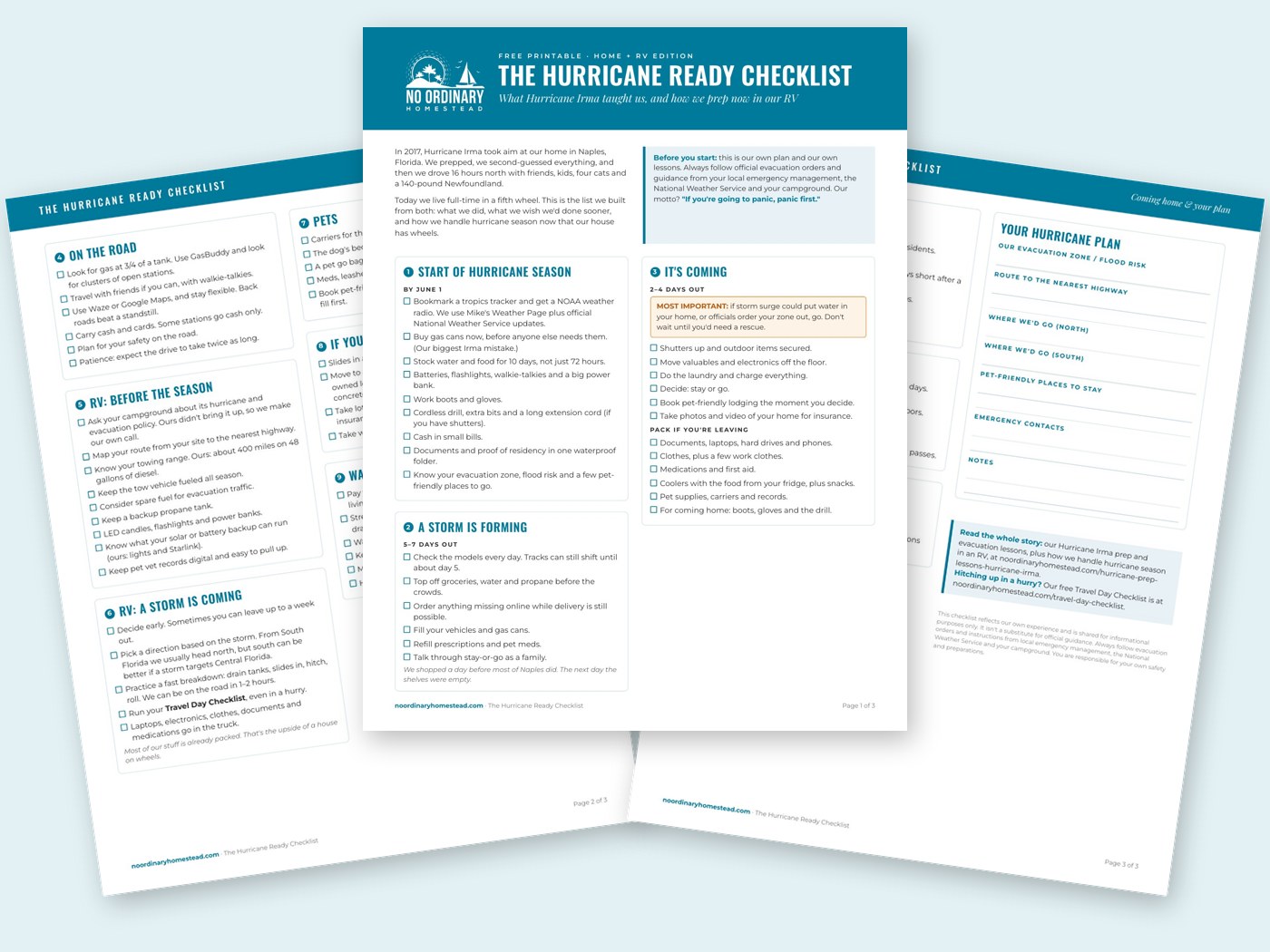
Get our free Hurricane Ready Checklist
Everything in this post, plus how we prep in our RV, on three printable pages with a fill-in plan page. Pop in your name and email and I’ll send it right over.
What We Do Now: Hurricane Season in an RV
These days, our home is a fifth wheel pulled by an F-350, with a Great Dane and two cats along for the ride. We pulled into our campground in Naples near the end of the 2026 hurricane season, and we stayed weather aware the whole time, fully expecting a storm or two we might have to leave for.
We watched one storm, Hurricane Isaias, very closely. It made landfall, but thankfully nowhere near us. It was a good reminder of just how important hurricane awareness is, even when you can take your house with you.
How We Track Storms
Stefan is still our resident weather junkie. Our go-to is Mike’s Weather Page, both his website and his Facebook page. He lives in Florida, has been tracking storms for years and is full of great information for anyone based here. We also follow the official National Weather Service hurricane updates.
When We’d Leave
We’ve always lived by the mantra “If you’re going to panic, panic first.” It has kept us ahead of the curve more than once. Being proactive, prepared and aware will get you far in an emergency.
If a storm looks like it’s headed our way, we’ll leave as early as we can. Sometimes that’s up to a week out, but not always, and a storm’s track can still change until about five days out. If it’s a huge storm and doom is barreling down at you, do the right thing and go.
Our campground didn’t mention a hurricane or evacuation policy when we checked in. We’d expect them to reach out only if an evacuation notice is issued, so we don’t count on it. We make our own call.
Where We’d Go
It depends on the storm’s size and direction. Storms often head up into the state, which makes fleeing them tricky with only two main highways out of Florida and millions of residents and visitors on the road. We’ve usually been in South Florida during storms, so we typically head north. But if a storm is aimed at Central Florida, you may have better luck heading south.
Why an RV Changes the Equation
When your house is on wheels, most of your stuff is already packed and ready to go. A condo can’t be moved, and you can’t avoid hurricane season if your home sits on the coast. Living with risk is part of life in an RV or a house when you get down to it. The difference is we can roll.
Realistically, in an emergency we could be on the road within an hour, definitely within two. It doesn’t take us long to drain the tanks, break down the rig and load everyone up.
- Keep the truck fueled. We try to keep the F-350 topped off so it’s ready to ride. Our 48-gallon diesel tank gets us around 400 miles, which is about as far as we’d want to drive in a day. In evacuation traffic, extra diesel would definitely be welcome. We don’t carry spare tanks right now.
- Keep backup power and light. We always have a backup propane tank, LED candles and flashlights, and power banks for our phones. Our rig’s solar backup can run the lights and the Starlink.
- Grab what’s hard to replace. Laptops, personal electronics, clothes, documents and medications. The things you’d need to start over.
- Have the pets ready. Our vet records are digital, the cats have their carrier, the dog’s bed is ready to travel when we are, and the pets have their own go bag with the basics and a week of food.
- If you have to leave the rig behind, bring the slides in and lock everything. If you can, move to a site with tie-downs. Some owners at our campground have big D-ring anchors set in their concrete pads. Then take lots of photos and video for insurance.
Our Advice for New Full-Time RVers in Florida
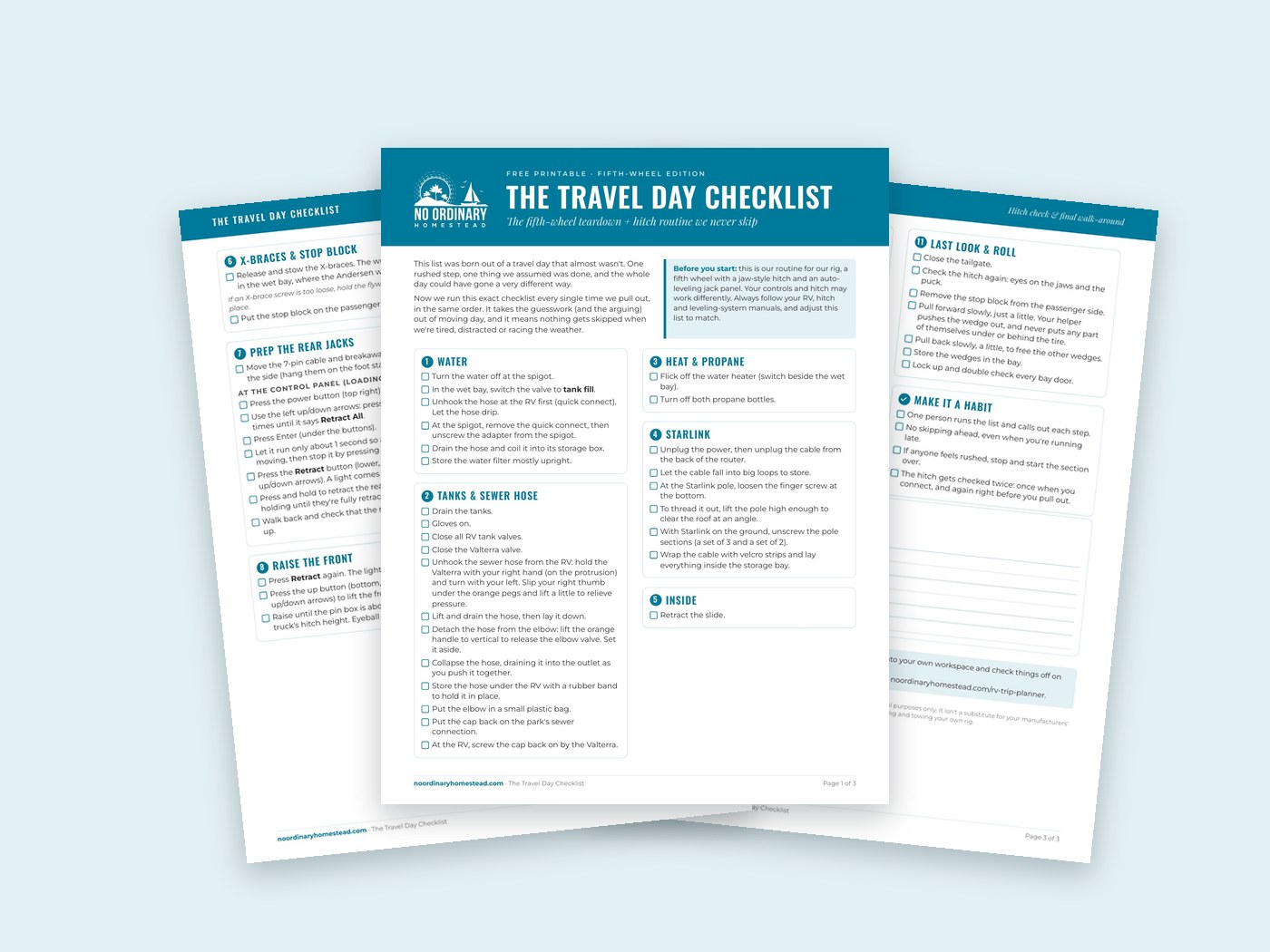
Make your own decisions and form your own plan. So many people don’t prepare until the last 24 hours, and by then your options are limited. Learn about hurricanes and the flood risk where you’re parked. Think about what your evacuation route looks like and how you’d reach the nearest highway from your site. And run through our Travel Day Checklist so hitching up in a hurry doesn’t mean forgetting a step.
Want to know what happened next? Read part two: Our Hurricane Irma Story: Riding Out the Storm and Coming Home.
Have you ever evacuated for a hurricane? What’s the one thing you’d never leave without? Tell us in the comments.