We visited St. Ignace, Michigan, in July 2026, during our Oshkosh or Bust RV road trip.
After the Fourth of July in Frankfort, we packed up and headed north to St. Ignace, the little town at the top of the Mackinac Bridge.
We drove on the Sunday right after the holiday, which turned out to be a smart move: we beat the rush. It was a quick one, too, about 164 miles and three hours.
St. Ignace at a Glance
- Where: the north end of the Mackinac Bridge, on Lake Huron, at the front door of Michigan’s Upper Peninsula
- Population: about 2,300
- Founded: 1671, making it one of the oldest European settlements in Michigan
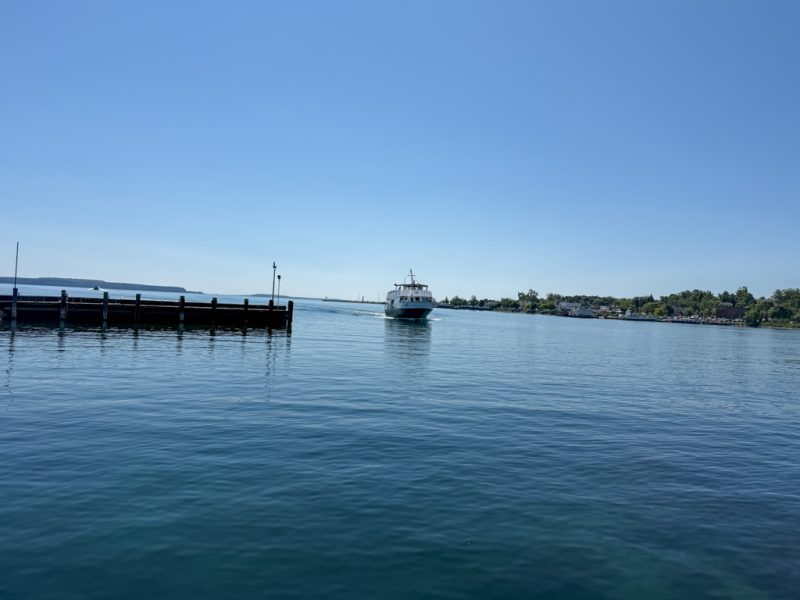
- Ferries: Arnold and Shepler’s both run to Mackinac Island from docks right on State Street downtown
- Known for: the bridge, fudge, pasties, smoked whitefish and, in winter, snowmobiles
- Best for: a base camp for Mackinac Island and the eastern U.P.
Crossing the Mighty Mac
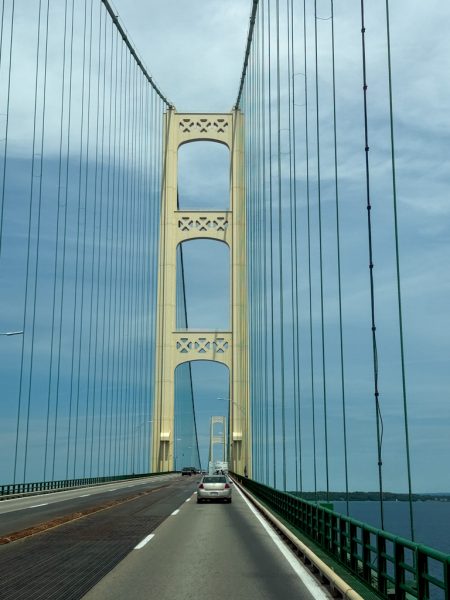
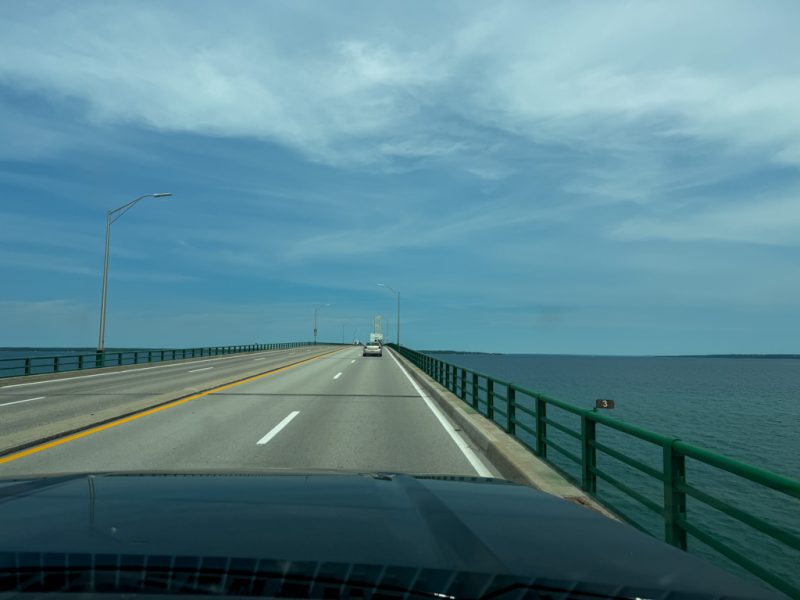
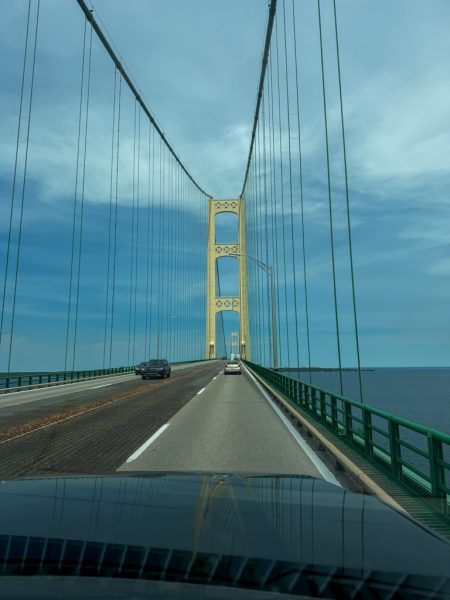
The highlight of the drive was the Mackinac Bridge. I was driving, paying attention to my lane, but I couldn’t help catching the occasional glimpse of the water below. It was amazing. Thankfully, there wasn’t much wind, and with a fifth wheel behind you, that matters. (Everything we learned about it is here: Crossing the Mackinac Bridge in an RV.) Over the week we saw the bridge again and again, from both sides of town and the water. It’s a massive structure, and it never stopped being fascinating.
First, How to Say It
Before we go any further: it’s MACK-in-aw. Mackinac Island, the Mackinac Bridge, the Straits of Mackinac: all spelled with a C at the end, all pronounced “aw.” Mackinaw City, right across the bridge, is spelled the way it sounds, which doesn’t help anyone. And St. Ignace? That’s IG-nus. We actually had to look that one up. We’d been saying “Saint ig-NAYS.”
A Little St. Ignace History
St. Ignace is one of the oldest European settlements in Michigan, second only to Sault Ste. Marie, which is just a few miles north. French Jesuit missionary Father Jacques Marquette founded the St. Ignace Mission here in 1671 and named it for St. Ignatius of Loyola. Two years later, he set out from St. Ignace with explorer Louis Jolliet on the expedition that took them down the Mississippi. Marquette died in 1675 on his way back north, and two years later a flotilla of canoes carried his remains back to St. Ignace for burial. The grave was lost for almost two centuries until it turned up on farmland in 1877. Today it sits in Father Marquette Mission Park, right downtown on the bay.
Next to the grave is the Museum of Ojibwa Culture, which tells the story of the Ojibwe, Huron and Odawa people who lived here when the French arrived in the 1670s. It even has a replica Huron longhouse, and admission is by donation.
Today it’s a small town of about 2,300 people and the front door to Michigan’s Upper Peninsula. It’s also one of the two ports for ferries to Mackinac Island, which made it a great base for us.
Where We Stayed
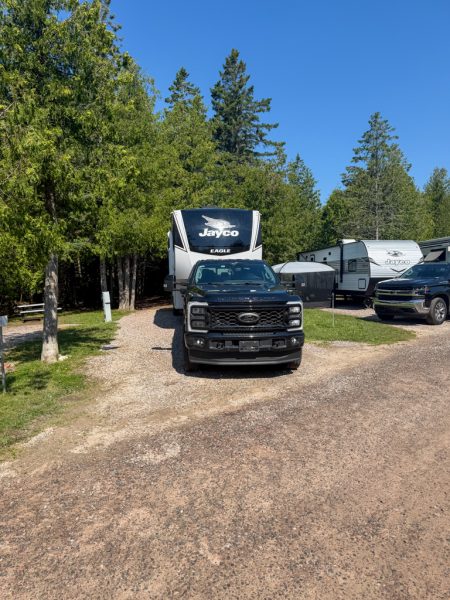
We stayed at the St. Ignace/Mackinac Island KOA Holiday. It was OK: a bit rustic, clean and nearly empty once the Fourth of July crowd went home. Backing into our site was a whole adventure. The full story is in our campground review: St. Ignace/Mackinac Island KOA Holiday.
A Low-Key Week (and That’s OK)
Our week was full in one way and empty in another. Stefan took Monday off so we could spend the day on Mackinac Island, and on Thursday the truck spent the day in the shop (more on that below). The rest of the week, all three of us worked from the RV.
Between the deer, the last-minute run to Chicago and a full workweek, we were pretty worn down by the time we got here. The weather was cool and gray most of the week, and we were glad this area didn’t come with a long list of must-sees. We worked, ran errands and recharged our batteries. We live and work full time in our fifth wheel, and some weeks are just more low-key. You can’t sightsee all the time.
Pasties, Fudge and Snowmobile Signs
St. Ignace looks the way you’d picture a tourist town on the lake. It’s the kind of summer place grandparents brought their kids to, and now those kids bring theirs. We enjoyed the old-school roadside attractions, like the Wood Lookout Tower (with its tourist-trap gift shop) and Castle Rock.
Castle Rock is a limestone sea stack that rises about 195 feet, with a long staircase to a lookout at the top (one source counts 171 steps). The Eby family opened it as a roadside stop around 1929, and it’s still family-run. It’s been billed as “Pontiac’s Lookout” for generations, a giant Paul Bunyan and Babe the Blue Ox stand out front, and the gift shop’s birch-bark walls and ceiling were handcrafted by local Native American artisans in the early 1950s. It’s exactly the kind of stop your grandparents would have made, and that’s the charm.
Pasty shops and fudge shops are everywhere. Up here they’re less a food and more a way of life. A pasty is a hand pie, traditionally beef, potato, onion and rutabaga folded into a sturdy crust. Cornish tin miners carried them underground, and when Cornish and Finnish immigrants came to work the U.P. mines in the 1800s, the pasty came with them. Once the Mackinac Bridge opened in 1957 and tourists started pouring north, the pasty stands followed. We weren’t brave enough to try them, but people say good things.
We also kept seeing snowmobile signs on the county roads, which is pretty wild when you think about it: in winter, snowmobiles are a common way to get around. And yes, the U.P. has a lot of trees. A lot.
About those snowmobile signs: St. Ignace is a serious snowmobile town. There are more than 100 miles of groomed trails in Mackinac County alone and roughly 3,000 across the U.P. When the Straits freeze solid, people cross to Mackinac Island on an “ice bridge,” and there’s even an annual crossing of the Mackinac Bridge just for vintage sleds. We’ll stick to summer, thanks.
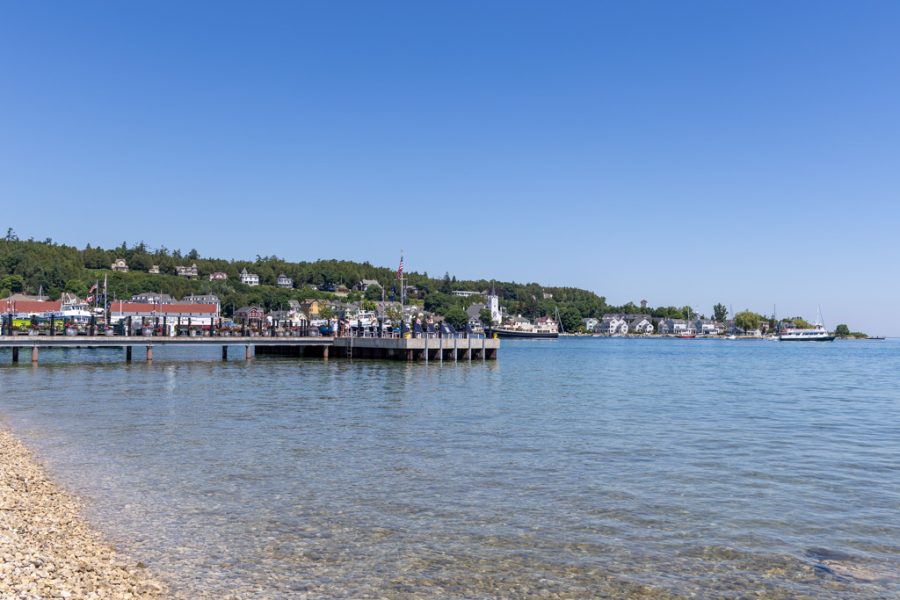
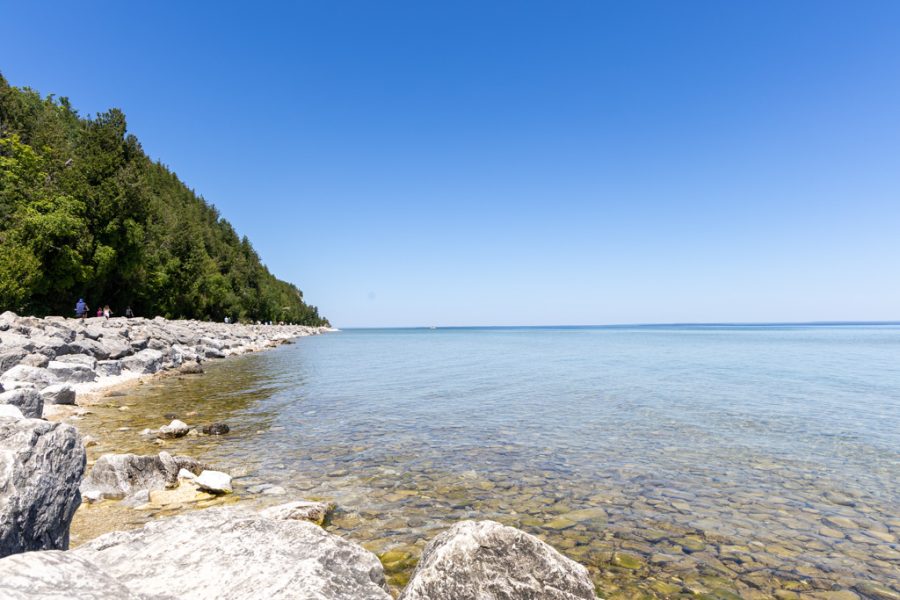
Feet in Lake Huron
We have a goal of dipping our toes in all five Great Lakes. Lake Michigan was already checked off, and on our day trip to Mackinac Island we added Lake Huron, wading in off the shore road below Arch Rock. We’d hoped to get to Lake Superior on this trip too, but wildfires kept us away. Three to go.
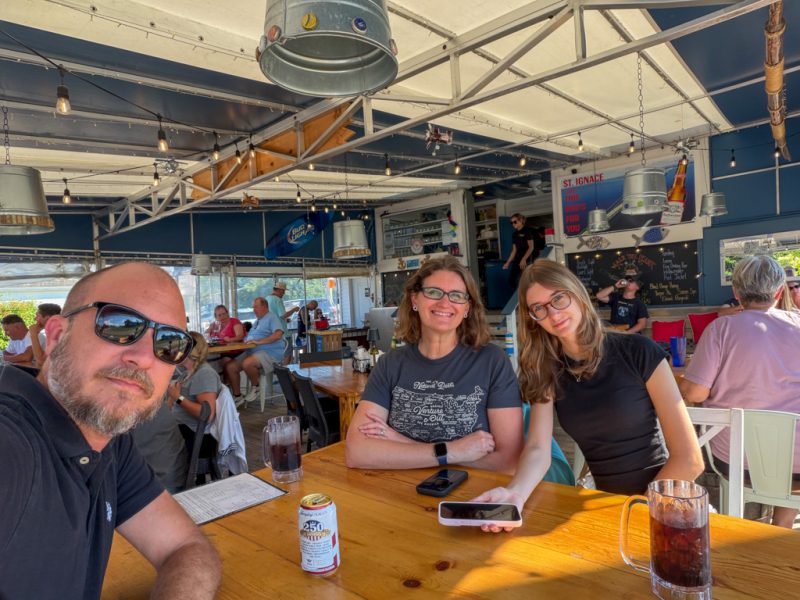
Dinner at the Gangplank
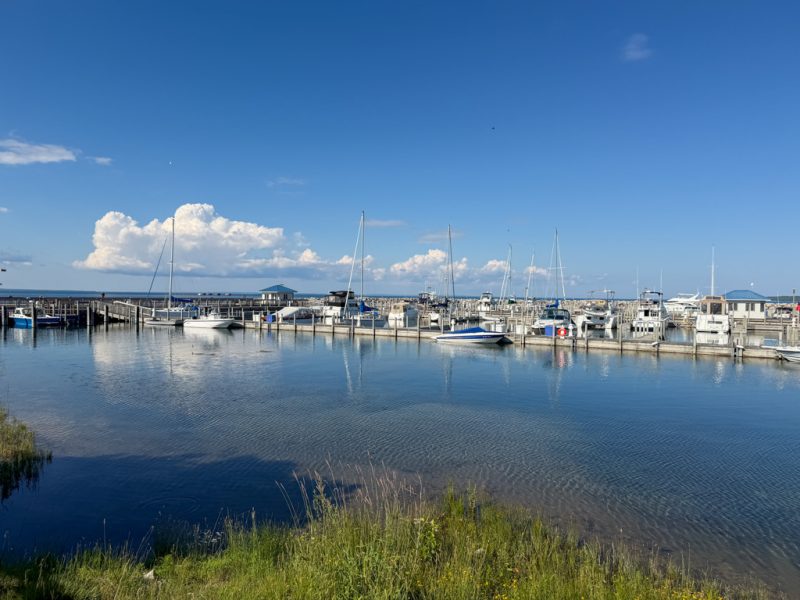
Other than the fudge, we mostly ate in the RV that week. The exception was The Gangplank Pub & Grub, a casual waterfront bar and grill overlooking the harbor. We went on a busy summer evening, and with only 11 tables we waited about 10 minutes. It was full of vacationers enjoying a beer and something to eat at the covered outdoor high tops. Whitefish is the thing to order up here.
The Ojibwe name for it translates roughly to “deer of the lakes,” and Father Marquette was already writing about the Straits fisheries in 1673. So I had the whitefish tacos and Stefan had the whitefish sandwich. We really enjoyed both, and the hand-cut fries were a nice touch. Mack’s pulled pork sandwich needed a bit more BBQ sauce. Service was friendly and quick. The kitchen was a little slow, but the food was worth the wait.
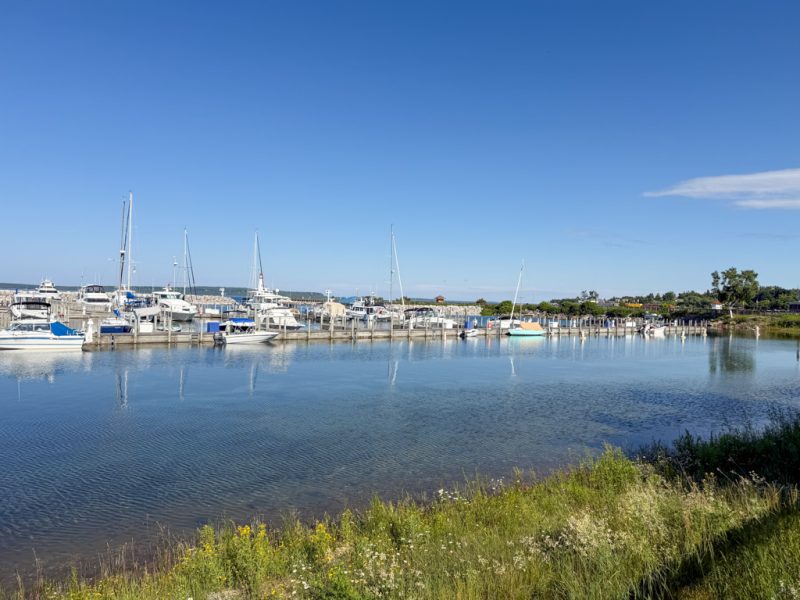
While waiting for our table we wandered over to the little market across the street by the marina, which was mostly local crafts and cute stuff. (We think it was the Bayside Farmers Market, which sets up beside the city marina on Thursday afternoons in summer.) We didn’t buy anything this time, but it was a nice stroll.
Since smoked whitefish is what this area is famous for, we also ducked into one of the smoked fish shops planning to buy some. The whole place smelled so good, all smoke. In the end, we didn’t buy any. We knew that in a fifth wheel, we’d be smelling it for days.
A Second Opinion for the Truck
After our run-in with a deer near Frankfort, a local body shop had told us the F-350 was safe to drive. But with about 1,500 miles and two months still to go before we got “home,” we wanted Ford’s own eyes on it. We’d tried to get an appointment in Traverse City before the holiday, but they were booked. Sarah Jones Ford in St. Ignace got us in.
We dropped the truck off in the morning, they gave us a ride back to the KOA, and when it was ready we just walked over (it’s only about half a mile). They’ve seen plenty of deer hits up here, and for a moment they thought we were there for body work instead of a checkup. The verdict after a thorough inspection: the truck was in great shape to drive. What a relief.
More to Do in St. Ignace
There’s more to St. Ignace than we had time for. If you have a few days:
- Bridge View Park. Free, and just west of the bridge toll plaza. There’s an observation building with bridge history displays and a telescope, plus covered picnic pavilions. Leashed dogs are welcome.
- Straits State Park. Observation platforms with bridge views and a stretch of Lake Huron shoreline. Its campground has waterfront sites with bridge views, if you’d rather stay in a state park (you’ll need a Michigan Recreation Passport).
- The Huron Boardwalk. About 6,000 feet along the downtown waterfront, with signs on the area’s shipping and fishing history and an original Mackinaw boat from around 1899.
- The Mystery Spot. A classic roadside stop where gravity seems “a little different,” plus ziplines, a maze and putt-putt.
- St. Ignace Deer Ranch. Whitetail deer, including white deer, that you can feed, plus a nature trail. After our run-in near Frankfort, we’d seen enough deer for one summer.
- A drive west on US-2. The highway runs along the Lake Michigan shoreline, with stops like the Cut River Bridge roadside park and Sand Dunes Beach.
When to Go
Summer is peak season, when the ferries run often and everything is open. A few things worth planning around:
The St. Ignace Car Show. Every June since 1976, hundreds of classic and custom cars roll into town for a weekend with a cruise night, a parade and fireworks over Moran Bay. Fun if you’re into cars, but expect the town to be busy.
Bronco the Mac. Every June since 2023, Ford Bronco owners (all generations welcome) roll into St. Ignace for a weekend that includes an escorted convoy across the Mackinac Bridge, guided trail rides with the Michigan Bronco Club, a meet-and-greet with food trucks and live music, and a lighted parade downtown. You have to register ahead of time; there’s no on-site registration. We didn’t have our Bronco with us on this trip, but it looked like a lot of fun, and it’s on our list to come back for one day.
The Labor Day Bridge Walk. Every Labor Day, walkers cross the Mackinac Bridge, and you can start from either St. Ignace or Mackinaw City. The bridge closes to vehicles for the morning, so if you’re towing, don’t plan to cross that morning.
Fall. The Richard Crane Memorial Truck Show comes to town in September, and there’s even an antique tractor crossing of the bridge.
Winter. This is snowmobile country. There’s an antique snowmobile crossing of the bridge in December and a pond hockey championship in February. We’ll leave that one to the locals.
On Our List for Next Time
We kept this week low-key, but we did a little reading after we left. Here’s what we’d add on a return trip:
- Smoked whitefish. This time we’ll eat it before we get back to the RV. Family smokehouses dot downtown St. Ignace and US-2 west of town.
- Father Marquette National Memorial. An interpretive trail in Straits State Park, near the foot of the bridge. It’s closed for an enhancement project and slated to reopen in spring 2027.
- The Museum of Ojibwa Culture, if we missed it this time.
- Lake Superior. Our feet are still waiting.
- Bronco the Mac, with the Bronco this time.
Is St. Ignace Worth It?
Yes. Everyone should visit at least once, even if it’s just to see Mackinac Island. We’d stay at the same KOA again, and next time we’d love more time (and better weather) to explore the U.P. beyond the trees.
Next up on Oshkosh or Bust: Garden, Michigan, and The Travel-Free Week That Wasn’t.
Have you been to St. Ignace or the U.P.? Tell us what we missed in the comments!

Free printable
The Simpler Way RV Trip Planner
The same pages we use to plan every route: stops, drive days, budgets and campground notes. Grab it free: